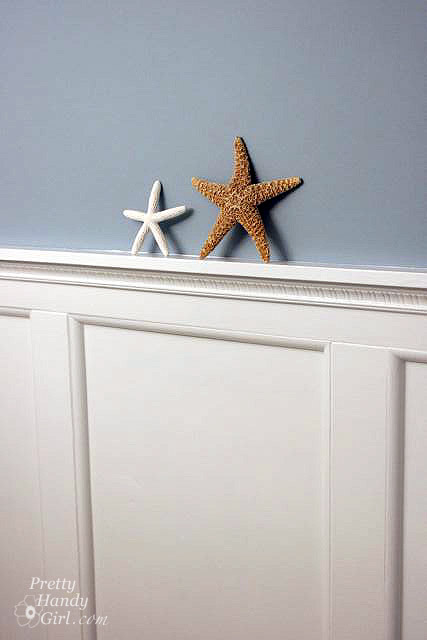
If you are just joining me and missed the tutorial for building board and batten moulding, you can view that tutorial HERE. Today I want to show you how to hide the holes, seams and how to paint the board and batten moulding. Plus, how I paint the wall so it looks more like wood and not like drywall.

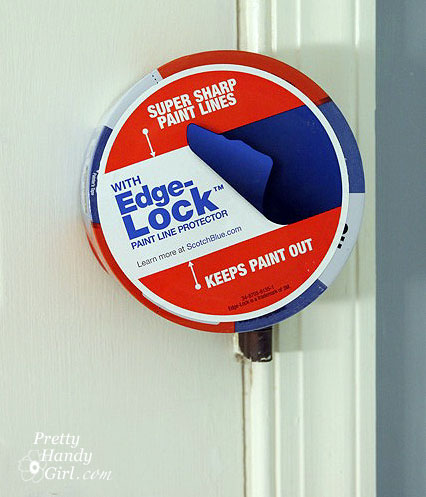
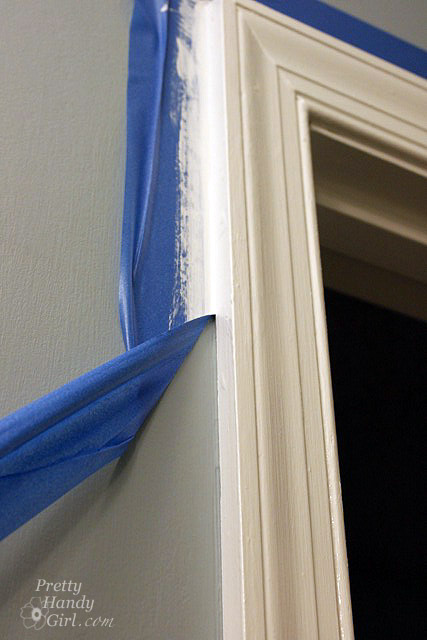
Start by taping off the moulding. I used ScotchBlue painter’s tape with edge lock technology because 3M just sent me these rolls to try out.

If you are re-painting the crown moulding and the door, tape them off as well.

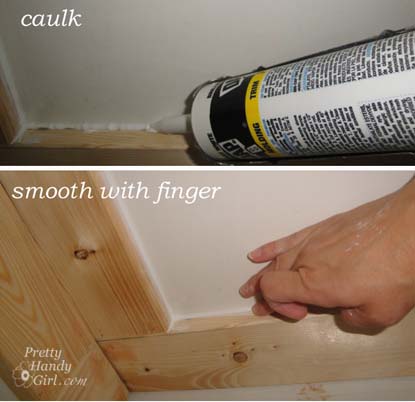
Usually I fill the nail holes with wood putty. Then I fill seams with caulk. To view a tutorial on filling holes with wood putty, click HERE.

I actually just read about a neat tip on Diane’s blog (who also just added board and batten moulding in her bathroom.)  She uses ice cubes and cold water for working with caulk. I’ve never tried this, but am happy to report that it really helps smooth the caulk and keeps it from sticking to your fingers.


Which caused me to amend the Pretty Handy Girl’s tried-and-true caulking method:

  1. Squeeze out your bead of caulk, using a caulk gun.
  2. Dip finger in the ice cold water.
  3. Run your finger along the bead to smooth it.

Seal every seam in your moulding and then let it dry.

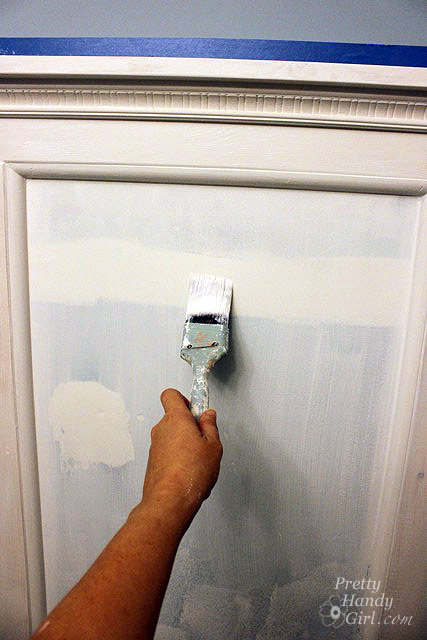
Once all the putty and caulk has dried, get the primer out. Paint primer on all the wood moulding using a paint brush. In the center (drywall areas), you can roll on the primer.

But, before the primer dries use the brush to spread it in long vertical strokes.

After the primer has dried, go ahead and add one coat of paint. Follow the same direction of strokes with the brush as you did when priming.

I made a video to show you the technique I used to give the wall a wood grain texture. Please forgive the painting clothes and unwashed hair! I haven’t hired a hair, makeup and costume stylist yet.

I have yet to be able to get away with only one coat of paint. If you look close you can still see some of the blue wall color showing through.

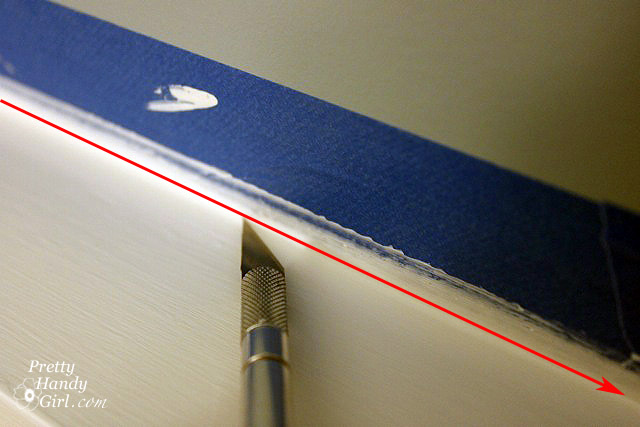
After the paint has dried, it is time to remove the tape. Anywhere that you caulked between the wood and the tape, you need to score the caulk to give it a clean edge when you remove the tape.

Remove the tape and looky at that clean edge! I’ve used ScotchBlue painter’s tape before, but I can honestly tell you that the new Edge lock technology is a big improvement. As long as you press the edges down firmly there is hardly any places where paint seeped underneath. The only places seepage occurred was where there was a dimple or imperfection in the wall.

One thing I didn’t caulk was the light switch plate which I had to cut to fit next to the batten. I will probably go back and add a little caulk between the switch plate and the moulding.


I hope you learned something today. Coming up next, the bathroom reveal!

Board & Batten moulding is very popular right now. And why not? It is easy to work with and looks great (after it is painted)! If you remember, I used board and batten in my  my son’s closet turned reading nook last year.

I decided to create a similar look in the boys’ bathroom. Only this time I wanted to round the edges of the battens for more visual interest. I’m warning you now, this tutorial is a bit photo intensive. But, how else would I give you a step-by-step tutorial?

I started by purchasing my lumber at Lowe’s. Did you know you can buy cheap furring strips for your battens? It will save you money. Especially if you don’t mind sifting through the stacks to find the straighter boards and sanding the face of your boards after cutting them. I bought 1x4x8 boards for the battens. And 1x3x8 boards for the upper ledge. I also purchased quarter round moulding and decorative moulding for underneath the upper ledge.

Removing Baseboard Tiles:

The bathroom had baseboard tiles that had to be removed. I grabbed a few tools and made quick work of removing them. The ear muffs and safety glasses were definitely a must!

Score the edges of the tile with a utility knife.

Hammer a flat pry bar behind the tiles.

Remove each tile one at a time.


Take some time to patch any holes that are in your wall. You can view a tutorial on patching drywall HERE. I needed my walls to be as smooth as possible since I wasn’t going to add board behind the battens.

Installing Board and Batten Moulding:

Mark the height where you want the top of your moulding to be. I used 5′ as the height, but then ended up lining up the bottom of my boards on the 5′ mark. So, for the 8′ ceiling room, the top of my moulding was at 65″. Use a level mark as a guide line across the width of your room.

Next measure the widths of the sections that your horizontal boards will be attached to.

Cut your boards to size.

Test fit your boards.

I cut the board that butted up to my mirror at a 30 degree bevel.

Once you have cut all the boards and they fit. Sand down the face and edges.

A nail gun and compressor are not a necessity, but they do make the job a lot easier! Otherwise, you will be doing a lot of hammering and nailing while holding boards in place.

I used the compressor at 110psi, which worked well for the 1″ pine boards. I used 2″ nails for the boards and battens and 1.5″ nails for the quarter round.

Be sure to wear your safety gear. The compressor is LOUD and no need to risk your eyesight. I know, you are jealous of how attractive I look in my safety gear (not!)

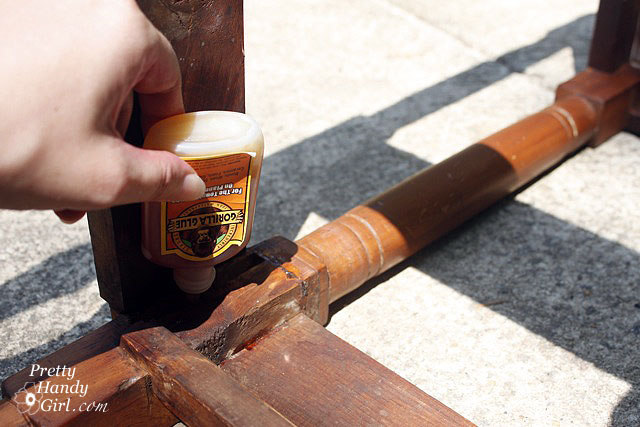
For the horizontal top boards, I added some construction adhesive. This is not 100% necessary unless you have monkeys for children. And I do, so the extra adhesive seemed like a good idea.

Press the board onto the wall.

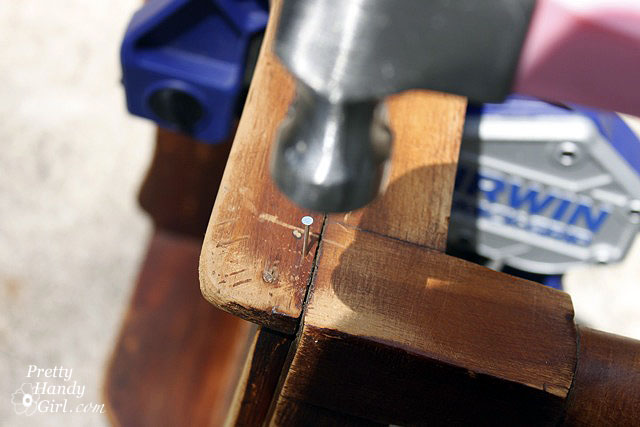
Shoot several 2″ nails into the moulding to hold it in place. Be sure to angle your nails to make it more secure.

That board shouldn’t go anywhere now!


Repeat the same steps for the baseboard boards (minus the construction adhesive.)

Next, measure the vertical distance between the top and baseboard battens. Be sure to measure at the exact location that a vertical batten will go. I’m sure your heights will vary.

Cut all your vertical boards and sand them down.

When you are figuring out the spacing, be sure to take into account if you will be adding a towel bar or other fixtures to the wall. My old towel bar was 24″ wide, so I made sure to space the battens to accommodate the towel bar.

While installing the battens you may run into a few inconveniences. Like, a toilet or something that can’t be moved. To deal with the toilet, I cut a piece of cardstock the same width as my batten. Then I slid it behind the toilet and scribed around the edge of the toilet.

Then I cut along my line and transferred the line to my batten.


Use a jigsaw to cut out the scribed profile (I tried to use my Dremel Trio to cut out the small section, but it failed miserably. I think the Trio is best used for thin stock like the back of a bookcase.)


Then you can install your batten around the “inconvenient” object.

By now your room should resemble something like this:

Installing Quarter Round Moulding:

Now comes the step that requires a little more precision. Cutting the quarter round moulding can be a little tricky, but don’t fear I know you can handle it. Remember the old carpenter’s adage, “Measure twice, cut once.”

Well, I admit it, I forgot! Ugh. Even I can make mistakes, so don’t be afraid to mess up once in a while. We all learn from our mistakes:

You will need to meaure the width and heights of the rectangle between your battens. Be precise for better accuracy and less caulk later!

Set your miter saw at a 45 degree angle.


This is what it should look like. The saw should be straight up and down at a 90 degree angle from the saw stand (in other words, no bevel cut).


Cut your quarter round so that the longest point on the moulding equals the measurement you took from the rectangle. You may have to face the “round” edge in towards the fence for some cuts. And it might take a few cuts to figure out the angles. But, I know you can do it. Once you have all your quarter round cut and dry fit, you can proceed with the install.

Remember those “inconvenient” objects. End your quarter round right before the toilet.

Add a 30 degree angle when butting up to objects like light switch covers and outlets.

Load the 1.5″ trim nails into your nail gun. Aim your nail gun into the quarter round at an angle so the nail ends up going through the quarter round and into the battens.


Hey, you are about 80% of the way done with installing the moulding!

Installing the top ledge and decorative trim moulding:

Cut the top ledges to size and sand them down. It is a good idea to round any exposed corners with the sander. This will undoubtedly prevent future dents to the head.

Lay the ledge boards on top of the upper battens. If your walls are uneven, your ledge will likely look like this.

No biggie. Grab your grade school compass. And set the two arms to the width of the widest gap. Then drag your compass along the ledge and the wall.

Get out your trusty jigsaw again and cut off that scribed line (have I told you how much I love my Porter Cable Jigsaw?! It pays to buy good quality power tools.)

Ahhh, much better. Any smaller gaps will be filled in with caulk later.

Nail the ledge into the batten below it. You can use construction glue for extra stability. (Yes, it is monkey protection for us.)

My favorite part of the moulding project is adding a little extra “bling”. I chose this decorative moulding to sit below the ledge and to give it extra support (again I have monkeys!)

Don’t forget to cut a 30 degree angle wherever you cut a batten at that angle.

Nail the decorative moulding onto the batten just below the ledge.

Now doesn’t that look beautiful?!

Fixing a few nail problems:

Remember how I said I make mistakes too? Well, here are two easy mistakes to fix when using a nail gun. When the nail doesn’t go all the way in (this usually happens if you don’t keep pressure on the gun when you squeeze the trigger), simply use a hammer and a nail set to hammer it into the wood.

Occasionally a nail may hit something when entering and end up popping out. Grab the end of the nail and pull it all the way through the wood. You may take some wood with it, but you can patch it with wood putty.


I’ll be back to show you how to caulk and paint this beautiful moulding! And then the final reveal of my Boys’ Fishy to Fabulous Bathroom! Finally, a bonus post on creating a branch towel bar.


Photobucket” border=”0″ alt=”Photobucket”>


Do you have an ugly builder’s mirror? I’m betting about 85% of you do. The other 10% were lucky to buy a home that has a beautifully framed mirror. And the remaining 5% either made or bought a new mirror with a frame! When I was first introduced to MirrorMate on Kate’s blog, I could barely contain my excitement. There was finally a fix for the ugly builder’s mirror in my kids’ bathroom {happy dancing}! I could finally say adieu to the stained, rusted and chipped behemoth in the bath and yet I wasn’t adding anything to the landfill in the process!

Bethany, who works for MirrorMate, helped me pick out the perfect frame for our bathroom. And shipped it as soon as the frame was available. Unfortunately, the frame arrived right before I left to surprise my sister in Ca. Then I came home and got deathly ill. So, the poor frame sat in our garage for a month. As soon as I started feeling better I jumped right into the bathroom makeover project. I have to tell you, the makeover was inspired by the beautiful MirrorMate frame. I just couldn’t put that beautiful frame into the fishy bathroom. It just would look like the grown up in a child’s playground.

Putting the frame together and framing the mirror was a piece of cake. Here is how we did it:

1. Unpack the MirrorMate and accompanying supplies.

2. Spread the frame and pieces out. Use wax paper (or old cereal bags) under the corners to protect your work surface from the glue.

3. Glue each corner.

4. Insert the small connector pegs into the slots at the corners. You might need a hammer to lightly tap them in.

5. Wipe off any excess glue with a damp rag (or baby wipe).

6. For added strength and to hold the frame while it dried, I chose to “clamp” my frame by typing rope around it. This was not a necessary step, but I think it helps insure a tight joint, so I did it.

Please tell me that I’m not the only one who started singing. “Spiderman, spiderman, does whatever a spider can, spins a web…”


While the frame is drying, assemble the cardboard guides for the MirrorMate installation.

Add the double stick tape to the back as shown in the directions:

After allowing the frame to dry for an hour, get your DIY partner to help you move the frame. You must be careful not to lift or carry the frame by the corners or it could come apart. I left the rope on it until we moved it into the bathroom (just to be safe.)

Clean your glass with rubbing alcohol (especially where the frame will adhere to the mirror.)

Put up with your handsome assistant insisting on reading the directions (even though you already did and are anxious to move along.)

Have your assistant hold up the frame and then have fun telling him to move it to the left. No, wait a little to the right. Well, maybe back to the left. {Hee, hee.}

Level the frame.

Insert the corner guides directly into the top two corners. Be sure the guide is touching the frame’s inner edges.

Remove the frame and then peel off the tape backing.

Then lift the frame back up with the help of your assistant. Align the frame onto the corner guides and press firmly onto the glass. You only have one shot at this, so go slow.
Remove the corner guides and the glue strips from the mirror.

Now stand back and admire your newly framed mirror! GORGEOUS, don’t you think? And the installation was a snap (or should I say a stick. LOL!)

No one will ever know that you are hiding a dirty stained, chipped and rusty secret underneath!


One final look at the finished product and a sneak peek at the finished bathroom. I’ll be sharing with you the board and batten tutorial soon.


One final note: I have to warn you, DO NOT put painters tape on your mirror or you will be crying the blues like I was.

I immediately contacted Bethany to see if she could send me some touch up paint. I can’t even tell you how helpful she was and when she reported that it was actually hot press leaf on the frame and not paint, I figured I’d be doing some creative treatment on the side. But, instead, she insisted on sending a new frame immediately (which arrived 2 days later!) MirrorMate has the best customer service and she told me “We want our customers to be happy with their purchase, even if that means sending a new frame.” Wow, now that is a company I want to do business with!


Disclaimer:

I was sent a complimentary MirrorMate frame for a product review. I can honestly say that this post reflects my opinions and I was not swayed to write a positive post. Nor was I paid to write this post. For more information you can read my disclosure statement.

I promised to show you how I lit my son’s bookcase. It really isn’t anything fancy.

But, a promise is a promise. Here is the view of the back of the bookcase:

I purchased the LED rope lights at Home Depot. They came with little snap in holders. You simply drive a screw into the mounting hole. Then snap the rope light into the holder.

On the top edge, I used a long channel strip (sold separately near the rope lights. It has a self adhesive backing. Then you firmly press the rope light into the channel. This took some serious strength, but I finally got the length of the rope light inside the channel.

Finally, I plugged the light into a timer.

The lights are set to come on at bedtime and turn off shortly before sunrise.

That’s it! And this is probably the shortest tutorial I ever wrote.

So, I’ll share a few pictures from my sister’s flower garden in California. Check out all the pollen on the back legs of this bee! They are the orange masses hanging from his legs.

The bees were loving the agapanthus as well.

The pink blossoms are from a lemon tree that grows in their back courtyard. Sadly none of them were ripe while I was there. I can only imagine how fresh and sweet lemonade from those fresh picked lemons would taste. Mmmmm!

Be back later this week with more DIY tutorials!

Artist Inspiration Board

Hey guys, today I’m dishing up a triple dose of posts for you. I’ve been busy, really busy, super busy! And you don’t know the half of it. As you are reading this, I’m on my way home from California. I flew out to surprise my little sister for her birthday. She and her husband are expecting their second child and I wanted to go all “Pretty Handy Girl” on their home ;-D.

First, you can read my tutorial for making this whimsical message center, from a curbside window, over at my friend Sandra’s blog,

Then you can come back here and read about this Artist’s Inspiration board also made from an old window.

Finally, if you like what you see you can head over to Parentables to see an entire post on curbside transformations! You won’t believe some of the before and afters!

Okay, ready? Well, let’s get this show on the road.

Materials:

  • Old divided light windows
  • Foam core
  • Tin snips
  • 3M duct tape
  • Scissors
  • Primer
  • Chalkboard paint
  • Irwin mat knife (or x-acto knife)
  • Clear Caulk (window and door sealant)
  • primer
  • fine grit sand paper
  • Two colors of paint (gold and medium gray)
  • Crackle medium
  • Polyurethane
  • Foam double stick tape
  • mirror
  • ruler
  • mirrored glass
  • tin pots, buckets or recycled cans
  • drop cloth bulletin boards from THIS post

Prepping your window:

You will need to clean, prime and paint your window before beginning this tutorial.

Here is what I did during the prep phase: Cleaned the windows (I used a bleach solution because there was mold and mildew present.) I repaired the glazing that was cracked and missing. I used paintable caulk. No need to buy glazing.

Prime the entire window, glass and all! Once the primer has dried, use the sandpaper to gently rough up the primer (especially on the glass. But, be careful not to scratch through to the glass.)

For the beautiful crackle finish on my window, I started by painting the window a metallic gold color.

When the gold had thoroughly dried, I coated the entire window with the crackle medium. Once that had dried, I painted a medium gray on top. That’s when the magic happens. The paint separates and reveals a hint of gold. It is important not to go back over the gray paint after you paint it on or you will get a gloopy mess!

I finished off the painting prep steps by applying two coats of water-based polyurethane.

Tutorial:

Measure all the individual window panes. Be sure to measure only the exposed glass.

Transfer your measurements to cut 2 squares of foam core. Make sure your blade is sharp! Dull blades will drag and tear the inner foam.

Next, transfer your measurements to cut two pieces of cork board. Cut the cork board with a ruler and mat knife.

Finally cut two pieces of mirrored glass to fit the remaining two panes (need help cutting glass? Have a professional do it, or watch Sandra’s tutorial HERE.)

You should now have 2 pieces of foam core, 2 pieces of cork board (wrapped in drop cloth as I showed you the other day), and two pieces of mirrored glass.

Dry fit all the cut squares to make sure they will fit in the window openings.

Take the foam core and tin pots outside. Spray them with primer.

When the primer has dried, spray the foam core and buckets with a few coats of chalkboard paint.

To view how to print onto painter’s drop cloth, refer to my tutorial here.

To attach the chalkboard foam core, mirrored glass, and drop cloth squares, you will need clear window and door caulk. Snip the top off at an angle. Insert a straightened coat hanger into the tip to puncture the inner lining of the caulk.

Put a fair amount of caulk onto each glass of the window. (Lazy supervisor in the background!)

Press the individual squares into it. Weight the drop cloth squares (with paint cans) while they dry.

To secure the chalkboard and mirror sections, run a bead of caulk along the edges of the boards.

Use a damp paper towel to smooth and clean up the caulk edging.

Once the caulk has dried, you can affix the tin buckets to the window. Drill holes through the bucket bracket or tin cans.

Attach a screw through the hole and screw it into the window pane.

To add a hanger to your memo center, flip the window over and measure down 3″ on both sides.

Use a drill to drive the screws into the D-ring style hangers.

I made this artist’s board to sell, but honestly I’m having a hard time parting with it. So, it may just find a home in my painting studio (aka Bonus Room). But, maybe you could convince me otherwise. How much would you pay for this one of a kind artist’s board? I keep thinking it is a real life version of Pinterest.

Don’t forget to view more of my curbside transformations.