I’m so excited to share this tutorial with you. I knew it could be done, but honestly I didn’t believe it until I tried it. When I saw THIS cute project over at Home Frosting, it got my creative wheels turning.

I asked Lesa for a few clarifications and she gave me the courage to try feeding drop cloth material through my printer. {gulp}

Printing on material is fairly easy to do if you have the right materials.

Materials:

  • Laser or ink jet printer (I only tried it on the laser printer, but it can be done on either.)
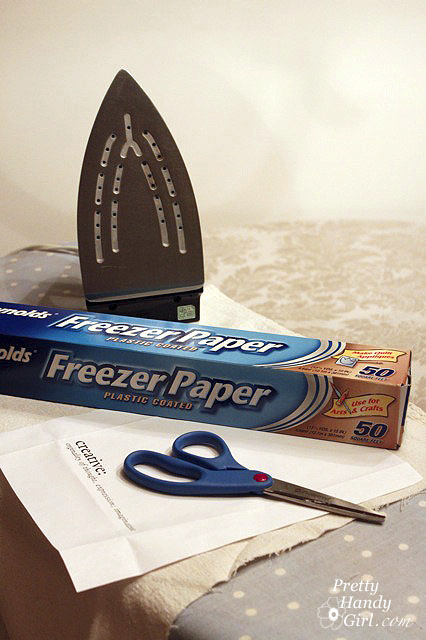
  • Reynolds Freezer Paper
  • Iron
  • Ironing board
  • Sheet of letter size paper
  • Scissors
  • 3M Duct Tape
  • Cork Board
  • Irwin mat knife
  • Painter’s drop cloth bleached and washed until soft

Start by creating your words that you want to print in Word or any other program.

Set your iron to preheat.

Tear off a sheet of Freezer paper slightly larger than letter-size paper. Cut the freezer paper down to 8.5″ x 11″.

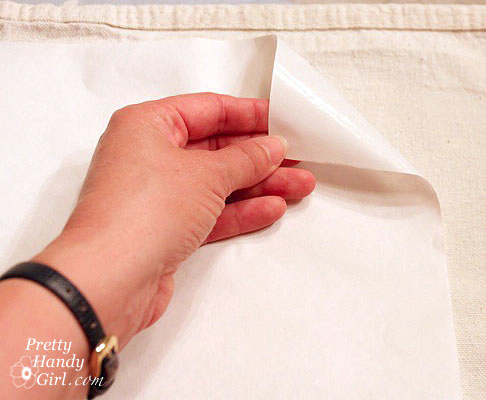
Lay the freezer paper shiny side down on the drop cloth.

Press firmly on the paper and move the iron around constantly for about 15 seconds. Let the freezer paper cool for a minute and test to make sure it is lightly adhered to the drop cloth. If not, iron a little longer.

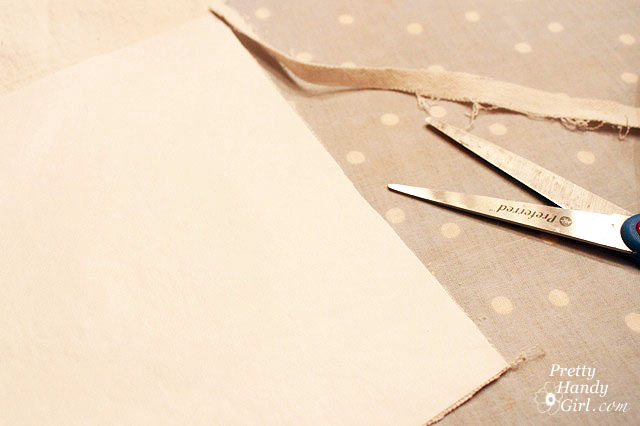
Now trim the edges of the drop cloth until it is the same size as the freezer paper.

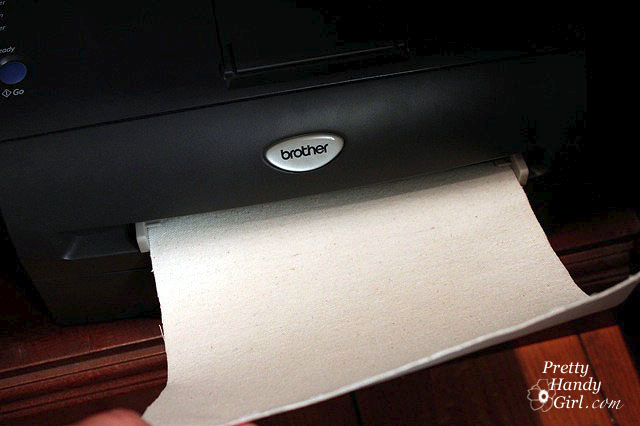
Take your freezer paper/drop cloth sandwich to the printer. If you have an individual sheet feed location on the printer, it would be best to use it. But, it can be done without. Print the document you created earlier.

Oooo, sooo pretty!!! I actually ran my “sandwich” through twice to get it darker, but it was still too faint for my liking.

If you have the same issue, you can go over the letters with a ball point pen.

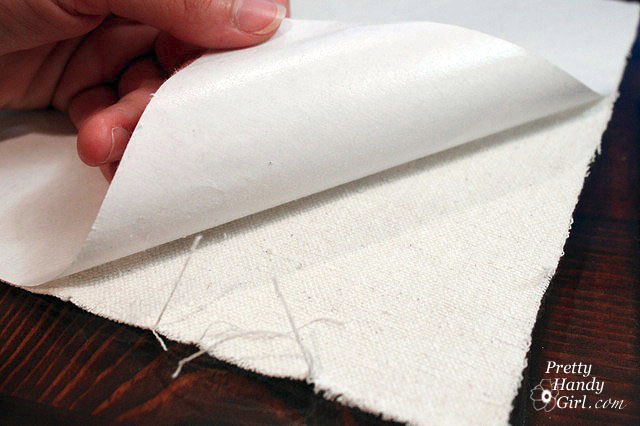
Peel off the freezer paper.

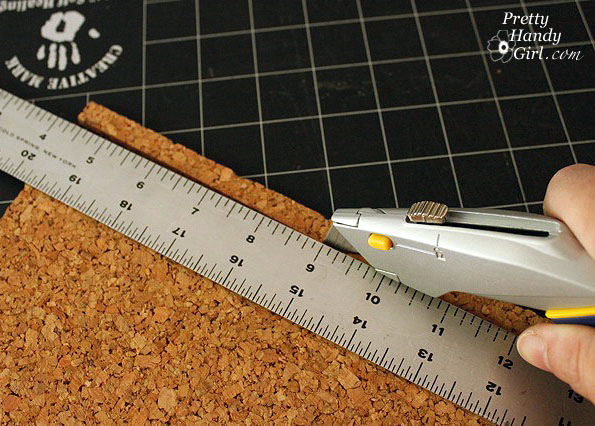
Now, cut your cork board. (If you are using the these cork boards in a window, be sure to pre-measure the individual window panes first.)

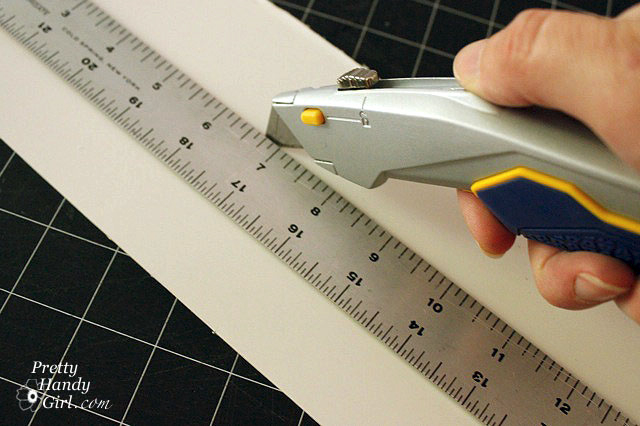
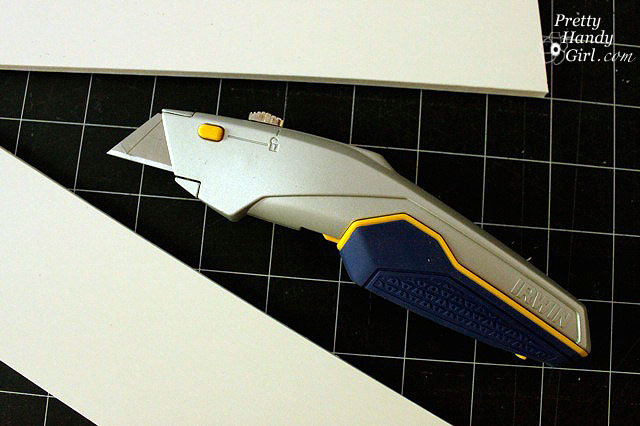
I have to tell you that Irwin sent me another tool to try. The mat knife. Their claims sounded outrageous, claiming it can cut better than other mat knives. “Whatever” is what I thought. But, as usual, they proved me wrong. I used the Irwin knife to cut BOTH cork board and foam core!

Have you ever cut foam core with a mat knife cleanly? Not me, until now.

I swear to you that Irwin has not paid me to say any of this. I just like their tools. I am waiting for an Irwin tool that I don’t like and then I’ll let you know what it is. But, I wouldn’t hold your breath.

Line up the drop cloth where you want it with the cork board underneath. Fold one edge of the fabric over onto the back.

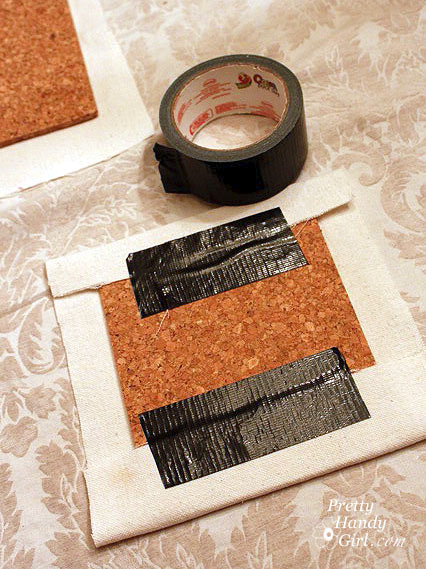
Secure it with the duct tape.

Pull the opposite side of the fabric and wrap it around the back. Continue until all the sides are taped to the back of the cork board.

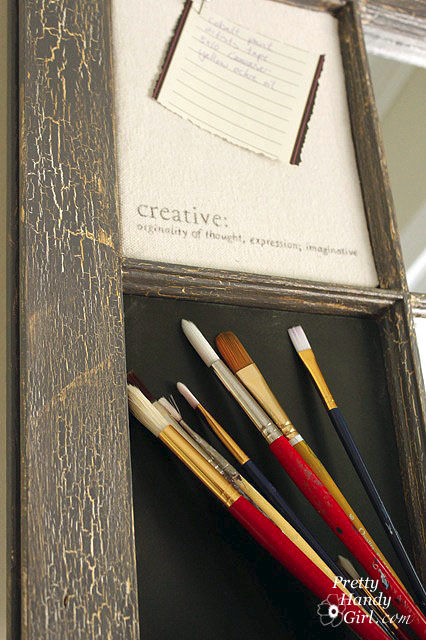
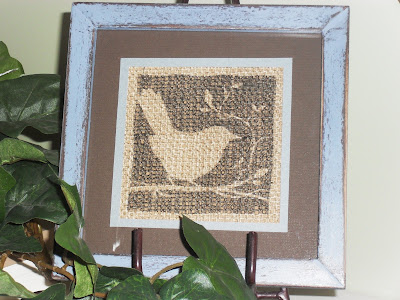
And there you have it! A unique personalized cork board.

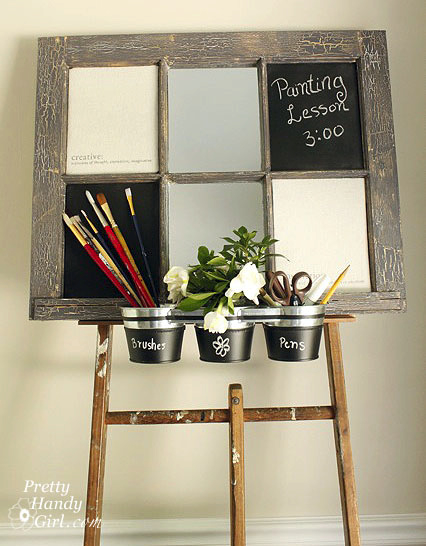
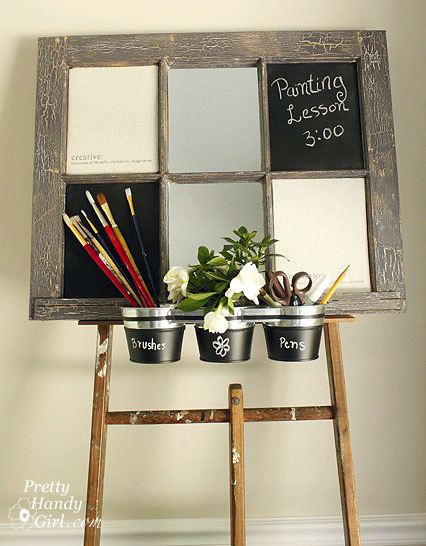
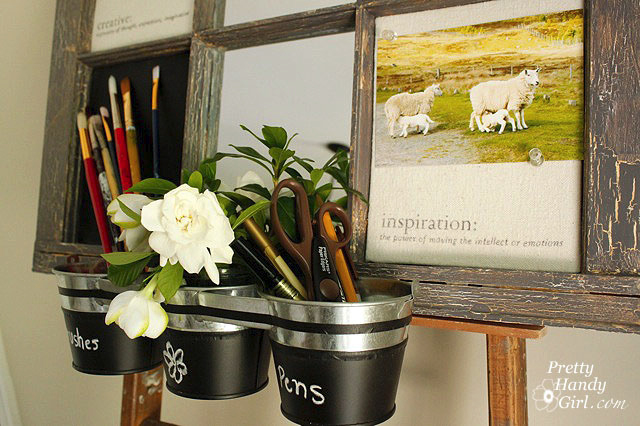
Want to see how to use the drop cloth bulletin boards in this Artist’s Inspiration Board?

Another project I completed before the birthday party was a quick makeover for a pair of ho-hum dollar store flower pots. My friend Heather helped me add some jute rope and fake flowers then set them out with utensils in them. Perfect for a summertime birthday party!

Materials:

  • Hot Glue Gun w/ glue sticks
  • Jute Rope
  • Flower Pot
  • Fabric Flowers
  • Scissors
  • Foil or wax paper (to protect work surface)

Instructions:

1. Plug in your hot glue gun to warm up. Cut the stems of your flowers about 2″ from the flower.

2. Turn the flower pot upside down. Put a dollop of glue against the rim of your pot and secure the end of your rope on it. Squeeze a line of glue around the pot rim and press the rope into the warm glue.

3. After one row is complete, add the flowers by bending the stems until they lay flat against the pot. Secure with a lot of glue. Then wrap the subsequent rows over the stems.

4. Continue gluing the rope onto the pot. Make sure to press each row of rope tightly against the row before it.

5. When you reach the bottom of the pot, secure the end of the rope with another dollop of glue. Be sure your rope doesn’t extend past the bottom of the pot or it could make the base wobbly.


Now set them on your table and fill with utensils. Later you can put a plant, flower or pens inside.

Are you ready for Independence Day? Would you like a quick and easy sewing project to add some patriotic flair to your home? Hop on over to Parentables to read my tutorial for making adorable star pillows.


And don’t forget, today (June 30th) is the last chance to enter the giveaways! I will be picking the winners after midnight tonight.

I hope you will take a moment to view how I test drove my Dremel Trio. This is seriously a really fun power tool! Just be sure you are safe so as not to ruin the fun. Eye protection, face mask, and ear plugs. Check.

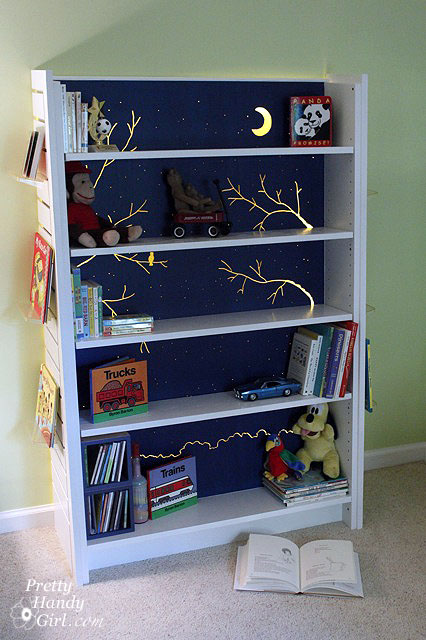
For those of you who like to skip to the end of the book and see the ending, here you go:


For the rest of you, here is how I created this cut out/back lit bookshelf that started life as a bookshelf from a closing Borders bookstore.


Tutorial for creating a cut out bookcase:
Almost any bookcase will work for this project, but the ones that have a thin wood (can be masonite) backing will work best. Set up a work area that you don’t mind getting dusty and dirty. Remove the shelves from your bookcase.

Cutting the endcap:

Materials:

  • circular saw
  • level
  • clamp
  • scrap wood
  • screws
  • drill

I cut the endcap in half lengthwise so I could use half for each end of my bookshelf, and to position it flush against the wall. To cut a straight line using a circular saw, I clamped one end of a level to the endcap. My level wasn’t long enough, so I drilled a scrap piece of wood on top of the level and into the end cap to support the other end.


I set the circular saw blade just below the depth of the endcap. By resting the endcap on two 2×4″ boards, I was able to creative a gap below the endcap for the sawblade to pass through.Then I ran the circular saw along the level for a straight cut. Straight as an arrow, and it met Pretty Handy Dog’s approval.

Cutting out the backing design and painting:

Materials:

  • Dremel Trio
  • Palm sander
  • Sandpaper (100 grit & 220 grit)
  • Scrap 2×4 lumber
  • Chalk or pencil
  • Wood putty
  • Putty knife
  • Primer
  • Paint (white and navy blue)
  • 3M Clean Edge technology painter’s tape
  • Newspapers
  • 2″ paint brush
  • Small paint roller and tray

Sketch out the design on your bookshelf (using chalk or pencil) before beginning.

Before using any new power tool, take some time to read through the manual.

To insert a bit into the Dremel Trio, you push in the blue (shaft lock) button on the front and use the enclosed wrench to loosen the collet nut on the tool.

Insert the cutting bit into the Trio. (The trio also comes with a sanding drum bit and a routing bit!)

Tighten the collet nut with the wrench.

Turn the blue handle on the side of the TRIO to raise or lower the base plate.

Adjust the base plate until the cutting bit extends slightly below the wood backing of your bookcase.

Lay the bookcase down on its back. Position 2×4 boards under the edges of the bookcase (or you will be cutting into concrete. I’m pretty sure the TRIO is not capable of that, but I could be wrong.)

Plug in your Trio and get ready to have some FUN! You may want to practice on a scrap piece of wood before working on your bookcase. The TRIO allows you to change directions quickly and easily. Creating fanciful cuts is a breeze!

Squeeze the trigger and when the bit reaches full speed you can plunge it into the workpiece. For the pin holes hold the Trio steady, insert the bit and then lift it back out of the same hole.

To cut trees and other designs, plunge the TRIO into the wood and then slowly move the tool through the wood to carve your design. Be wary of long “V” shape cuts as they will make the backing weaker.

When your design has been completed, use the power sander to sand the back of the bookcase (where the majority of the splintering will have occurred.)

Insert the sanding drum bit into the TRIO and sand any large cut out areas.

Fold a piece of sandpaper in half and feed it through the thin lines of the branches to sand any rough edges that can’t be reached with the sanding bit.

Set the bookcase upright and inspect the cuts for more splinters. You can preview what your design will look like when lit up. Lookin’ good, huh?!

Before sanding the rest of the bookshelf, repair any dents or holes with wood putty. (This is a post I wrote about repairing all types of holes if you need help.)

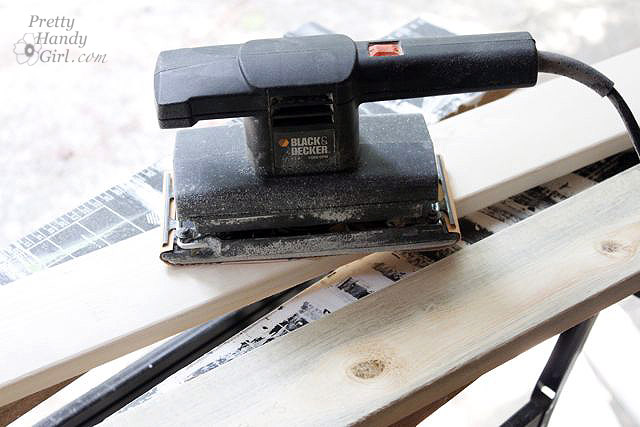
Use the palm sander and a fine grit (220 grit) sandpaper to rough up the rest of the bookshelf.

Apply a coat of primer to the bookcase, shelves and sides. (Still working on emptying that can of KILZ Clean Start primer! Love that stuff.

When the primer has dried, mask off the sides of the bookcase where they meet the back.

3M sent me this Scotch Blue Painter’s tape with Edge-Lock protector to try. I was skeptical, but when I pulled the tape off it did give me a clean edge. The only place I had a little bit of seepage was in the corners where I didn’t press the tape tightly into the corner. The key to using this tape is to firmly press the edges with your finger to engage the “Edge-Lock” seal. I haven’t tried it for painting walls, but you better believe I have a wall project coming up that I can try it on.

Paint the back of your bookcase. I chose a very dark navy blue. To save paint, I used a medium blue paint for my first coat to darken the back and hopefully save paint.

Then paint one coat of the navy blue.

Follow up with a second coat to eliminate any streaking.

When the navy paint has dried, tape along the edges of the navy blue backing, where it meets the sides. Slip pieces of newspaper underneath to catch any paint splashes. (Will you get a load of my lazy supervisor! You think he’s been working hard in the heat? Uh no, that would be me doing all the work and him snoozing away the day.)

Paint the rest of the bookcase, the sides and the shelves white. I used two coats of Benjamin Moore Impervo Semi-gloss white.


Once the paint has dried completely, re-assemble the bookcase. And screw the end cap halves onto either side of the bookcase.

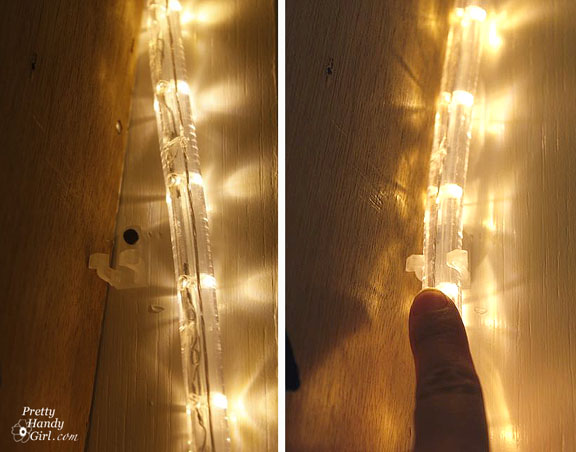
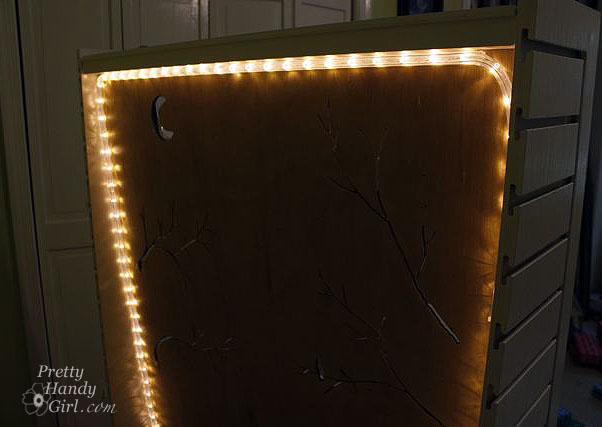
I installed a light rope behind the bookcase (tutorial to come at a later date) and set the lights on a timer. The rope light comes on at dusk and illuminates all the cut outs.

There is a very soft glow emitted from the back of the bookcase.

It provides the perfect amount of light for my son who HAS to have a light on at night.

My only complaint about the rope lights is that they give off a strong plastic odor. But, after a week the smell has dissipated.

I had the foresight to purchase a few of the clear display stands that slide into the end caps of the bookcase. It makes it easy to display books to pique my son’s reading interests.

Oh look! There he is now! Mission accomplished, reading interest piqued. Yes, I think he is double-jointed and a teacher pointed out that both my son’s sit like that. Must be in the genes.

A few more detailed pictures of the bookshelf. This has to be one of my favorite projects I’ve created recently. And it wasn’t very difficult to complete.


Recently I decided my garden bench that used to be a Craig’s List bed frame, needed to be refinished. I repaired, sanded and repainted the bench before setting it onto our porch where it would get less exposure to the rain.

Well, it wasn’t weathering the elements too nicely. Or maybe I should say it was weathering them poorly. Regardless, I really liked the bench and decided to strip it and start over again. I believe the main problem was that the bed frame was not solid wood, it was glued pieces. Then, if you factor in that I used spray primer and spray paint, the rain and moisture got in easily and caused the wood to swell and some of the glued joints to come undone.

But, the bench was still structurally sound, so we moved it onto the screen porch and I got ready to refinish it.

Refinishing a Weathered Garden Bench

Safey First, (as Meri-K will tell you.) Because I was sanding and scraping the old paint I had to wear eye protection and a dust mask. I also wore ear plugs while sanding and gloves to keep my hands from getting rough.

Materials:

(I’ve included affiliate links for your convenience. I earn a small percentage from a purchase using these links. There is no additional cost to you. You can read more about affiliate links here.)

Instructions:

Begin by using the wire brush to remove any flaking paint and to get into the grooves of the spindles (and other hard to reach places.)

Tip from a Handy Girl: I am about to share with you a helpful time saving trick, so pay attention. If you have a power sander that holds the sandpaper with a clip. You can stack your sandpaper. I put the 220 grit on the bottom, then put the 1oo grit on top of that. After sanding my bench with the 100 grit, I simply tear off the top sheet and expose the finer 220 grit.

Sand down the bench with a rough 100 grit paper first, then follow up with a finer 220 grit sand paper.

Secure any loose pieces of the bench. To use Gorilla Glue, you need to moisten the two pieces that you will secure.

Then put a small amount of Gorilla glue onto one of the pieces.

Clamp the joined pieces and allow to dry overnight. (By the way, don’t waist your money on cheap clamps. That little black & orange number below just bit the dust last weekend. My Irwin clamp is a CHAMP!) Check back after 30 minutes to wipe off any Gorilla glue that has spread out of the seam.

Because the posts on my bench were really falling apart, I decided to remove the ball finials.

Use a saw to cut both finials off.

Patch the hole using toothpicks and wood glue.

After the glue has completely dried, saw off the toothpicks.

Add a curtain rod finial on top of the sawed off posts.

It looks like those finials were there all along!

Clean your bench off with a damp rag to remove any sawdust.

Cover the entire bench with one coat of KILZ Clean Start Primer. Want to know why I use KILZ Clean Start primer for all my projects now? Read how much I love it in this post where I used the same primer for painting a bamboo rug. I’m never buying any other primers (unless I’m priming a tricky surface, then I’ll use BIN 1-2-3 oil based primer. But, I won’t be happy about using that stinky stuff.)

After the primer has dried, use a piece of fine grit sand paper to gently remove any burrs or imperfections.

Then wipe off the bench with another damp wipe. I used Benjamin Moore Impervo Semi Gloss paint for the top coat on my bench. It leaves a really tough coating and will hold up to wear and tear.

Roll on the paint in one area. Then follow up with a brush to even out the paint. Remember to run your brush in the same direction as the grain of the wood.

Lightly sand after the first coat has dried and finish up with a second coat of Benjamin Moore Impervo paint. I didn’t add polyurethane, but if you are really concerned about a piece of furniture that will be exposed to the elements, go ahead and add two or more coats of polyurethane.

My bench should successfully last outside now for three reasons:

  1. I moved it inside the porch and out of the direct sun and rain.
  2. I primed the bench with a good quality brush-on primer (instead of a spray paint type.)
  3. I brushed on two coats of paint making sure I got into all the cracks and crevices of the bench.

Here she is in her newfound home, our screen porch:


With zero VOCs and the quality that is standard in all the KILZ products, this primer is a must have for the DIY painter!


Disclaimer: The products mentioned in this post are products that I use and stand behind. The opinions expressed in this post are authentically mine. I was sent a gallon of KILZ Clean Start Primer and the Irwin Quick Grip clamp to try out, but I was not paid or swayed to write favorable things about the products. If I don’t like a product, I won’t write about it. And I certainly won’t pass it off on my valued readers.


I had the pleasure of talking to Meri-K Appy the other day. She is the president of the Home Safety Council and has over 30 years experience talking about home safety. Meri-K has a wealth of knowledge about preventing injuries while working on and around your home.

I recorded my talk with her and hope you will take some time to listen. It is very valuable information! Feel free to put the audio on and then do something else while you listen.

You may also want to take some time to browse the Home Safety Council website. The site is filled with loads of information about how to keep you and your family safety (not just during DIY projects.)

SafetyTalk.mp3


Cliff Notes:

I took some notes during the talk. These sum up some of the important information:


There are 3 Parts of the Body that are Most Important to Protect:

1. Eyes (Vision) – Wear safety goggles when doing any type of DIY project

No need to look like Professor Scientist! You can wear eye protection that is fashionable and comfortable!

3M Tekk Tortoise Shell Safety Glasses

3M Tekk Fuel Light Safety Eyewear

When should you wear eye protection?

a. Using Power Tools

b. Mowing the Lawn

c. Sanding, cutting glass

d. Any activity where objects can become airborne

2. Ears (Hearing) – About 30 million people are exposed to dangerously high levels of noise. Anything over 85 decibels can damage your hearing.

Some examples of common decibel levels:

    • City Traffic Noise (inside a car) – 85db
    • Lawn Mower – 107db
    • Power Saw – 110db
    • Rock Concert – 115 db

When should you wear ear protections?

Ear protection should be worn anytime you are participating in an activity that has loud noise. Even noises that don’t seem excessively loud can cause hearing loss when sustained exposure occurs.

Ear protection is cheap! Foam inserts cost only a few bucks and will protect your hearing.

Inexpensive Ear Protection – Foam Ear Plugs

For better protection and comfort, use ear muff style ear protectors. Check out these! They have a am/fm radio built into them. So you can rock out (at a safe decibel level) while working on your projects.

3M Digital Work tunes ear muffs

Be aware, that one danger while wearing hearing protection is not being able to hear a child come up to you. So make sure your children are being attended to when you need to use power tools and hearing protection.

3. Lungs (Breathing) – Great care should be taken when working with anything that has dust or chemical particulates.

    • Some examples of when you should wear a mask or respirator:
    • Sanding
    • Scraping
    • Spray Painting
    • Using Chemicals
    • Disturbing anything that contains lead, asbestos or other potentially dangerous particles

You’ve seen the scary chemical warfare respirators:

You don’t have to wear that fashion for home repairs (unless you are working around lead or asbestos.)

Protection can be as simple as this dust mask:

8661Pc1-A/8661 - Dust Mask 5Pk

Better yet, 3M has a cool flow valve dust mask for a few dollars more that is more comfortable and less hot:

3M 8511 N95 Particulate Respirator Mask (10 pack)

Test lead paint in your home with these easy to use Lead Check testers:

3M Lead Test Kit – 2 pk – $12.45

Top Causes of Home Improvement Injuries:

  1. Falling from a height (beyond broken bones you could receive head trauma)
  2. Harsh chemicals and poisons (Using and not following the warning labels)
  3. Electricity (electrocution and/or fire if wiring is done improperly)
  4. Power tool injuries (cuts, burns, lacerations, etc.)
  5. Fatigue (tired, using medications, or controlled substances)
  6. Poor Lighting (Unable to see what you are working on.)

Home improvement Injuries are Completely Preventable:

  1. Be sure to 3 points of contact on ladders ( i.e. one hand and two feet on a ladder at all times.)
  2. Always read labels and follow directions (ventilation, safety gear, disposal, etc.)
  3. Electricity (hire a licensed professional if you are unfamiliar with building codes and wiring safety.)
  4. Get trained on how to use power tools (don’t trust an instructor that isn’t wearing proper safety gear.)
  5. Be alert, awake, healthy, and not taking any substances that can impair you when DIYing.
  6. Work in a well lit area.
  7. Consider hiring a professional for lead paint remediation, plumbing, electrical or any profession that requires a license.


Important Websites and Phone Number:

If you ever have any questions about lead in your home and how to deal with it:

3MLeadCheck.com

National Lead Information Center: 1-800-424-LEAD(5323)

If you have any questions about the presence of lead, asbestos or radon in you home, contact the EPA or go to their website for more information. These organizations have been set up to protect your health. Not to make your life more difficult!

EPA.gov

National Center for Healthy Housing

More information about 3M safety gear and where you can get your own:

3MTekk.com


Disclosure: Meri-K Appy and Pretty Handy Girl are not paid sponsors of 3M. However, 3M made a donation to the Home Safety Council to fund more research and development preventing injuries.

Some of the images above are linked to affiliate links which pay a very small percentage to Pretty Handy Girl. Other images simply link to online stores where you can purchase the product for your convenience.