It’s a jolly good day, wouldn’t you say?! Did you watch the Royal Wedding this morning? Or did you DVR it to watch later  (like I did.) I hope you enjoyed my photos from London and didn’t mind the diversion.

Now I’m back into DIY tutorial mode for the time being. Today you can get a double dose of Pretty Handy Girl! Can I get a “WOOT!”

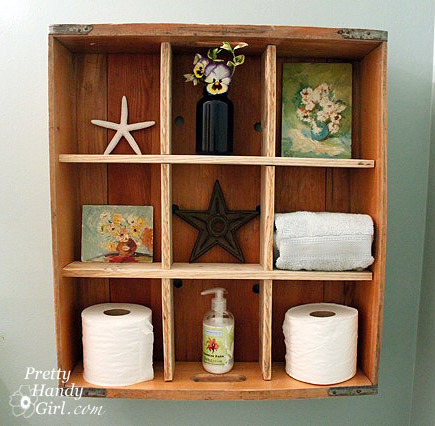
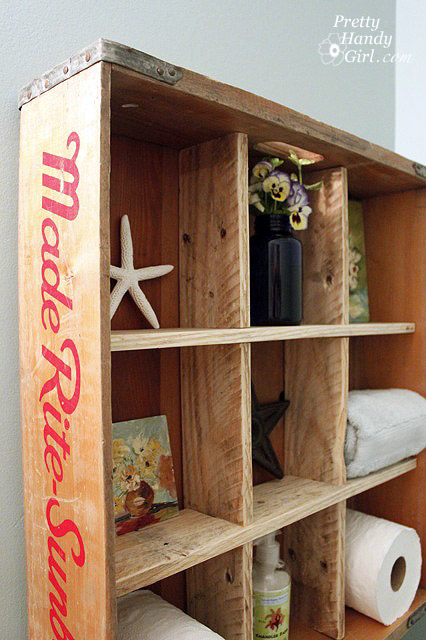
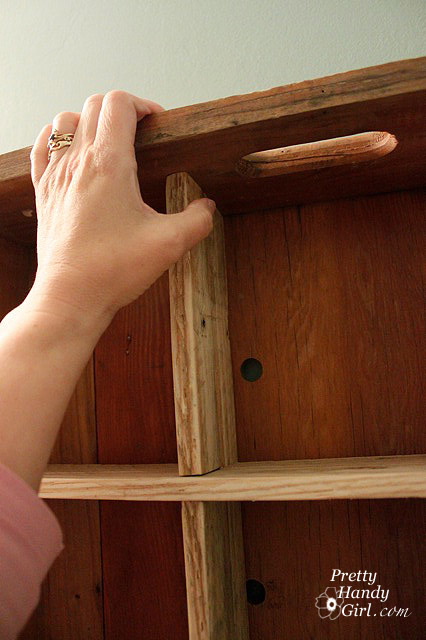
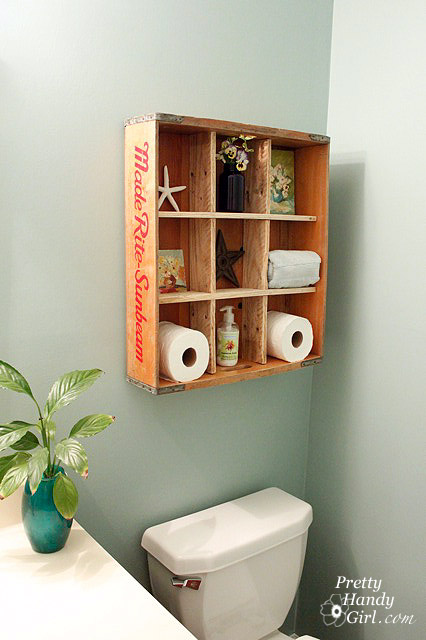
First up I will be showing you how to make Cubby Shelves out of a Bread Crate and a wooden pallet.

And the best part about this project is it doesn’t require any nails or screws! To view this tutorial you will want to head over to visit with the very lovely and very beautiful Amy from Positively Splendid.

Not only is she as beautiful as Kate Middleton, but she also possesses the talent to create a royal wedding gown. Too bad Kate didn’t call her to design her dress. Amy is a sweetheart and a fellow blogger I met at Blissdom. You will just love her blog!

After you have read my tutorial (and gobbled up several of Amy’s tutorials) you can slip back over here to learn how to hang almost anything on the wall perfectly level and plumb the first time. I’ll be showing you how I hung my bread crate cubby shelves in the tutorial.

Let’s begin, shall we?

Materials:

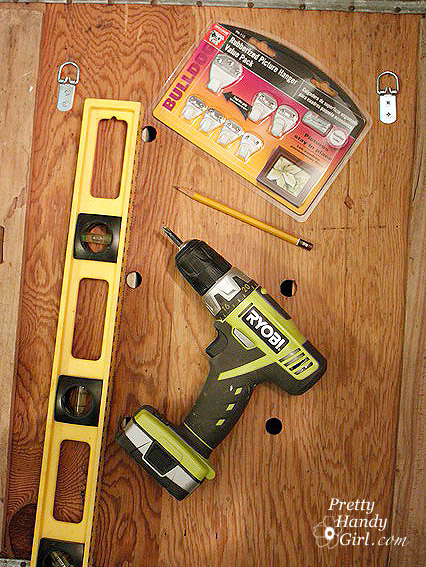
Picture Hangers (be sure to check weight limit)

Hammer

Level

Pencil

If your object doesn’t have hooks or a wire yet, you will likely need:

D-ring hooks

Screwdriver or Drill with a screwdriver bit.


If you have had misadventures hanging pictures, I have the tutorial for you! Hanging anything on the wall successfully doesn’t have to be hard. All you need are the right hangers and the right technique.

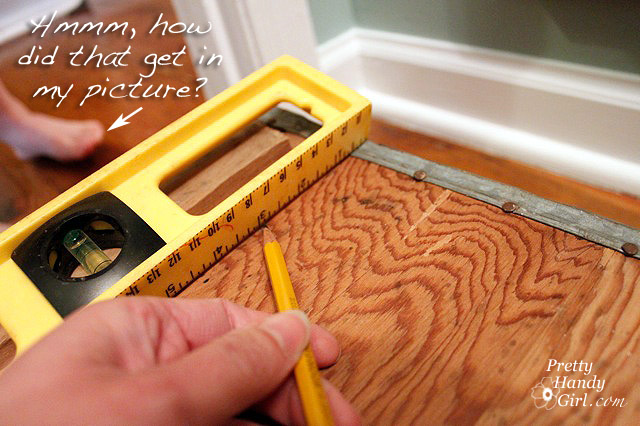
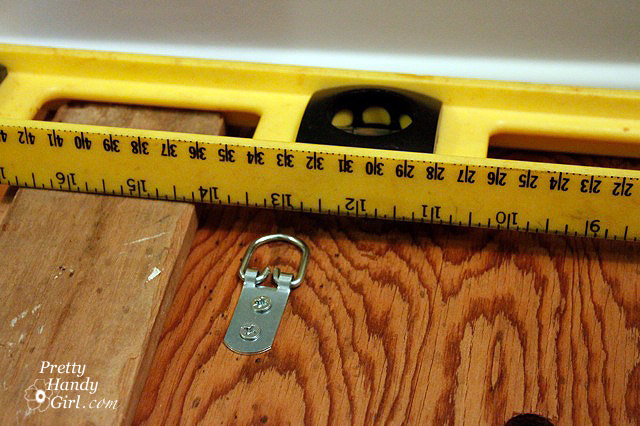
Because my crate didn’t have any hangers attached to it, I needed to add D-ring hooks. Starting on the left, I carefully measured 3″ down from the top of my object. Then made a mark 4″ in from the side. I repeated the same steps on the right side making sure the hooks would be the same distance in from the edges and 3″ from the top edge.

Then I screwed the D-ring hooks into the back of the crate.
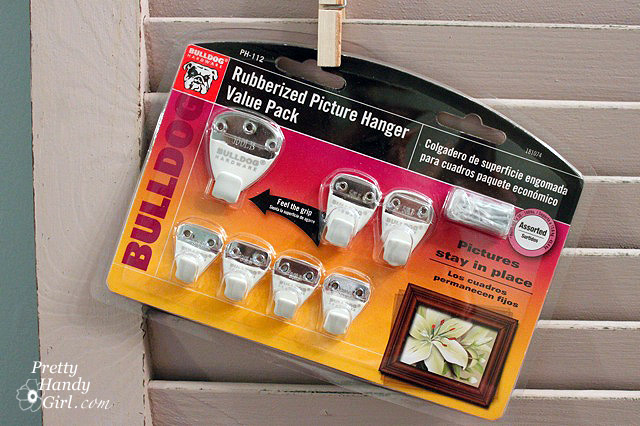
Hanging something heavy requires using some different hangers that are rated for the weight of the object you are hanging. Bulldog Hardware sent me some of their rubberized picture hanging hooks to try. These have rubberized tips to keep pictures from shifting or moving (like when my son rushes inside slamming the door behind him.)

In my case, my crate weighs about 12 lbs. filled up. So, I reached for two 50 lb. hangers (Did you forget I have boys that can exert up to 100 lbs. of pressure on anything in my home?)

Start by holding your object up against the wall where you want to hang it.

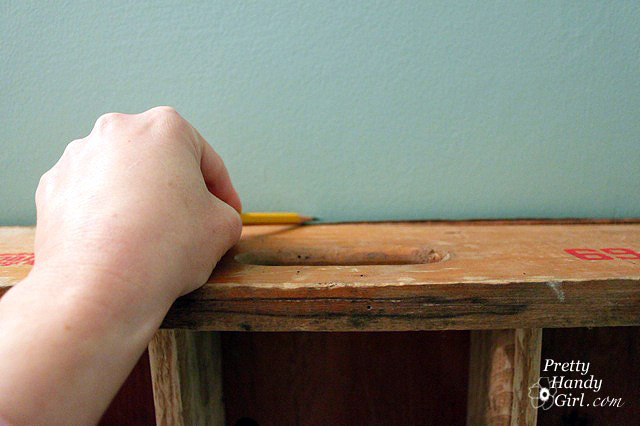
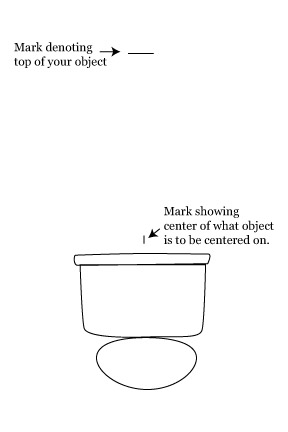
Make a pencil mark at the top of your object. Set your object down.

Now determine what you want to center your object on. For example: centering the object on a wall;  centering it between two windows; or centering your object on another object. In my case I am centering my shelf on the toilet.

Find the center and make a pencil mark.

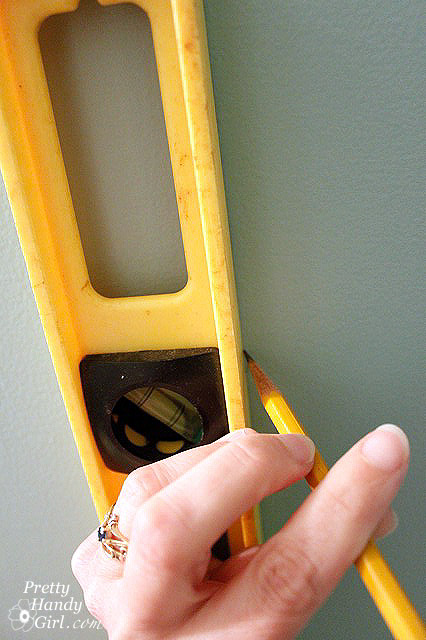
Set your level vertically against the center mark.

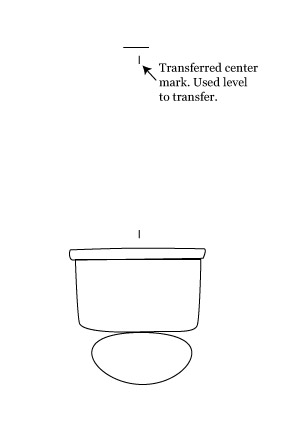
When the level reads perfectly plumb (straight up and down) you can transfer the center mark higher and closer to the top of your object.

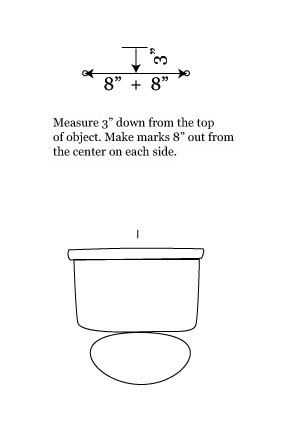
Now, measure the distance between the hooks on your object.

Mine are 3″ down from the top. And let’s say the hooks are 16″ apart.

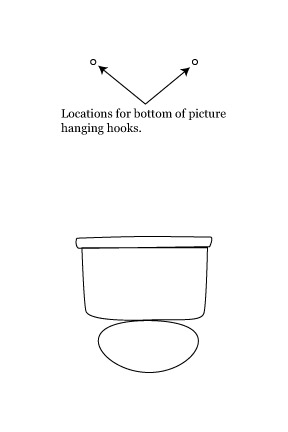
This tells me I need to install my picture hangers at 3″ down from the top of the object and  8″ out from the center mark on both sides.

Use the level to make sure that both marks are level.

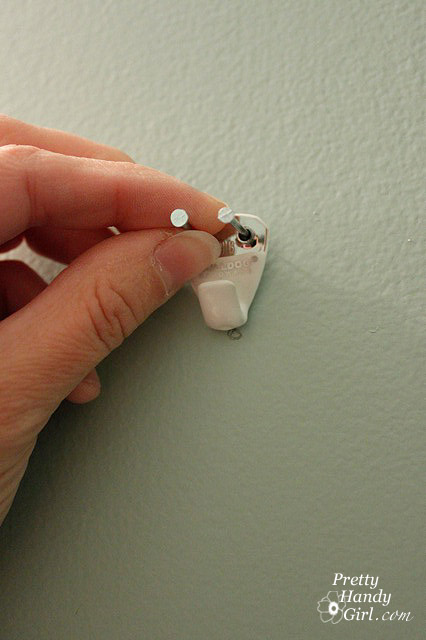
Set the picture hanger against the wall so the bottom of the hook lines up with the marks you made.

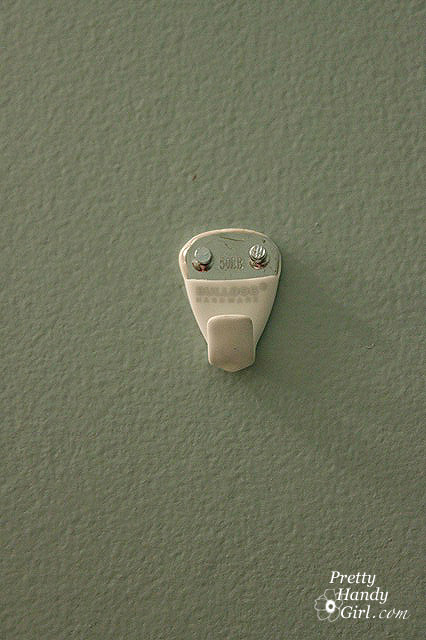
Gently tap the nails in with a hammer.

Carefully lift your object and line up the D-ring hooks with the picture hanger hooks. Sometimes it helps to have an assistant for this part.

Pull down on your object and make sure it is secure. Now fill ‘er up and enjoy!

What do you think? Did this method make sense? You can certainly use the same technique to hang pictures or a group of pictures.


As promised, I have a tutorial for making a cake stand using a plate and a candlestick. This is nothing new, and if you’ve hopped around the blogosphere, you have probably seen some variations of this project.

These are a few of the projects that sparked my creativity when I found a striped candlestick at a my friend Su’s yard sale.

Centsational Girl’s sherbert colored dessert stands are pure and sweet eye candy:

Crafty Nest used simple clear vases, candlesticks, and dishes to make single and multi-level cake stands:

And House of Hepworth’s turned a cheese dome into a cloche!

So, armed with my striped candlestick, I scoured my local Goodwill for a plate that had some citrus color for my stand. I finally found the perfect plate, but had to give myself a pep talk to buy it. It was perfect, except for the meal that was baked onto it. Ewww. Seriously, it looked like someone had just eaten off the plate and then donated it. GROSS PEOPLE!

But, alas, it was the perfect  color, and when I got home I drenched it in Get Clean Basic H2 Degreaser and wiped it clean BEFORE cleaning it in my sink. (I think I might be a tad germ phobic.)

Tutorial:

Materials

  • Plate
  • Candlestick (or other base)
  • Sandpaper
  • E-6000 glue
  • Rubbing Alchohol
  • Paper towels
  • Books or weights

Begin by thoroughly cleaning the plate and candlestick.

Using a fine grit sandpaper, rough up the top of the candlestick and the base of the plate where you will be bonding them.

Clean the plate and candlestick with rubbing alcohol to remove any residues.

Squeeze out E-6000 on the rim of the candlestick.

Center the candlestick in the middle of the bottom of the plate.

Set books on top of the candlestick to weigh it down while the glue dries.

Let the glue dry overnight, then turn your cake plate over. And, serve up some wonderful dessert…


…or simply make some fruit more appealing, …

…or use it as a plant stand…

But, personally, I prefer the dessert!

What about you? How would you use this citrus striped cake plate?
Sharing with:

Welcome back, I hope you are ready to paint with me today! If you are just stopping by and haven’t prepped your room for painting, you may want to take a moment to read Painting Like a Pro Step 1 and Step 2.

Okay, are you ready? I’m going to show you how I painted my downstairs half bathroom, the professional way!

Before

After

Materials:

  • paint tray
  • two plastic grocery bags (optional)
  • a paint roller with a regular nap for smooth walls. If you have a textured wall (orange peel, cottage cheese or as “My Boy’s Teacher” showed me: sand texture) you may need a thicker napped roller.
  • 2.5″ angled painter’s brush
  • edger (optional)
  • Painter’s tape (I prefer the Scotch Blue Delicate Surfaces tape)
  • a damp rag
  • sanding block with 200 grit or higher sand paper
  • damp sponge with a bucket of fresh water
  • x-acto blade (optional)
  • small flat artist’s brush

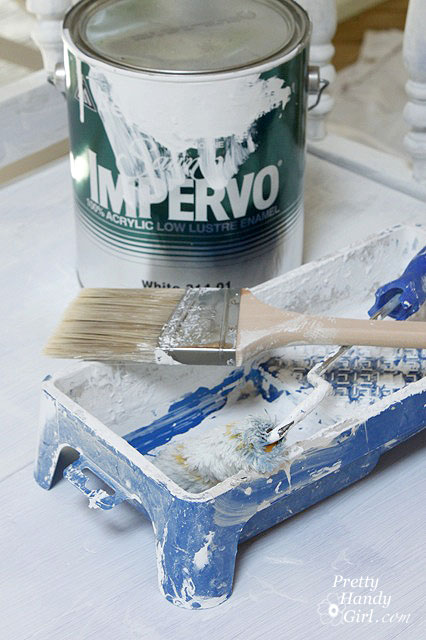
Go ahead and pour your paint into a paint tray (make a liner with grocery bags as I show HERE.)

Only fill the tray about half full (more than shown in the picture), you need some blank space at the top to squeeze the excess paint out of the roller by rolling it back and forth.


Painting Walls and Ceilings:

When I paint a room, I always paint the ceiling first, unless it REALLY doesn’t need painting. It is more efficient to paint the whole room while you have the tarps down and supplies out. Besides, you know you won’t go back and paint the ceiling another day. Am I right?!

You can paint the ceiling the same way I paint walls, just use an extension pole and a two-step ladder for painting the border. Don’t worry about taping off the walls or trim right now. I’ll tell you when to tape later. The only time I would use tape now, is if I need to mask off something like the vanity, a light fixture or a wall I’m not going to paint.

1. Begin by painting the border on your wall. Use either a paint brush or the edger. If you are using the Aura paint, let this border dry before you move onto the next step. If you are using another brand/type of paint, work quickly and move onto the next step.

2. Use your roller to roll out a 3 – 4 foot “W” shape. Try to roll into the edge while it is still wet (unless you are using Benjamin Moore Aura paint.)

3. Roll the roller back and forth, up and down and in random directions until you have filled in a 4′ square section of wall.

4. Roll the roller very lightly over your square to make sure the coat of paint is even; feather the edges; and to rid the wall of any start and stop roller marks.

Start on the next section with another “W” shape and repeat steps 1-4 until you have covered your wall in paint. Then move on to the next wall. Keep in mind that you will need at least two coats of paint. You’ll get a more durable paint job, more even coverage, and it will look professional if you use two coats of paint. So, own up to the fact that you will need two coats!

A few words of caution while painting:

  • If your paint has started to dry and {{gasp}} you see a spot you missed or a bug in your paint, resist the urge to roll over it. Wait until it dries, then sand or paint the messed up area.
  • It is best not to overload your roller with paint. Too much paint can drip and run. If that happens, use your damp rag to wipe it up immediately. And remember, you are going to use two coats, right?!

Now that you have completed the first coat (and it is dry to the touch), pull out the sanding block. Lightly sand all the walls. You are just knocking down any bumps (or bugs) and giving your paint layer a little “tooth” for the next coat to adhere to.

Then wipe down your walls with a damp sponge to remove all the sanding dust.

The sanding between coats may seem like overkill to you, but trust me, the sanding step makes a difference! And you wanted to know how to paint like a professional, didn’t you?!

Now, go ahead and paint your second coat of the wall color repeating Steps 1-4 above, for  painting a border and rolling the paint inside.

Done? Well, not quite. Remember when I showed you this the other day?

Yes, the wall paint is on the trim. That is okay, I want it like that. I knew I was going to paint the trim and wanted to make sure that the wall color went right up to my trim, it’s all by design baby, trust me.

At this point you have painted the ceiling and all of the walls in your room. If you are sure your walls are dry (at least 1 hour or more), then you can move on to the trim.


Painting the Trim:

Now you can go ahead and tape off the edge of your walls where they meet the moulding. Then use the matte medium  trick I showed you HERE (or you can use a small amount of wall color if you like) to seal the edge of the tape on the wall side.

Go ahead and paint all your trim with a 2 1/2″ paint brush dipped in a small bucket of trim paint. I prefer Purdy brushes because they last for years! See my post on cleaning brushes HERE to see how I protect them from wearing out.

Be sure to put two coats of paint on the trim, this will help to keep it looking new and stand up to the “Matchbox Demolition Derby” games that ensue in your home. (What? You don’t have those games in your house? Lucky for your home.)

When the paint has dried partially (don’t wait too long), go ahead and remove all the tape.

If you don’t have any imperfections, you better go play the lottery right now! If you are human and normal you will have a few. No big deal. You can use one of two techniques (I use both).

1.Gently scrape any excess paint off with an x-acto blade.

2. Use a small square artist’s brush and paint over any seepage. I like to shake my can of paint and remove the lid to expose just enough paint on the lid for touch ups.

Horray, you are done! Now you can tell your friends, “I’m sorry I can’t give you the name of my painter, because I painted the room myself!”

Here are the before and after pictures of our half bathroom. I am LOVING the results. I have a few more tutorials for you from this project. I promise, they will come in due time.

Before – Beech Wood Vanity

After- Painted Vanity Black

Before – Towel Ring on Wall

After – New Towel Hook on Wall

DIY – Vintage Soap Sign

Before – Shutter on Wall behind Door

I would love to know if you paint a room using my Painting Like a Pro tutorial. And how it worked for you!

Other Steps in this Series:

Step 1. Prep work

Step 2. paint and sheen


No Solicitors Sign

We live on a quiet street in a peaceful neighborhood in Raleigh. Unfortunately, every so often, my son’s peaceful naps were interrupted by: DING DONG! And when I answered the door, this is who greeted me.

ARRGGGHHH!

I finally decided to halt the door-to-door salespeople in their tracks. Especially after a neighbor informed me that sometimes these so-called salespeople aren’t actually selling anything. There have been a few incidents of burglary in our neighborhood, and one of the burglars had actually knocked on doors the day before. Apparently he was casing the home to see what homes were empty at what times. Plus, it offered them an opportunity  to peek inside and see if there were any valuable items inside. Scary! Especially when I’m home alone with the little ones.

I decided to take matters into my own hands and create a No Solicitor Sign.

While at Goodwill, I searched for two small picture frames.  The frames I bought were in good shape, but I added some new paint and glaze to give them a fresh look.

I printed out a simple message on decorative paper and inserted it into the frames.

No Solicitors! Unless:

  • You are a Girl Scout.
  • You are a Boy Scout.
  • You live on this street
  • You are a friend of ours

This message seemed to cover all the bases and still allow for the kids selling muchies!

I hung one sign by our side door.

And put a second one inside the storm door of our front door.

I can honestly say that we have not had a single unwanted salesperson knock or ring our doorbell since I hung the signs.

I’m not the only one who can’t stand solicitors, Becca from Blue Cricket Design cut some vinyl for her side light by her front door. I can’t help but smile every time I see it. 😉

Blue Cricket Design’s Sign

Want your own No Solicitor Sign? Download it HERE!

I hope you’ve enjoyed the posts on “Falling in Love with Your Home” in February. We’re in the home stretch (yes, pun intended) now. Today I have my roomie from Blissdom, Sandra from Sawdust and Paper Scraps. She and I love our power tools, and LOVE to build things. I think it would be a blast to work on a collaborative project one day. She’s definitely my soul sister.

Please welcome the lovely Sandra from Sawdust and Paper Scraps who is going to show you how to disguise an ugly view!

Good morning Pretty Handy Girl fans! I’m Sandra from Sawdust and Paper Scraps, here to share an easy and inexpensive project to transform and beautify a window with a less-than-stellar-view!

(Or a window where you want privacy without blinds or drapes like a bathroom or shower.)

We have a basement and even after I added casing, trim and paint to the inside of my window… it was still really unattractive- outside!

So I went to Lowe’s and bought a $14 roll of frosted glass vinyl window cling!
Before installing, I made sure my window was as clean as possible.  I had to clean AND scrape off some paint because SOMEONE was a little sloppy!  (uhem-me)

I installed it on one window by myself and it was something like a scene from an I Love Lucy rerun.  Vinyl flopping down over my head, sliding off one side while I was trying to smooth out the other…
Definitely easier to install with 2 people. But do-able with only one!

The instructions for the stuff I bought said to spray the window and the sticky side of the vinyl (with a liquid that you can purchase separately. But, you can also use a soapy water mixture in a spray bottle).  You have to peel off the backing which I did just a little at a time while person 2 sprayed and then stick it to the window.

After you put the vinyl on the window, use a utility knife to trim off the excess and a credit card or little squeegie to smooth out the wrinkles and push the extra liquid out from under the vinyl.  While it’s wet, you can pull it off and reposition it- so keep it all wet until you have it placed just right.  Then let it dry.  That’s it!

Easy.

I think it’s a big improvement for relatively little cost or effort.

This particular room is my daughter’s playroom so I also built some shutters,


a wall of storage,

and a playhouse. If you’re looking for another project to whip up!

But it all started with the window-well.

And a little vinyl cling!

Thanks for having me Brittany!  And thanks for letting me share with you all one thing I did to help me “Fall in Love with My HOME!”

Thank you Sandra! Great tutorial. I love how easy and quick that solution was. If you haven’t been to Sandra’s blog, you need to zoom over there now. She is the Queen of built-ins and decorative mouldings. Plus, she has just enough crafts to keep you creative!