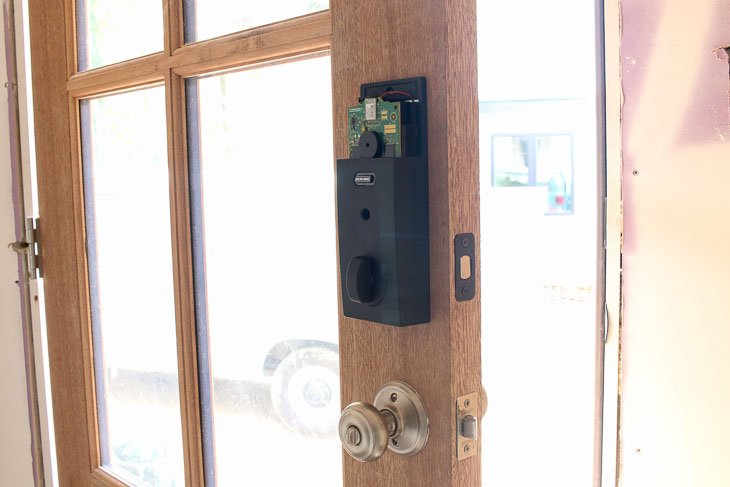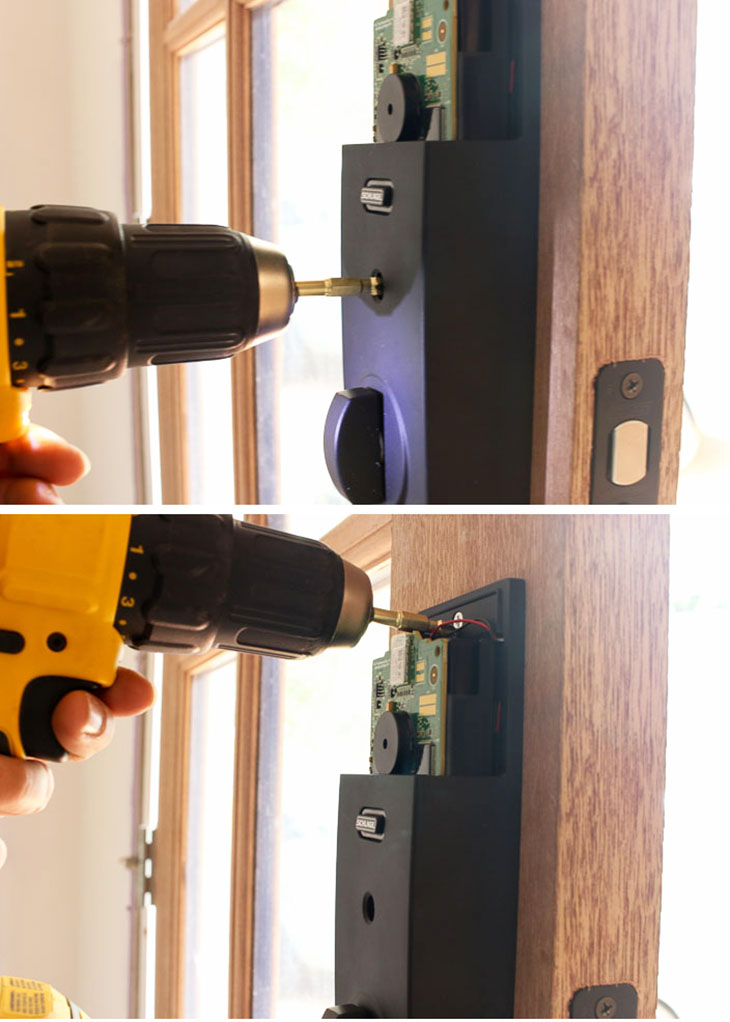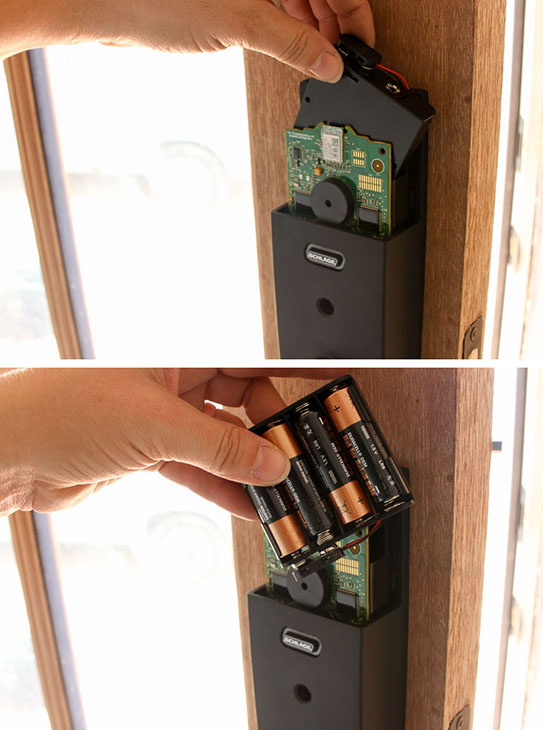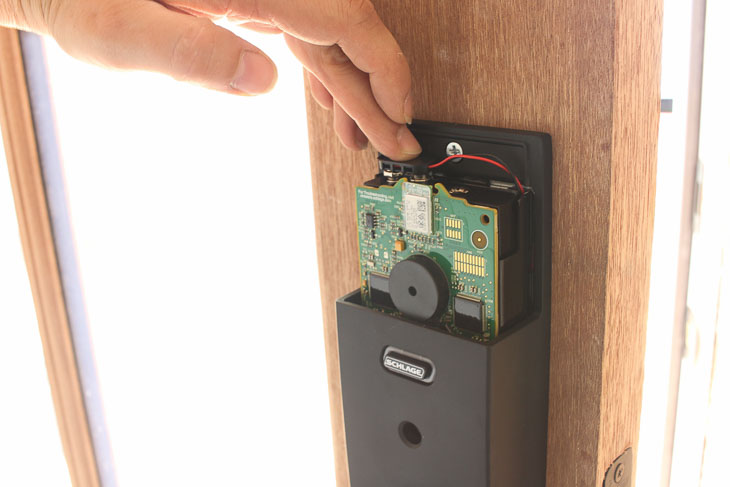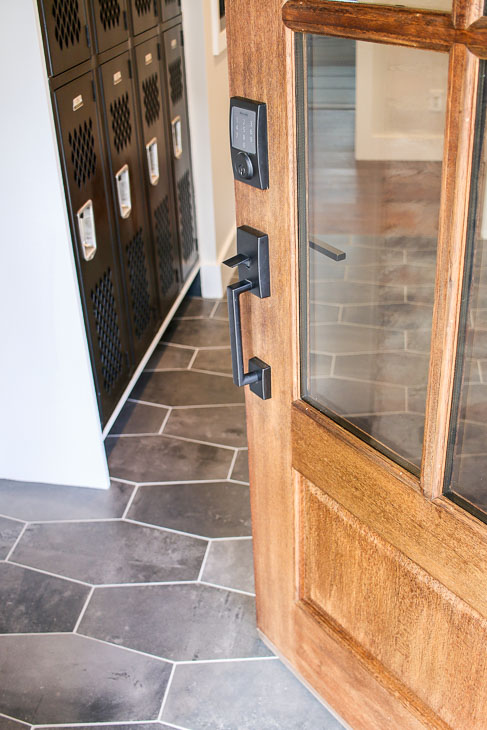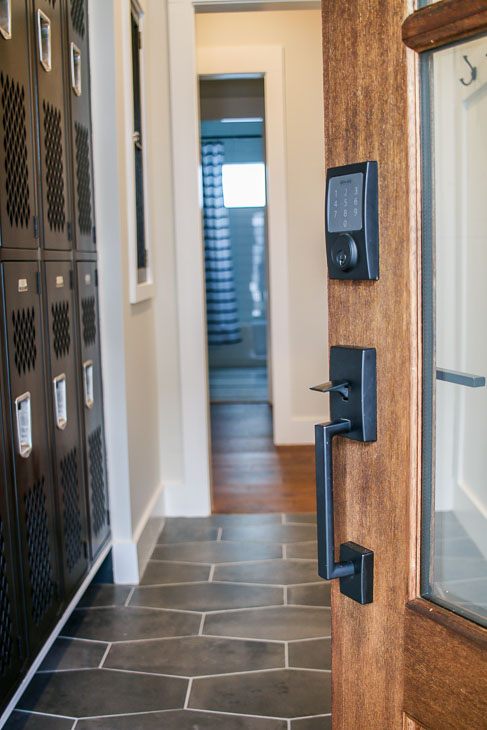
attach keypad

How and Why You Should Install a Smart Lock on Your DoorHow and Why You Should Install a Smart Lock on Your Door
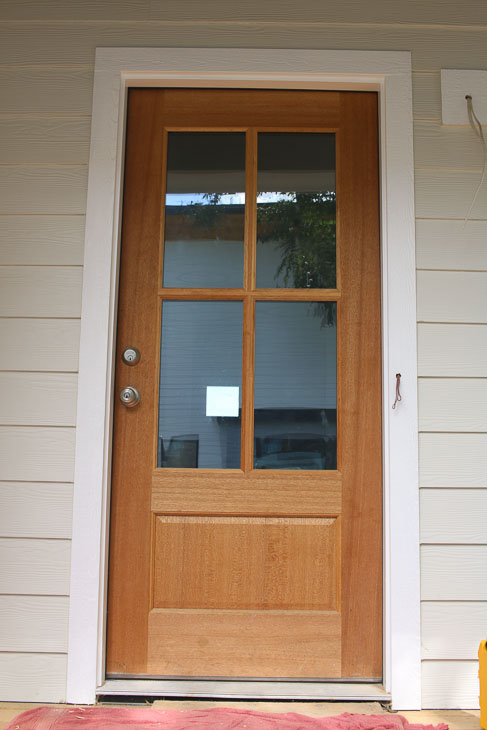
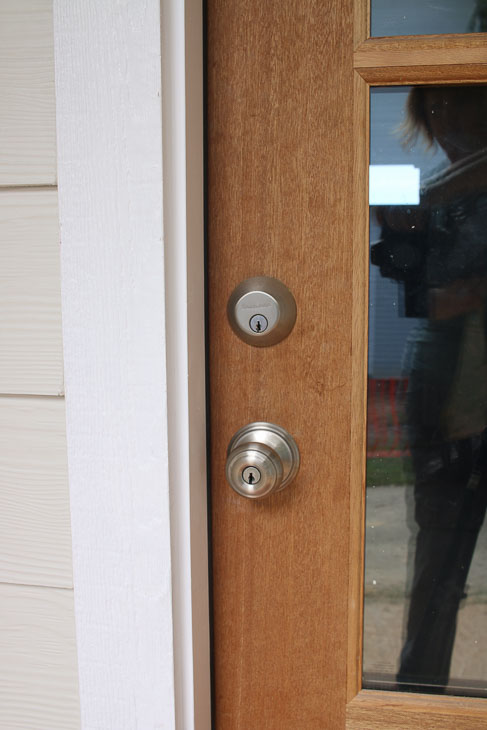
Smart locks have been around for a while, but I’ve been slow to jump on the bandwagon and install a smart lock. I worried they might be tricky to install and had heard stories of the technology being glitchy (although I can’t find a lot of concrete evidence beyond this firmware update glitch that left 500 LockState locks completely useless.) However, after installing a Schlage smart lock on the Saving Etta house, I am a converted technophobe.

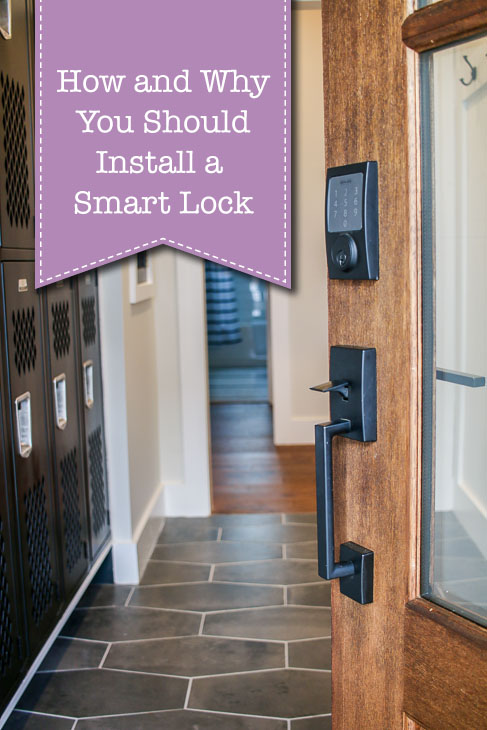
If you’ve never installed or used a smart lock before I have some considerations for you when deciding How and Why You Should Install a Smart Lock on Your Door.

Why are Smart Locks are a Good Investment?

If you’ve ever had the unfortunately situation of locking yourself out of your home, with a smart lock this is a thing of the past! You only need to remember your code! Do you hire contractors or cleaning people to work at your house? Now you don’t have to take off work or give them a key if you aren’t home. Set up a temporary code for each person and remove the code when they are done. The same can be done for guests or for an AirBnB property.

Do you have kids old enough to let themselves in after school? Why not give them a code so you don’t have to worry about them losing a key and you can keep track of when they got home.

Finally, if you’ve ever had that nagging feeling that you left the door unlocked, you can rest easy by simply checking or locking the door remotely from your smart phone.

What if I told you a smart lock can also help lower your homeowner’s insurance and could be a selling feature when you sell your home? Is there really any reason  you wouldn’t want a smart lock? There may be, so read on.

Some Things to Consider Before Buying a Smart Lock:

  • Do the centers of your deadbolt and door knob holes have at least 5 ½” between them? (If not the interior circuit and alarm unit may not fit.)
  • Does your deadbolt hole equal 2 1/8″ in diameter?
  • Does the deadbolt and door knob hole backsets equal 2 3/8″ or 2 3/4″ from the edge of the door to the center of the holes?
  • Is your door thickness 1 3/8 – 1 3/4″ wide?
  • Is the latch bore hole in the door frame at least 1/2″ – 7/8″ deep?

If you couldn’t answer yes to all of these questions, a smart lock may not be right for your current door.

If you have a door that requires you to push hard, pull up, or hip check it, you will need to make adjustments to your door before installation. Why? A smart lock is activated by an electronic mechanism. The deadbolt needs to move freely into the frame to work properly.

Do you have a smart phone? If you don’t, you can still use a smart lock, but understand that you can’t take advantage of all the remote features.

Most smart lock run on batteries, but many needs Wifi or Bluetooth to handle features performed on your phone remotely. Obviously these functions may not be available if the power is out in your home. For this reason, it’s always good to carry a back up key on your keychain.

Some experts say smart locks can be hacked, but most standard locks can be picked or opened with brute force. Both have their limitations. I’d recommend doing further research if you are concerned about smart lock security.

Finally, there is the cost to consider. Smart locks aren’t cheap, but as I mentioned above, they can save you money on insurance or give you more money in your pocket when it’s time to sell.

How Hard is it to Install a Smart Lock?

Installing a smart lock to your entry door may seem like a hassle, but it’s actually a fairly simple installation anyone can accomplish.

farmhouse door

For some reason I thought the install would be more difficult, which is why I installed the ho-hum satin nickel knob and deadbolt on the Saving Etta house door. Sadly, it stayed on the door for months. As the completion date neared, I thought I’d need to clear an hour or so to install the Schlage Smart Sense lock. Boy was I mistaken, it took less than 30 minutes!

old satin nickel door hardware

Let’s give your home a smart upgrade by installing a smart lock today. Here’s how to install the Schlage Smart Sense Deadbolt in thirty minutes or less.

(I’ve included affiliate links for your convenience. I earn a small percentage from a purchase using these links. There is no additional cost to you. You can read more about affiliate links here.)

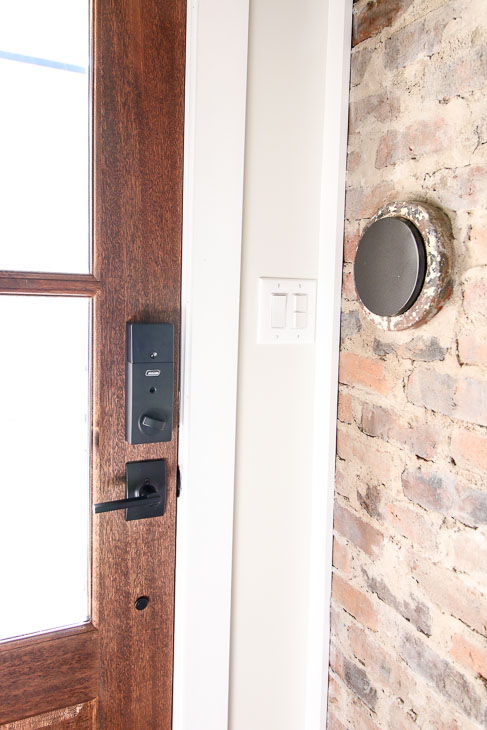
beautiful interior view of Schlage Smart Sense lock

How to Install a Schlage Smart Sense Deadbolt:

Remove the Smart Sense Deadbolt from the box and make sure you have the booklet included. This booklet has the programming codes and must be kept in a safe place. DO NOT THROW IT AWAY!

Materials:

Instructions:

First check to make sure your deadbolt engages freely into the door frame and deadbolt strike plate.

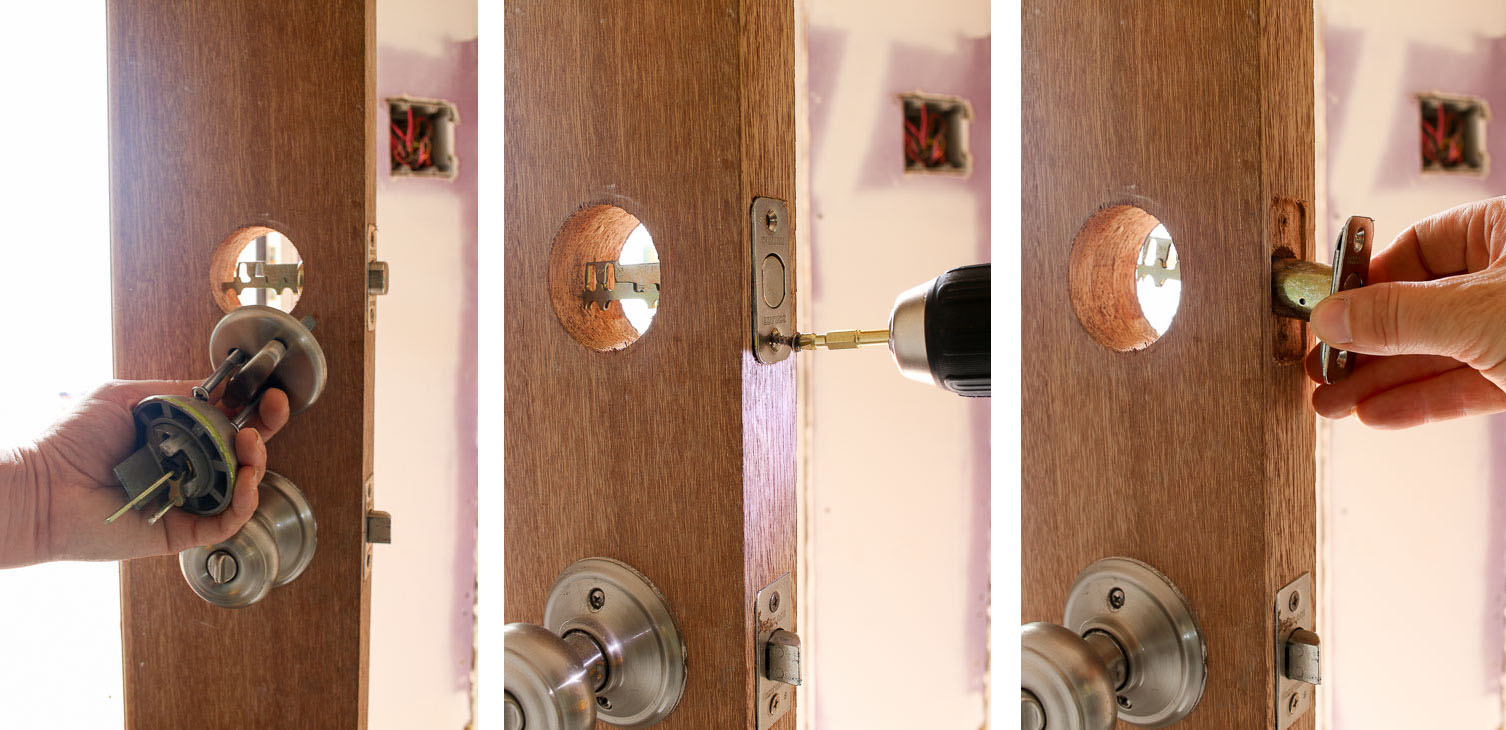
Remove the existing hardware.

remove existing hardware

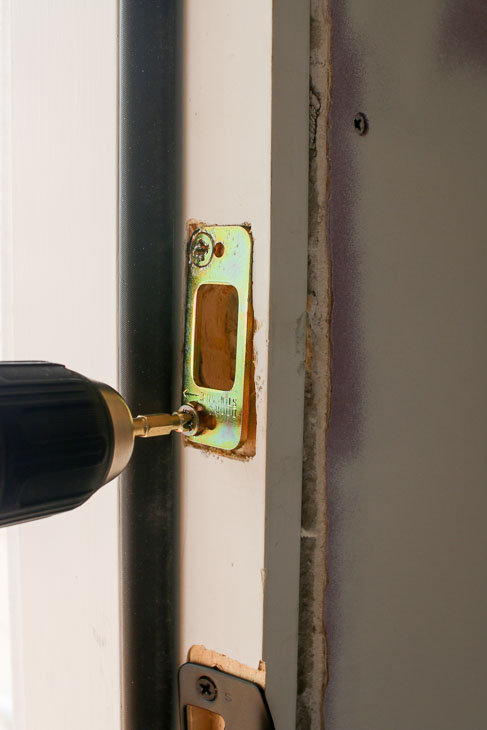
Also remove the existing strike plate from the door frame. Then install the reinforcement plate into the door frame using the longer reinforcement screws. (Pay attention to the wording on the reinforcement plate telling you which way to orient the plate.)

attach reinforcing plate

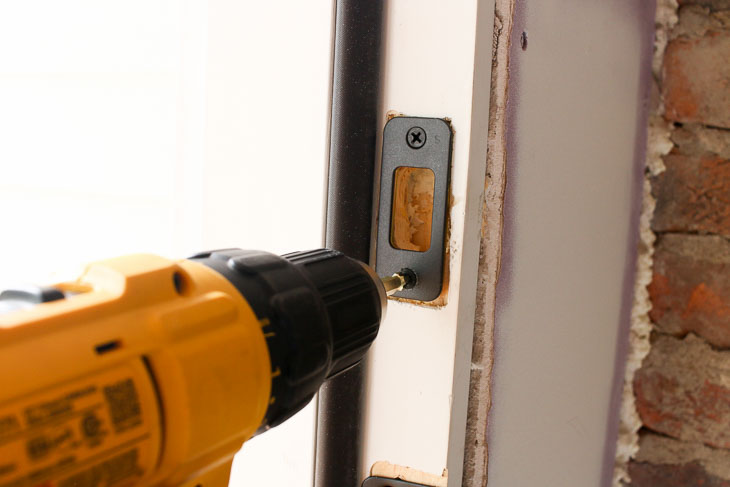
Install the new strike plate on top of the reinforcement plate.

attach strike plate

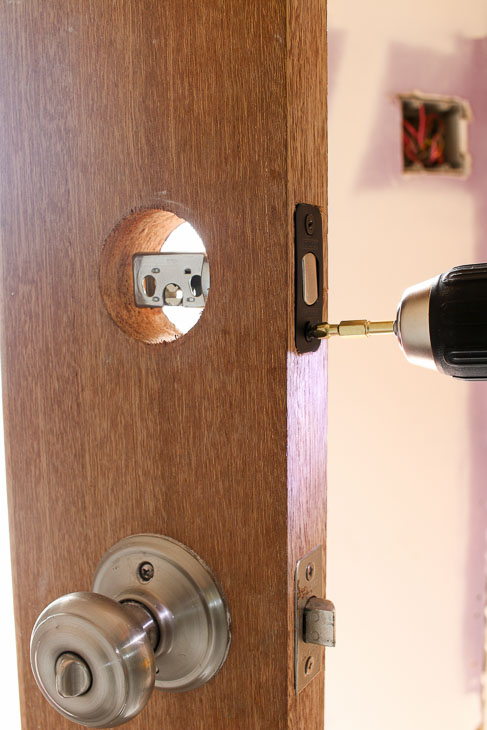
Insert the new bolt into the door (if you have a circular faceplate in the door, you’ll have to swap the rectangular plate with the round one in your kit and use the hammer and block to tap the bolt in.) Secure the bolt to the door.

attach bolt

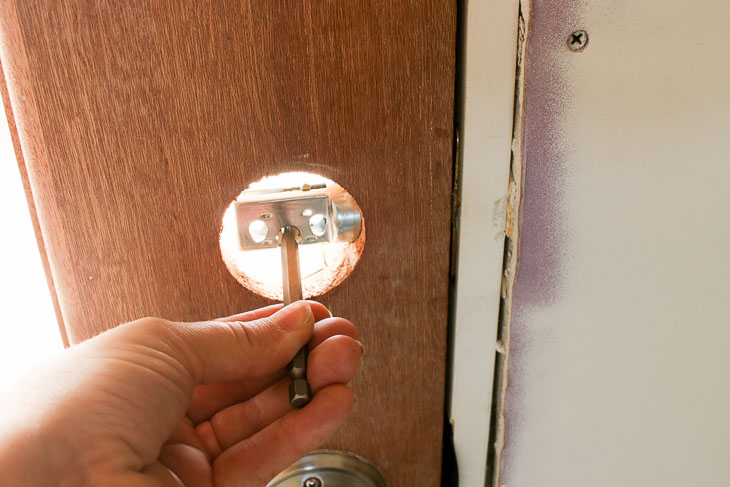
Close the door and use the flat head screwdriver to test the locking mechanism. Does the deadbolt seat properly in the door? If yes, move on. If not, make any adjustments to your door now.

My door needed some adjusting (a shim behind one of the hinges to square up the door) before the deadbolt could open and close freely. 

test dead bolt

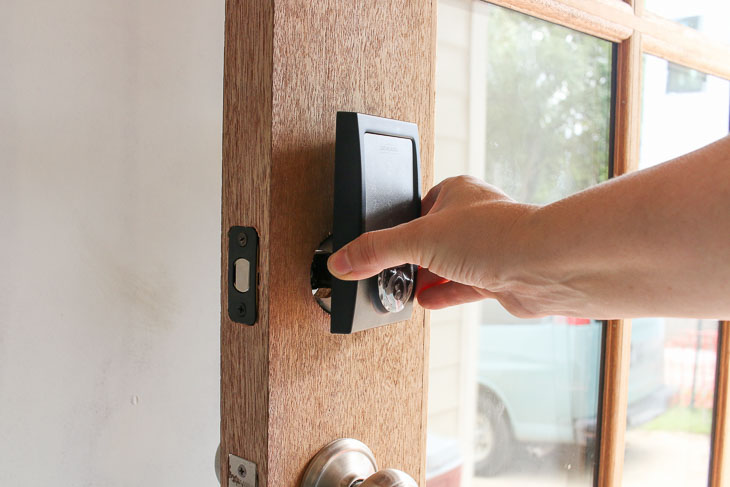
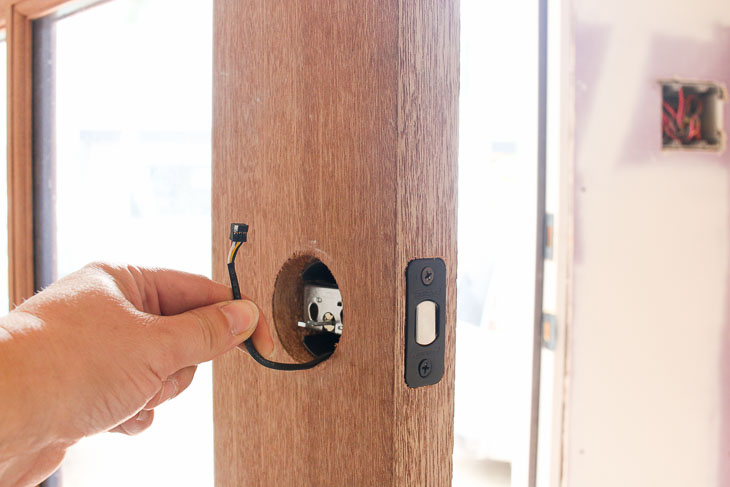
Now that the bolt seats properly, add the keypad to the outside of your door (be sure to feed the cable through the door and under the bolt as you seat the keypad.)

attach keypad

The cable should be positioned under bolt and exit on the interior side the door.

signature

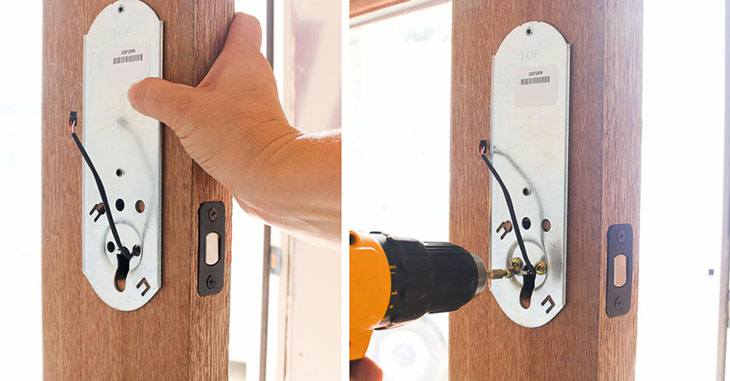
Add the support mount to the interior of the door using the mounting screws provided. The support mount is stamped with the words TOP and AGAINST DOOR. Be sure to orient the support accordingly. Make sure the support mount and keypad are straight and plumb before tightening the screws.

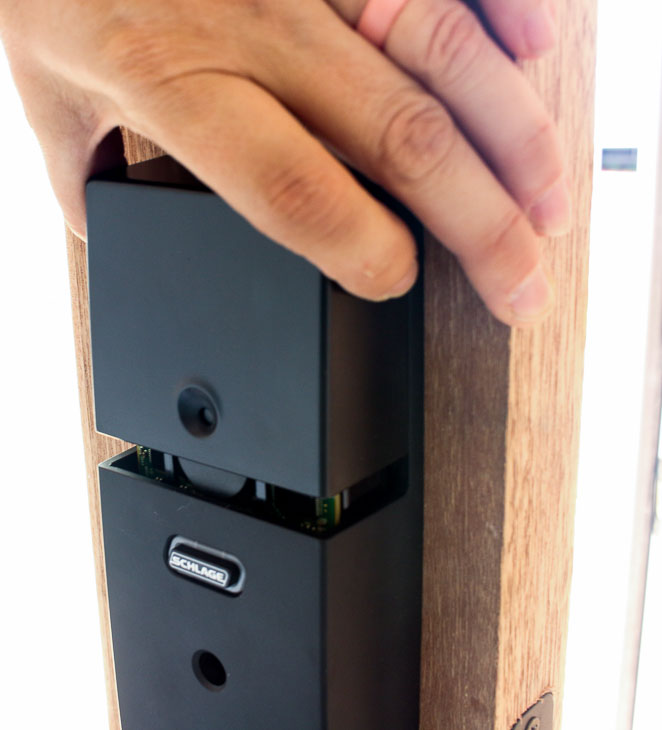
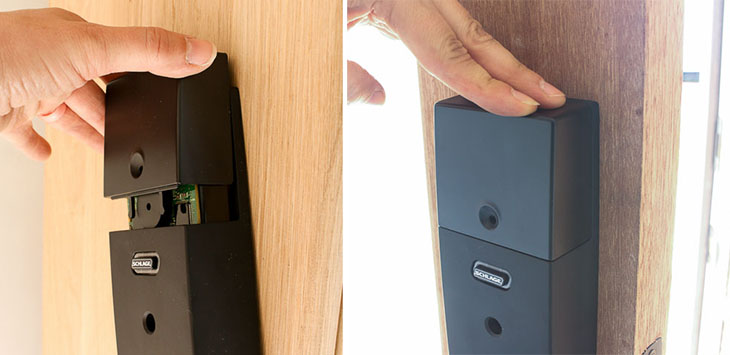
Remove the top cover on the alarm unit.

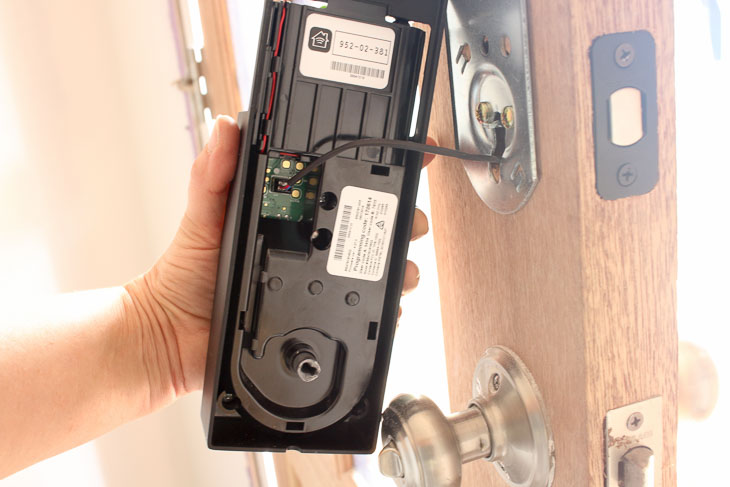
Attach the cable to the back of the interior alarm unit.

Carefully attach the alarm unit to the support plate. You may have to turn the knob to line up the slot in the back of the alarm unit with the tab in the bolt.

Secure to the mounting plate with a screw in the middle of the until and a second screw above the circuit board. (Please note: Schlage recommends using a hand held screwdriver instead of a drill. I’m a rebel, what can I say?)

Remove the battery tray inside the alarm and insert four AA batteries.

Replace the battery tray with the batteries facing the door. Re-attach the battery connector.

Make sure not to turn the deadbolt knob until you set up the keypad. Replace the cover.

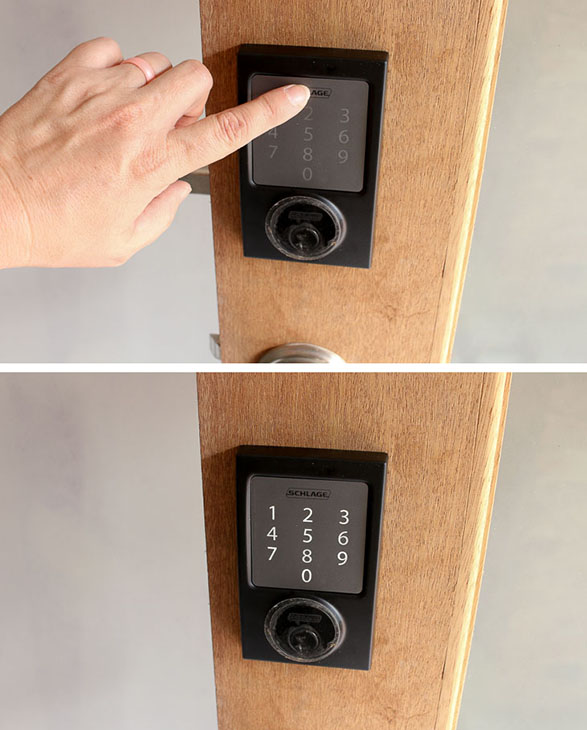
Now it’s time to test your keypad. Grab the brochure and locate the default codes on the sticker. Press the Schlage logo. The keypad should light up.

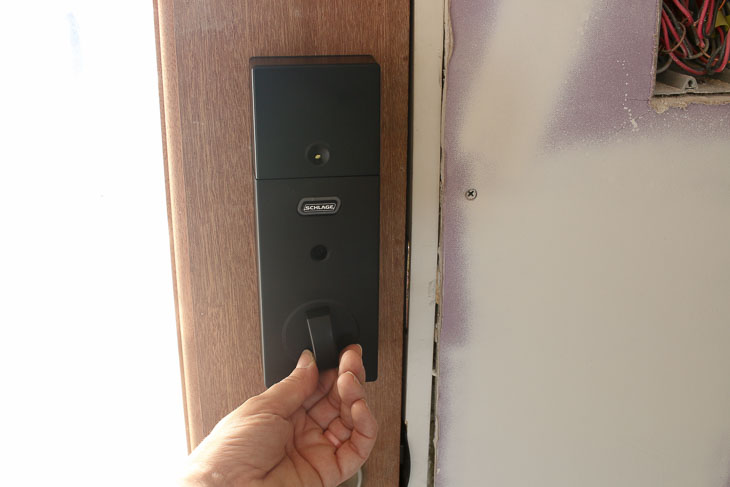
Enter the default code and the deadbolt should go through a set up routine. Let it finish, then close the door from inside the house and test the lock using the thumb turn. The bolt should still be able to open and close freely. (If not, make any adjustments to your lock or door as necessary.)

Now you can test the keypad entry. Take a key with you as you step outside. Close the door and press the Schlage logo. The door should lock.

Press the Schlage logo again (the door should stay locked.) Now enter one of the default codes and the green check mark should illuminate and unlock the door.

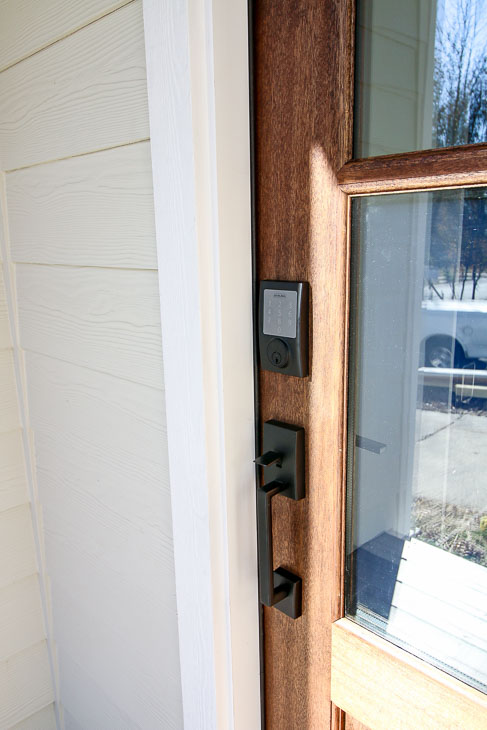
Your new Schlage Smart Sense deadbolt lock is now set up.

To manage your new smart lock, download the Schlage Smart Sense app on your smart phone and follow the instructions. You can also set up new codes, or lock and unlock it remotely.

Schlage has an installation video if you have any questions about this installation. Watch it below:

The Schlage Smart Sense Deadbolt was fantastic to have on the Saving Etta house. I was able to program temporary codes for the subcontractors and deactivate them after they finished their work.

I will definitely be looking into adding one of the Schlage Smart Sense Deadbolts  to my own home. Especially because my boys are always misplacing their keys. 😉

Disclosure: As a sponsor of the Saving Etta project, Schlage sent me the Smart Sense Lock for the house. I was not told what to write, all opinions are my own. 

Pin this image to help others learn more about smart locks!


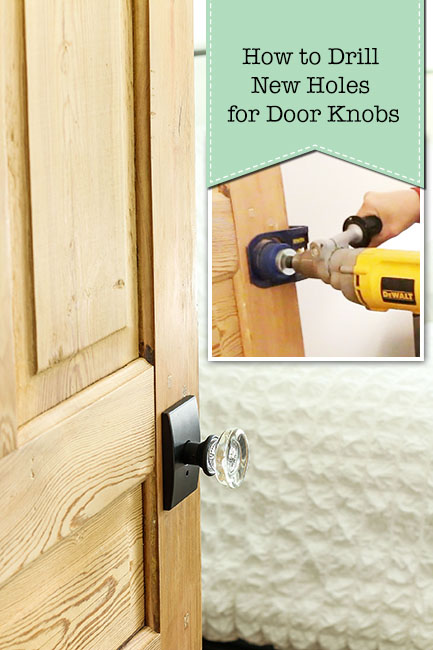
Want to learn how to drill new door knobs holes?

How to Drill New Holes for Door Knobs

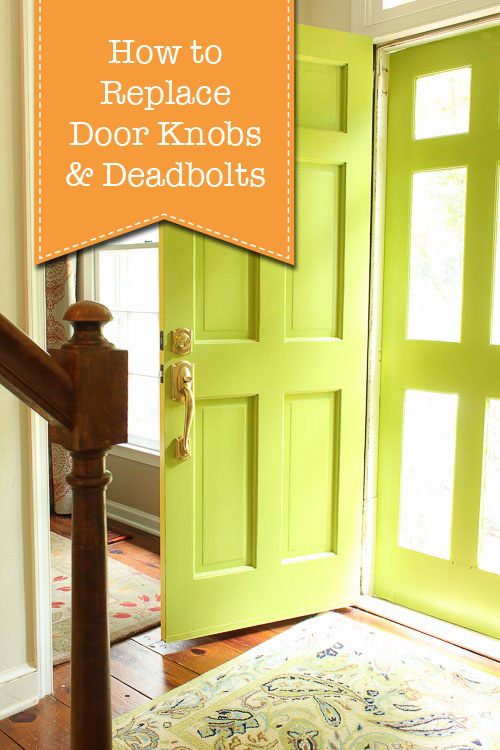
Or maybe you want to learn how to replace the other door knobs in your home:

How to Replace Door Knobs and Deadbolts | Pretty Handy Girl

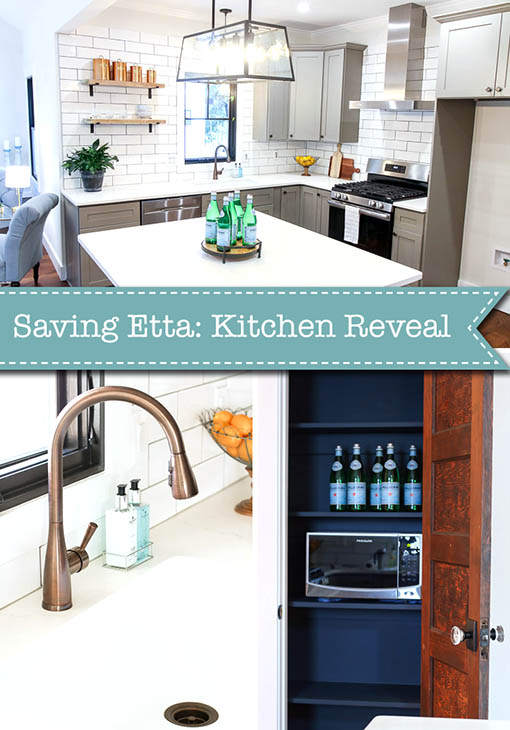
Saving Etta: Kitchen RevealSaving Etta: The Long Awaited Kitchen Reveal

Thank you all so much for your patience with me as I put together the final Saving Etta updates. I have more to come, but for now I know you’re anxious to see the Saving Etta kitchen reveal. Get settled down with a nice cup of coffee or hot chocolate because there are many photos coming your way!

Before I show you this beautiful modern farmhouse kitchen, I want to thank the Saving Etta sponsors who made it all possible!

Plygem, Broan-Nutone, Impressions Hardwood Collection, Leviton, Ask for Purple Drywall, Wood It’s Real, STIHL, Schlage, Duluth Trading Company, Magnolia Home Paint, KILZ, Jeffrey Court Tile,  The Builder Depot, Wilkinson Supply Co., Designer Drains, Liberty Hardware, and Ferguson Bath, Kitchen & Lighting Gallery

My Big Fat Crazy Push to Finish

Remember when I told you I was on a tight deadline? In early October, I had an inkling that I needed to get the house finished and listed for sale within 6 weeks. My husband thought I was crazy (and in hindsight I probably was).  Market strategists had been predicting a downturn in the fourth quarter of 2018 and I could tell things were starting to get inflated near downtown Raleigh. Surrounding homes were selling for more and more since I bought Etta in May of 2017. I felt a strong need to get the house on the market before things slowed down for the holidays. This meant a final push and a self imposed crazy work schedule for me.

My day started at 5am to shower, eat, and get my sons out the door. We’d leave the house at 6:45 to drive my eldest to school. After dropping him off I’d head downtown. By 7:30am I’d arrive at the house and get straight to work planning out the tasks for the day. My subcontractors usually showed up at 8:30 or 9 am. They took a break for lunch but then got back to work until about five o’clock. By then, it was solidly dark and my subs headed home to their families. I usually worked until about 8 or 9 pm and grabbed dinner at one of several fast food restaurants on my way home.

Once home I had just enough time to answer emails and throw some tools and materials in the truck for the next day. The good part about my crazy schedule was I usually fell asleep easily after a long day’s work. The bad part was I packed on about ten pounds eating mostly fast food (even though I rarely sat still all day).

Lest you think I was working inside a cozy climate controlled house, I wasn’t. It was early November and the cold weather had set in. I bundled up and warmed myself in front of the space heater from time to time. I even bought a little used Keurig single serve maker to be able to drink warm coffee and tea. We didn’t get the gas meter hooked up and approval to run the heat until the day before the open house (almost a month after tiling the backsplash.)

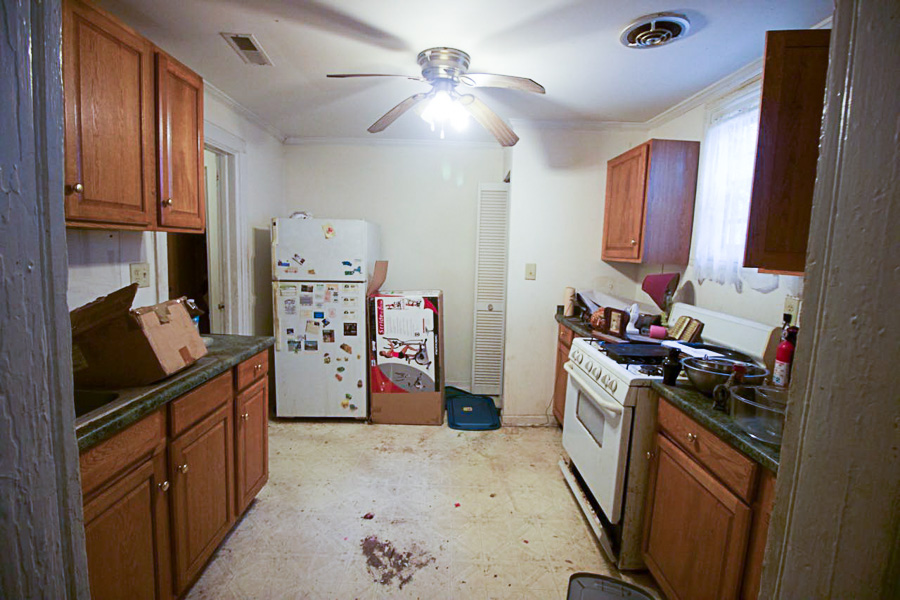
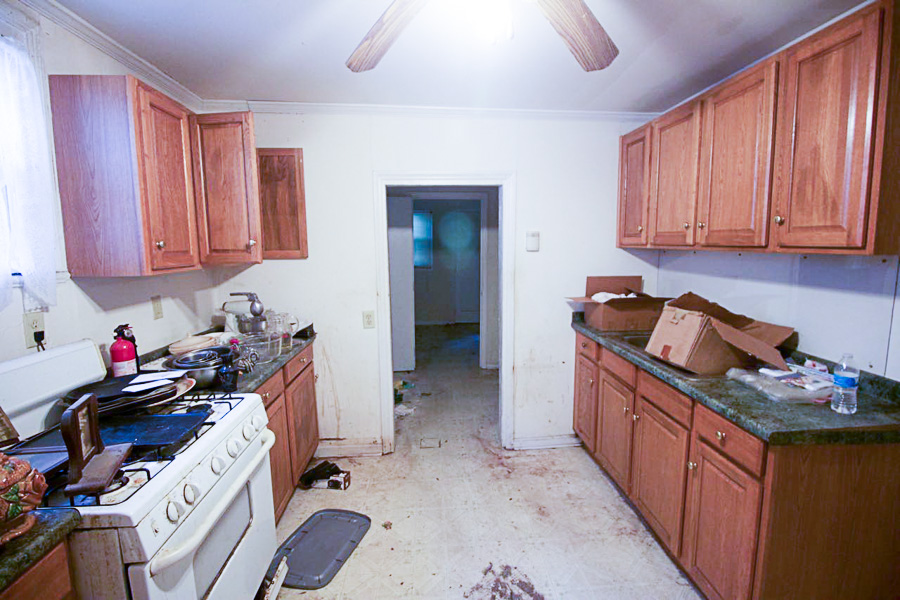
Was it all worth it? Absolutely! The house turned out amazing and I was pleased with the final results. And just a little reminder of what the kitchen looked like when I bought the house (you can see more progress shots in this kitchen update post):

Saving Etta - The Story of Saving a House Built in 1900 | Pretty Handy Girl

Saving Etta - The Story of Saving a House Built in 1900 | Pretty Handy Girl

Ready to see the kitchen? Without further adieu…

The Saving Etta Kitchen Reveal
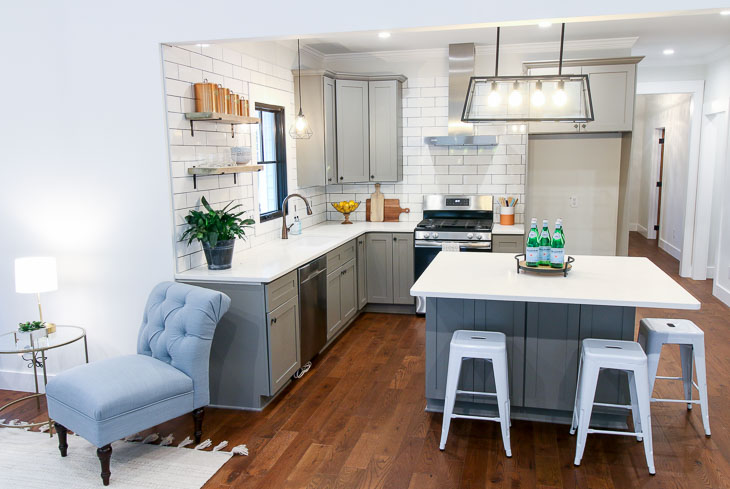
This is just one angle of the kitchen. You can read how I installed the cabinets with some help from my husband and a good friend here.

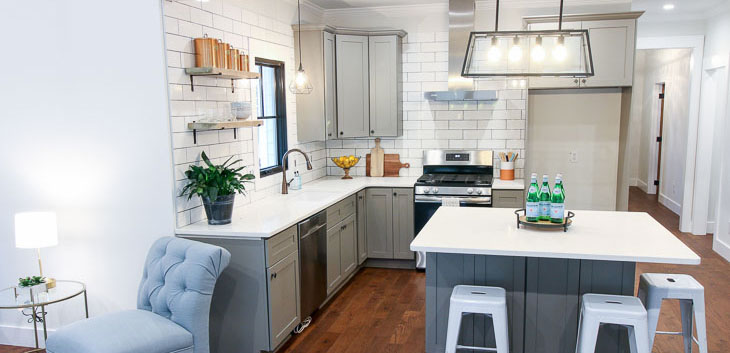
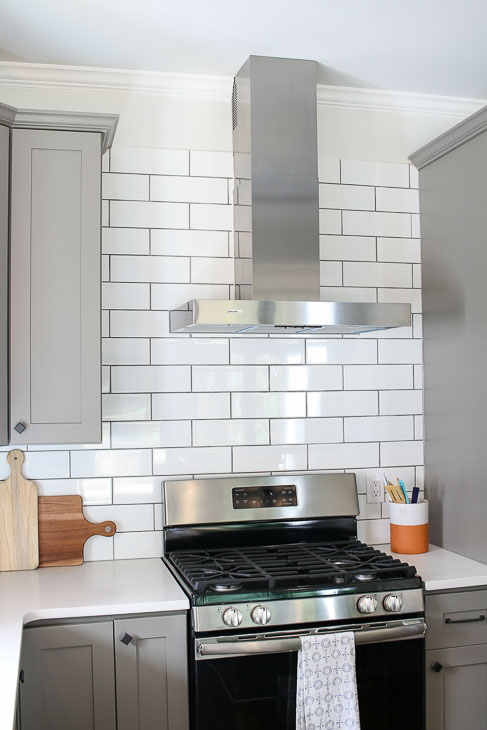
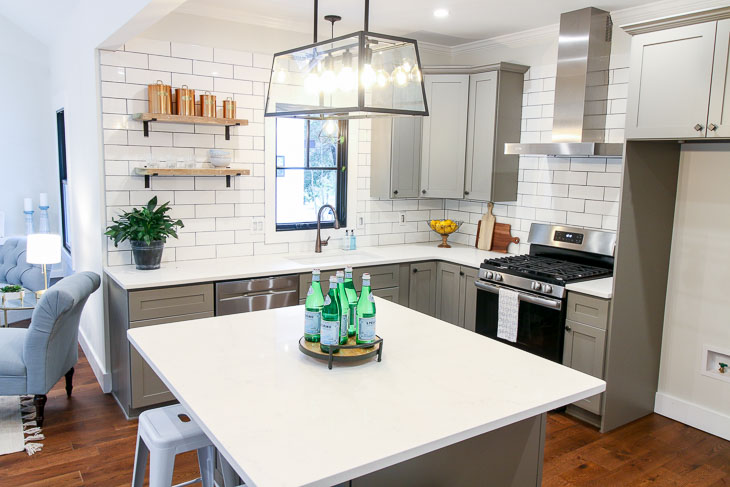
gray shaker cabinets with subway tile backsplash and stainless steel hood from Broan

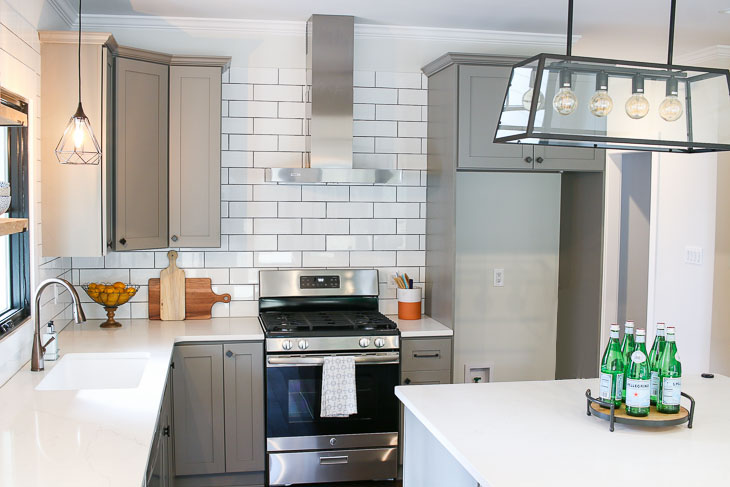
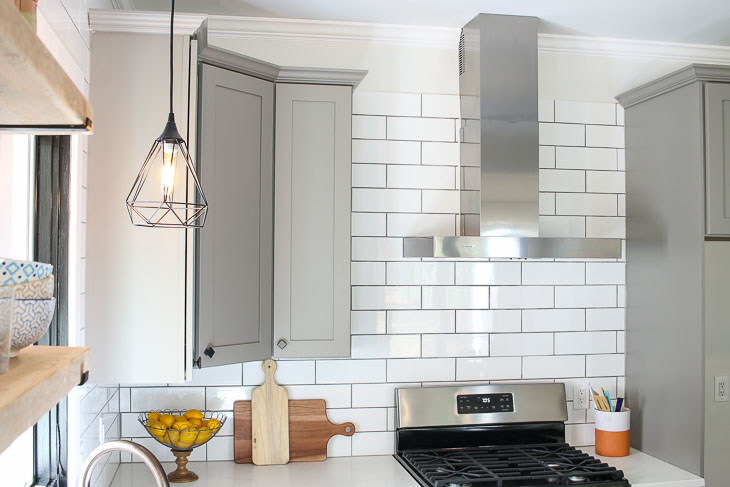
I love the sleek stainless steel range hood I chose. It’s the Broan RM533004 30″ Chimney Hood. And you can see how it was installed and why I had to act as supervisor.

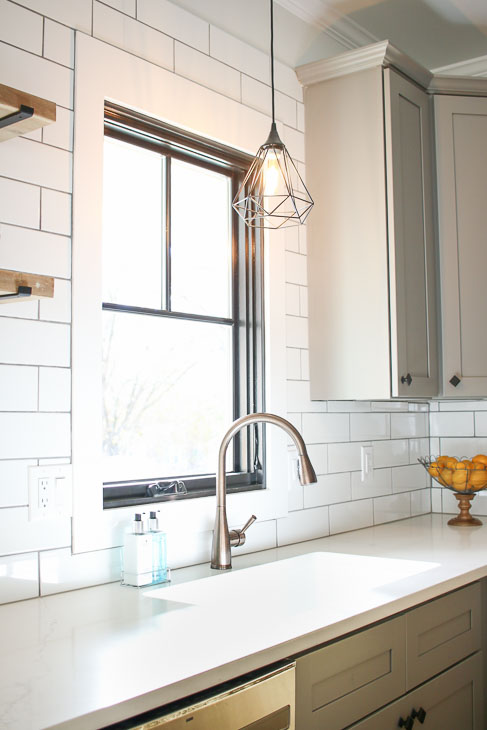
Plygem mira window with facet pendant light and subway tile

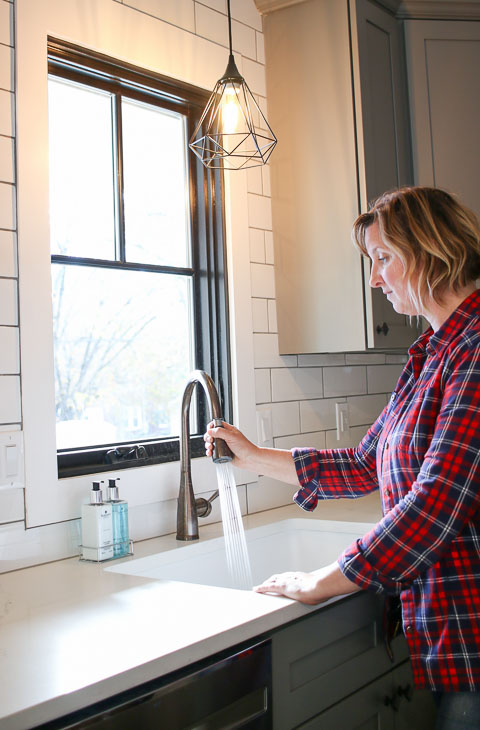
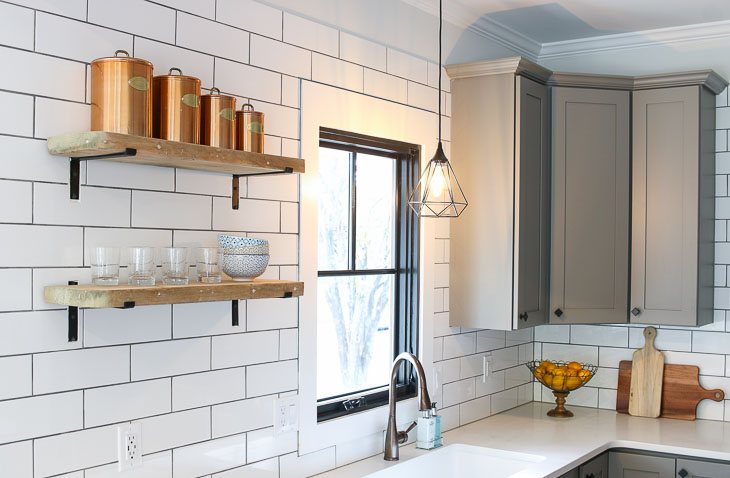
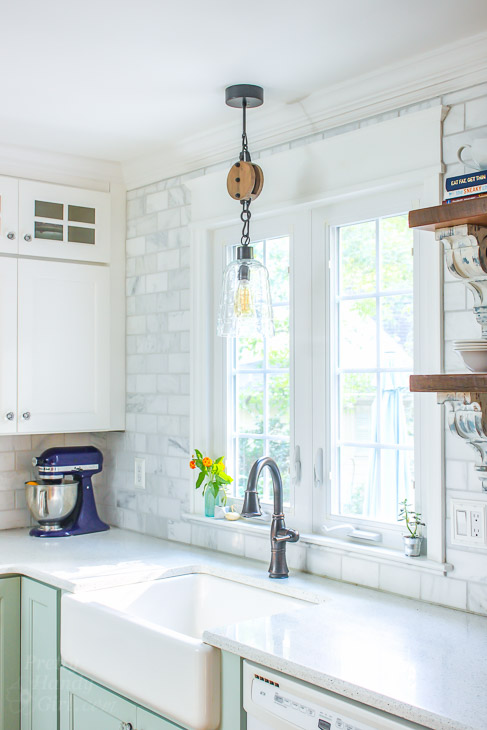
This kitchen sink, faucet, pendant light, and the window brought me joy, partly because they all lined up perfectly! Anyone who does kitchen renovations knows it can be hard to center all these elements with each other during the rough in stage without the cabinets or countertops in.

As I mentioned the other day, the pendant light was a swap I made after the first light wouldn’t cooperate. I took down the first pendant light and replaced it with this modern geometric pendant and pendant light kit from Lowe’s. I really like the open cage, no glass shade to clean!

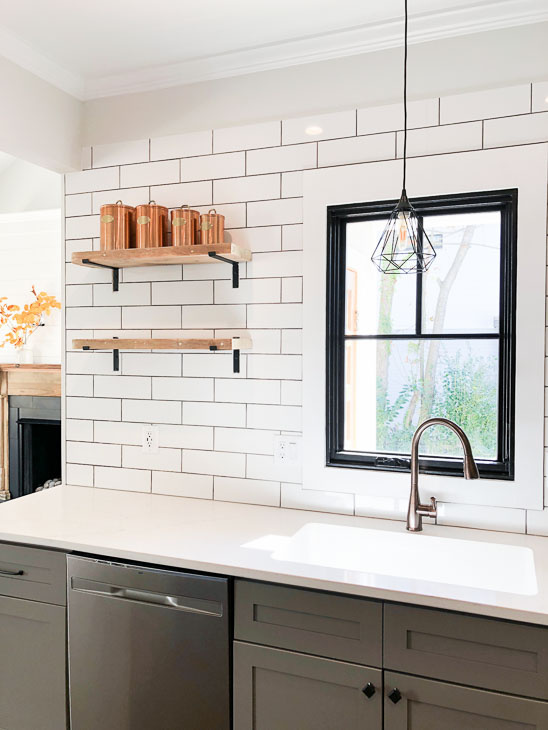
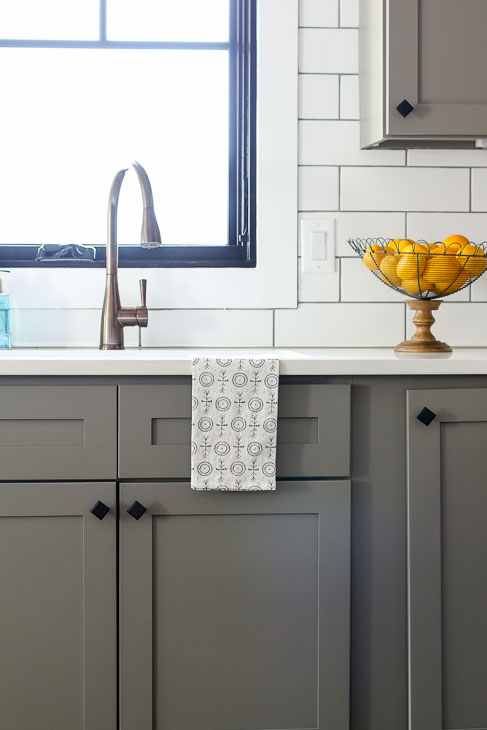
Plygem Mira black framed casement window over bronze faucet subway tile open shelving

The window is a Plygem Mira casement window. It has a folding hand crank for opening to let in fresh air, but the handle tucks neatly out of the way when not in use. All the Plygem Mira windows in the house operate smoothly and look gorgeous! Especially with the simulated divided light grilles. You can read more about the windows and how they are installed in a new construction house.

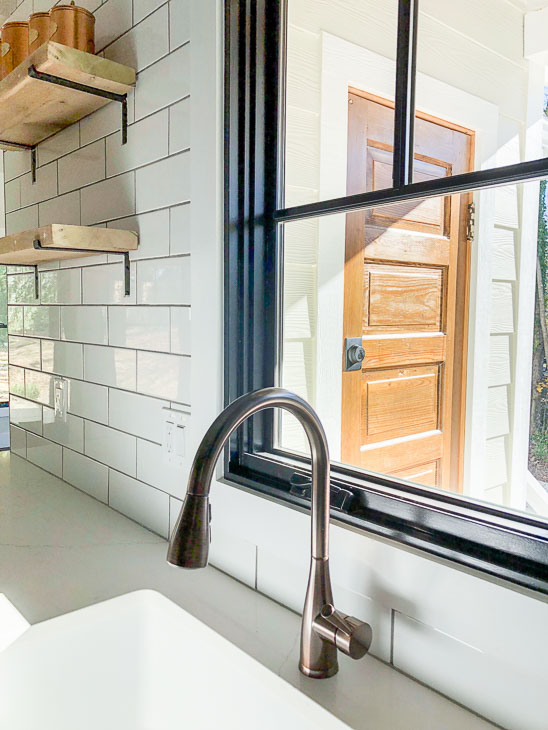
Plygem Mira black framed casement window over bronze faucet subway tile open shelving

Just outside the window is one of the reclaimed doors I saved from a series of 1890-1920 houses that were slated for demolition. Behind the door is a little shed off the side porch.  It’s nice being able to gaze on that gorgeous wood door while at the sink. Plus, the homeowners can see anyone pulling in the driveway from here.

PHG using Mirabelle kitchen sink sprayer

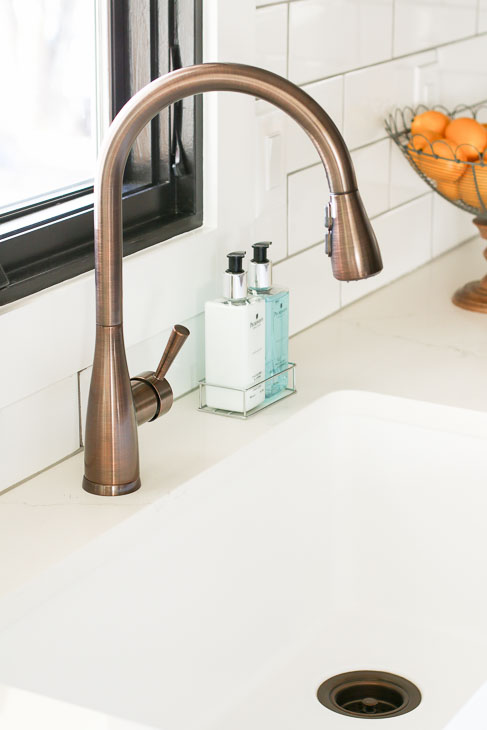
You may have noticed that beautiful faucet! It’s a: Mirabelle Calverton Pull Down Faucet in oil rubbed bronze. The finish on this faucet is beautiful and unlike anything I’ve seen before. Ferguson Bath, Kitchen, & Lighting Gallery stocks the Mirabelle line of kitchen and bath products (and provided the faucet and sink for the Saving Etta kitchen). If you’ve never been to a Ferguson showroom, you have to go! Especially if you are getting ready to remodel your kitchen, bathroom, or build a new house.

Mirabelle Faucet by Single Basin Sink

The sink is a Mirabelle Totten Single Bowl Granite Composite Sink (also available from Ferguson Bath, Kitchen, & Lighting Gallery). The granite composite is definitely a material I wasn’t familiar with. It has a very slight texture but looks like a cast iron farmhouse sink. Luckily it’s not as hard or as heavy as cast iron. Which makes it easier to install and more forgiving if you drop a glass or dish in the sink.

Plygem Mira black framed casement window over bronze faucet and gray cabinets

When I was finishing up the house, I was going to forgo staging and save some money. But, after seeing how pretty this kitchen was and how empty everything felt, I opted to hire a local stager. I discovered Minted Spaces on Instagram and immediately fell in love with Aryn’s design style. I knew her staging would appeal to a wide variety of buyers. In the end, they did a phenomenal job staging the Saving Etta house.

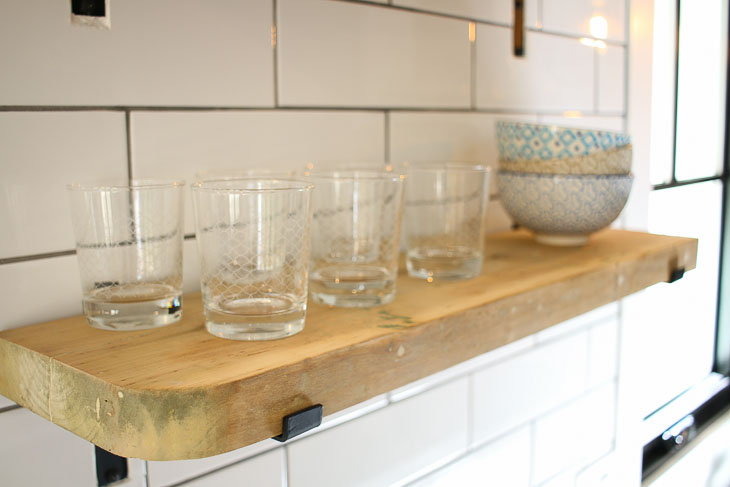
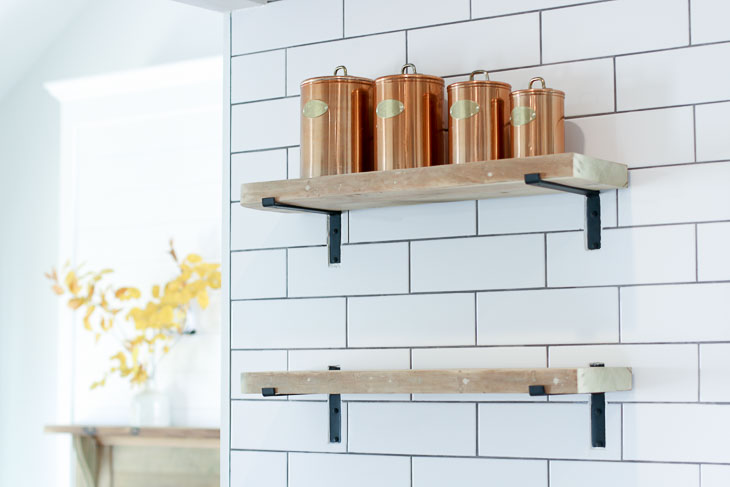
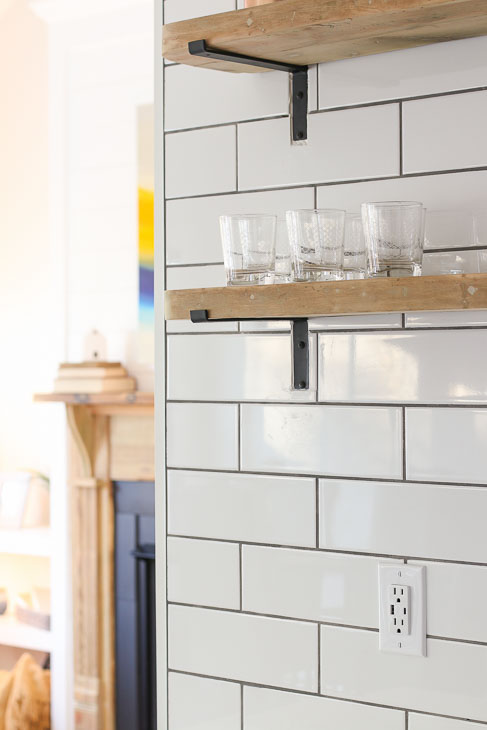
reclaimed lumber open shelving modern farmhouse style with glasses

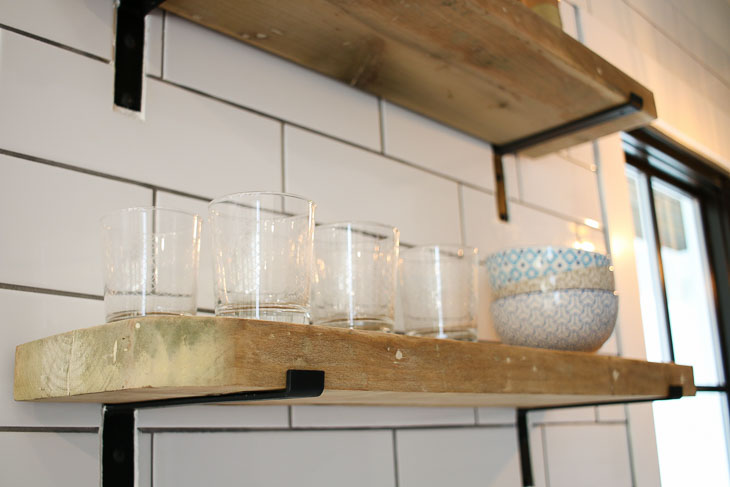
These open shelves aren’t just your random reclaimed lumber. Nay, they were made from the original mantel shelf! When I decided to salvage and re-use the 1900 mantle from one of the front rooms, I didn’t think about trying to purchase gas logs to fit inside the old mantel. Unfortunately once the fireplace was installed, I realized I needed to widen the legs to make it work.

reclaimed lumber open shelving modern farmhouse style with glasses

Luckily I work with a local salvage company who found some longer lumber to match the old mantel shelf. After we rebuilt the new fireplace mantel surround, I wasn’t sure what to do with the old shelf until I realized I could cut it in half and use it for the open shelving. At first I was going to round the cut ends, but decided to leave it because it helps tell the story of it’s origin. (You can see the re-built mantel in the background below.)

All together, I’m so happy with this area of the kitchen. It has the perfect blend of modern and aged rustic elements.

Open modern farmhouse shelves on subway backsplash

The Pantry

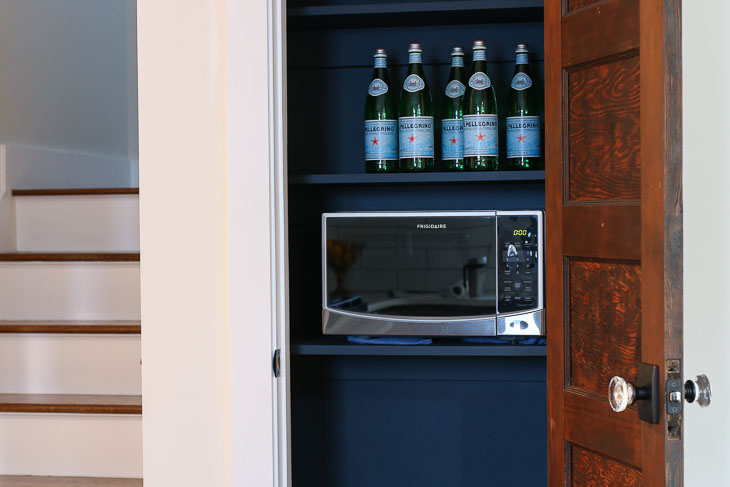
For some reason, I came up with the idea to paint the interior of the pantry black. It might have stemmed from my desire to do something different in there. Originally I thought about wallpaper, but I knew patterns are a personal preference, and one pattern may be loved by one person and hated by another.

When I saw photos of Blackboard from the new Magnolia Home paint line, I envisioned how the food labels and packaging would look in front of a dark background. The colors would stand out for certain! Although Magnolia Home partnered with me as the paint sponsor for the Saving Etta house, my last minute decision on the pantry color lead me to my local Ace Hardware to purchase a gallon of blackboard.

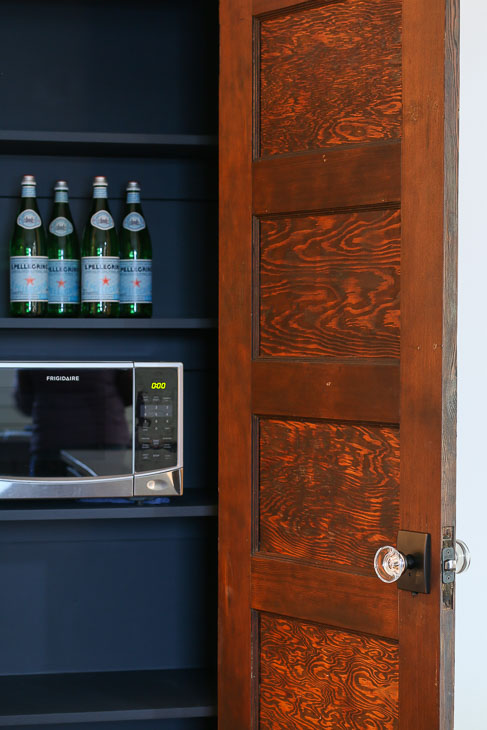
Pantry with Reclaimed door and microwave. Black walls

That’s how I found myself painting this little pantry Blackboard by Magnolia Home Paint. One concern I had was how durable the paint would be in the pantry. After cleaning off dirty finger prints and dings on the rest of the walls, I knew this paint could withstand a fair amount of scrubbing. But, I didn’t expect it to perform like this!

You may recognize that wood door as a twin of outside shed door. It was salvaged from the same house being demolished. For some reason this door has a much more unique wood grain on the panels than the shed door. At first I thought about covering up the grain, but the more I saw it the more I fell in love with the uniqueness of the lines.

Pantry with Reclaimed door and microwave. Black walls

We can’t forget the beautiful glass door knob. Did you think it was an antique knob salvaged from an old house? What would you say if I told you it’s brand new and you can buy these knobs for your house! Schlage was also a sponsor of the Saving Etta house and they provided me with those beautiful Schlage Hobson Glass Knobs with Century Trim.

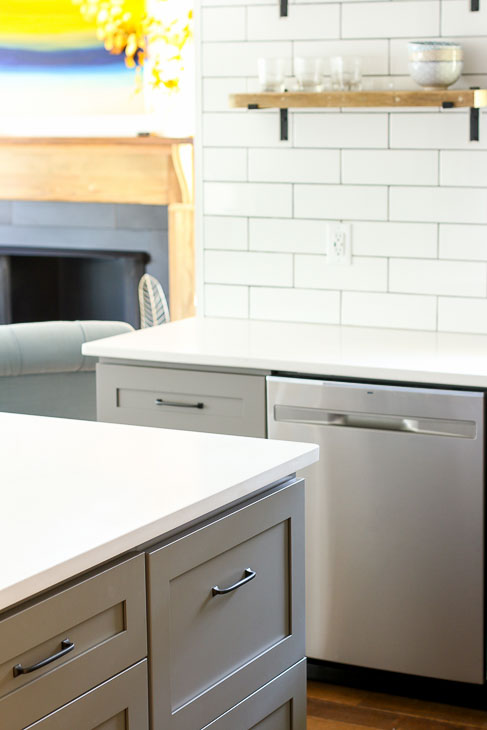
Gray shaker style kitchen cabinets and stainless steel dishwasher

The huge island in the kitchen was a must for this space. (And because I wish we had the room in our kitchen for a big island!) The side closest to the refrigerator has two cabinets with five drawers total.

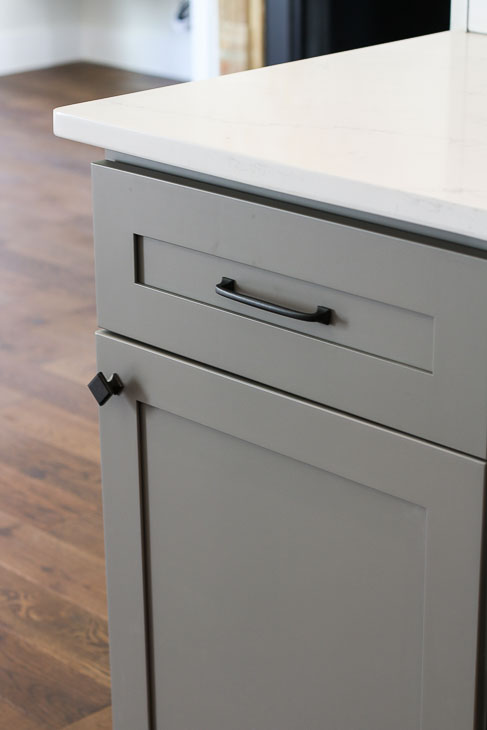
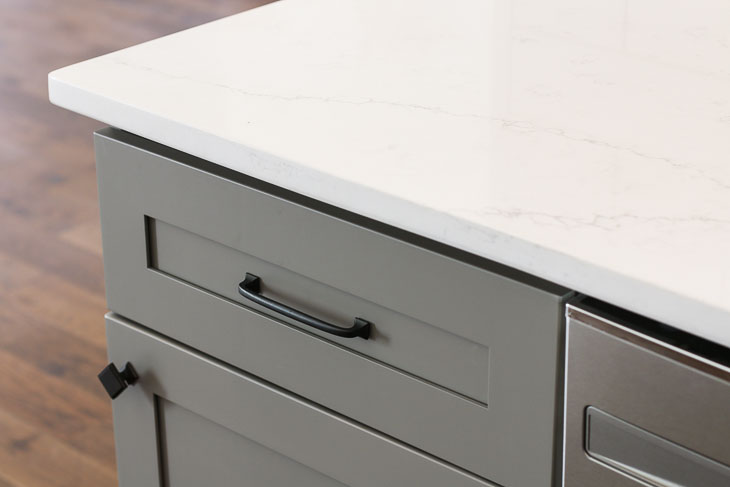
Liberty Classic Square and Lombard pull on gray shaker cabinet

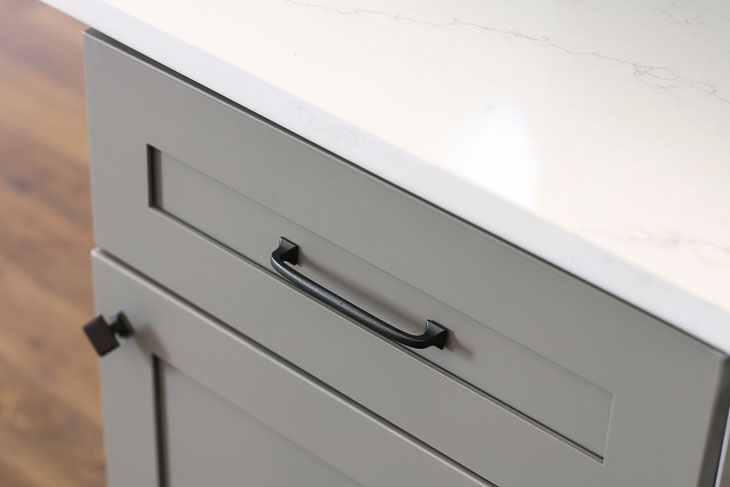
The cabinets have beautiful iron knobs and pulls. The Liberty Hardware Classic Square Cabinet Knob in Soft Iron are supposed to be installed as squares, but I turned them on an angle to reflect the diamond theme from Etta’s exterior. The Liberty Hardware Lombard Cabinet Pulls have the same soft iron color and a square end to match the knobs. I love how soft and sleek the pulls feel in your hand.

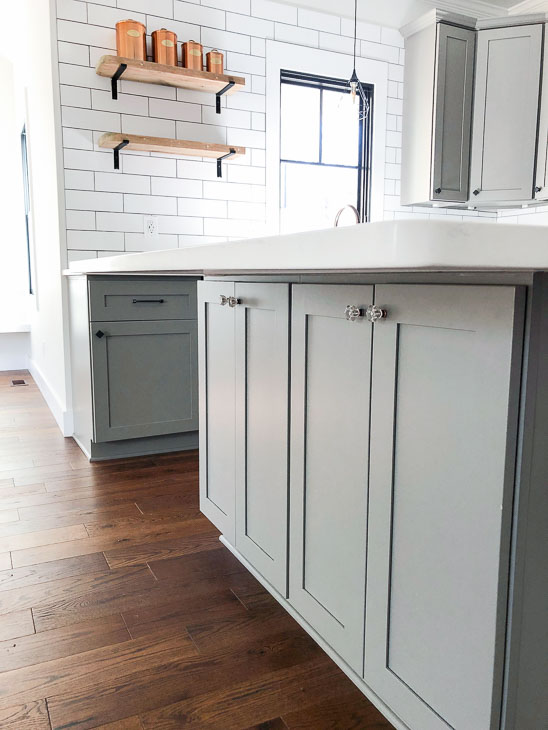
island cabinets on seating side

The other side of the islands has two more cabinets with shelves inside for extra storage. This side also has a one foot overhang for extra seating. I bought these cute Liberty Brand Acrylic Faceted Knob with oil-rubbed bronze and copper for a change from the rest of the cabinet hardware.

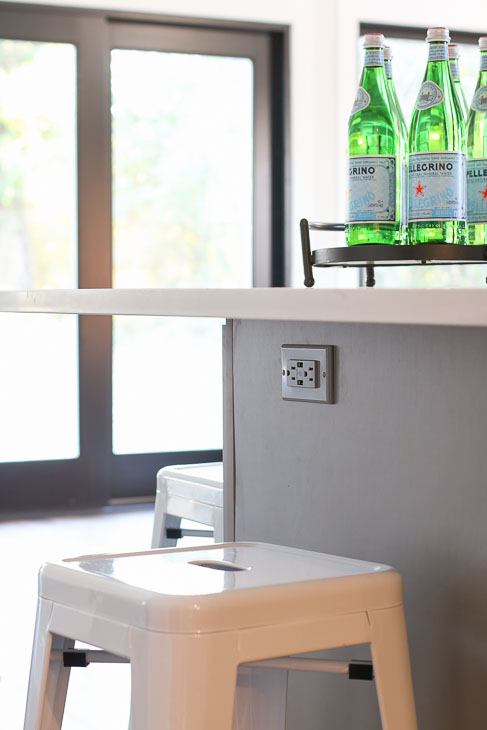
Leviton gray usb charging outlet in gray island

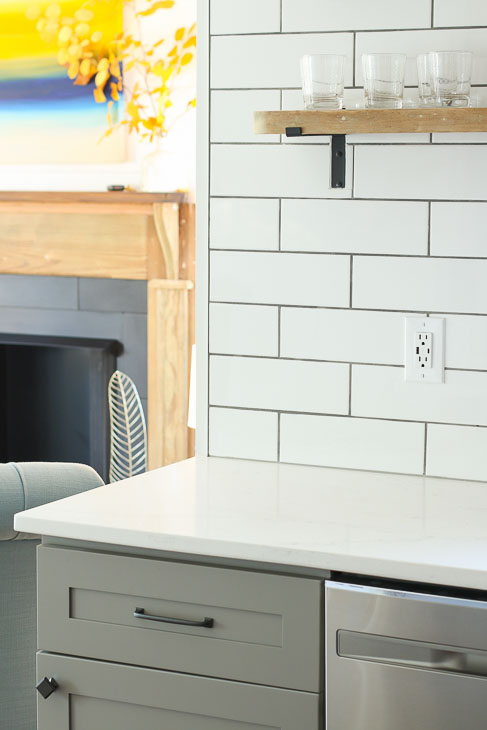
You might recall I installed this USB charging outlet in the side of the island. I love that Leviton has colors to match almost any wall or cabinet color you can dream of. You’ll notice the same outlet in white below.

White subway backsplash open reclaimed wood shelving

The countertops are Carrara Venatino Quartz from Cosmos. I love the look and how similar it looks to marble without the softness of real stone.

liberty lombard kitchen cabinet pulls and carrara quartz countertops

The larger scale Jeffrey Court 4 x 12 Subway Tile backsplash really makes this space in my opinion. They are classic but also modern. The white tiles provide a nice contrast against the gray cabinets.

Subway tile backsplash, gray shaker cabinets, stainless steel range hood from Broan

The light fixture over the island is from Houzz. I’m not going to link to it, because frankly I’m not very pleased with the quality and it was a pain to install (remember I had to go hunt for the parts.)

Beautiful modern farmhouse reclaimed open shelves subway tiles and carrara quartz countertops

The Impressions Hardwood Collection Elegance Series wood floors throughout the house are beautiful! They are the real deal, solid white oak floors with wire brushing to give them an aged look. You can find out more about the wood floors in my post about why I couldn’t save the original flooring.

I am proud of how the kitchen turned out. I poured a lot of thought and effort into the design and tried to envision how the kitchen would function for future homeowners.

Modern Farmhouse Kitchen in a 1900 historic house

I hope the kitchen reveal was worth the wait. What did you think? Do you like the fixtures I chose or if not what would you do differently?

Kitchen Sources:

A huge shout out to all the brands who sponsored the Saving Etta project and helped me turn this ugly duckling…

Saving Etta - One Woman's Journey to Save a House Built in 1900 | Pretty Handy Girl

…into a beautiful swan again.

saving etta beautiful restored 1900 house near downtown Raleigh

I hope you will consider using some of the sponsoring brands when you are ready to take on a new kitchen, bath, or renovation project in your home.

Which were your favorite elements in this beautiful kitchen?

signature

Disclosure: I received materials and/or compensation from the sponsors of the Saving Etta project. These were the kitchen sponsors: Plygem, Broan-Nutone, Impressions Hardwood Collection, Leviton, Schlage, Magnolia Home Paint, KILZ, Jeffrey Court Tile, Liberty Hardware, and Ferguson Bath, Kitchen & Lighting Gallery. I was not told what to write. All opinions and words are my own. As always, I will notify you if you are reading as sponsored post or if I was compensated. Rest assured I am very particular about the brands I work with. Only brands I use in my own home or that I’ve had a positive experience with will be showcased on this blog.

Saving Etta: Kitchen Tile UpdateSaving Etta: Installing the Tile Backsplash & a Mistake I’ll Never Make Again
Last week you got to see how the range hood was installed (and how I averted disaster during the installation.) Today I’m sharing more kitchen updates. We’re going to dive into tiling a backsplash and one mistake I’ll never make again.

Before we get started, I want to give a big shout out to my sponsors! These brands came together to help me save Etta and I am incredibly grateful.

(I’ve included affiliate links for your convenience. I earn a small percentage from a purchase using these links. There is no additional cost to you. You can read more about affiliate links here.)

After hiring tile setters to lay the bathroom and mudroom floors, I chose to save some money by tiling the backsplash myself. After all, I consider myself fairly experienced at installing backsplashes after I tiled three walls in my own kitchen and wrote a tutorial to help you learn to tile.

Fall Decor in a Rustic Farmhouse Kitchen | Pretty Handy Girl

Light Fixture Installation Woes:

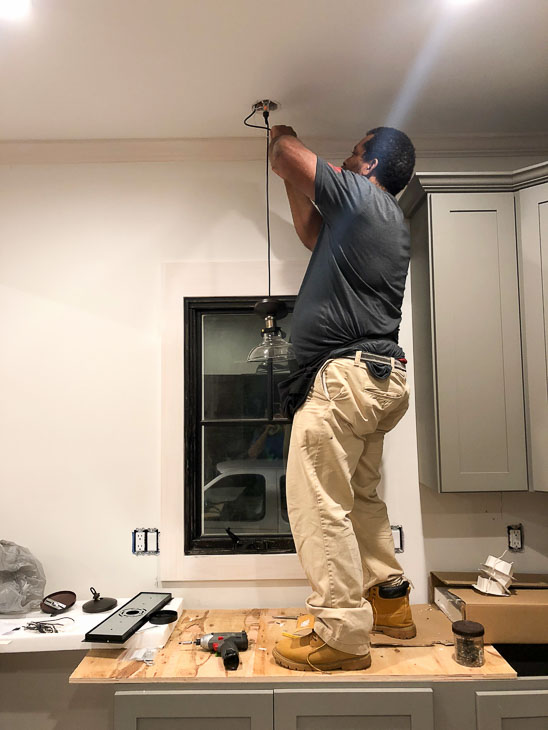
Shortly before tiling, my electrician joined me late one night to finish installing the light fixtures in the kitchen. My sons and I had already installed all the recessed can lights. But, I let my electrician handle the remaining fixtures. Especially because I was on a tight deadline to get the house finished and on the market before the holidays.

electrician hanging pendant light

This guy standing on plywood at 9pm at night, is my knight in shining armor. Harvey has been my electrician for over six years and he’s helped me solve electrical problems on multiple occasions.  The thing I love most about him is he always pushes me to take on the smaller electrical projects myself. When I wanted to hire him to install a switch for an automatic door activated light in our pantry, he explained the process then left me with these parting words, “Call me if you get stuck.”

Most light fixture installations are straight forward and simple, but we had several issues with the lights I ordered for the Saving Etta house. One of them was missing parts to attach the hanging hardware to the canopy that attaches to the ceiling box. Harvey sent me to a nuts and bolts store. I kid you not, it was an obscure hardware store I never knew existed in Raleigh. Walking through the door, was like walking back in time. Picture Michael J. Fox stepping into the soda shop in Back to the Future. The gentleman working the counter looked at my light fixture parts and started searching through aisles of fasteners, nuts, bolts, screws, and who knows what else. Ultimately he found a nut that would work for our light. Hallelujah.

The gentleman took my credit card and I nearly laughed as he ran it through one of the old carbon copy credit card machines. If you’re too young to know what this is, I leave you this video for your education. For the rest of us, enjoy a trip back in time.

Back at the house, Harvey had finished installing the pendant light over the sink. But, something looked off. The pendant shade wouldn’t hang level no matter what we tried. Ultimately, I took it down and replaced it with a modern geometric pendant and pendant light kit from Lowe’s. In my opinion, the light is perfect for the modern farmhouse look I was envisioning for Etta.

Plygem mira window with facet pendant light and subway tile

Countertops:

After the cabinets and range hood were installed it was time to call the countertop fabricators. The owner arrived and took measurements, then he sent me to look at slabs in the local granite and stone warehouse. I took my youngest with me and we watched in awe as a huge robotic arm lifted giant slabs of quartz and granite for customers to view. You can join us as we are looking through the slabs in my Facebook Live video:

Can I share something with you? I’m not a big granite fan, although I saw some amazing slabs at the warehouse. Instead of granite, I chose a marble looking quartz. The quartz is called Carrara Venatino from Cosmos. I think Cosmos has it manufactured especially for them. If you like the countertops, you can see if there is a Cosmos distributor near you.

Liberty Lombard - cabinet drawer pulls

The countertops are one of my favorite finishes in the kitchen. I almost wish I had used them in our own kitchen instead of the recycled glass quartz countertops. My only complaint about the Carrara Venatino is it tends to scuff easily. Belt buckles and rivets leave gray lines that look almost like pencil marks on the edges. It’s not a huge deal as they seem to wipe off with a rag and some cleanser.

Tiling the Backsplash:

The backsplash turned out beautiful and definitely attracted a lot of attention in this open concept kitchen. I used Jeffrey Court 4″ x 12″ white subway tiles from Home Depot. The subway tiles have a timeless classic look and the larger size meant the install was a little faster than standard 3×6 subway tiles.

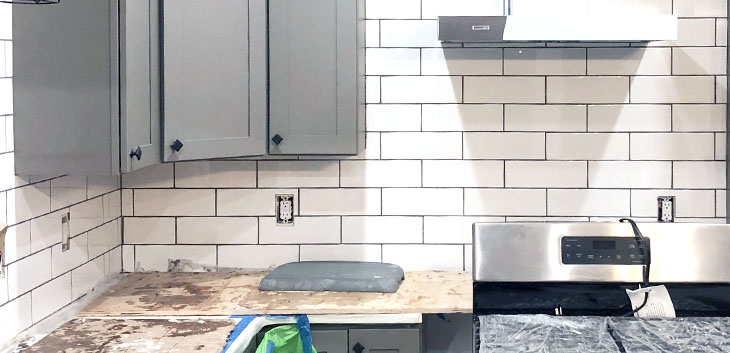
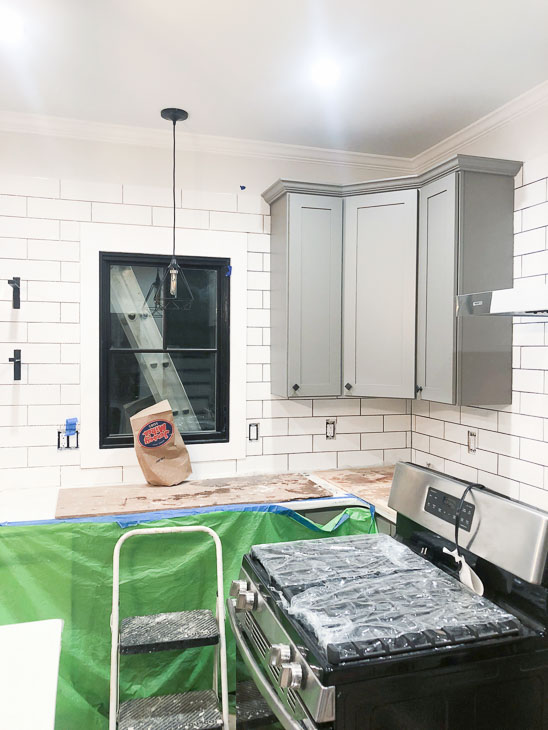
subway tile backsplash being installed

There were two particular evenings I stayed crazy late. I had to bust my butt to finish the tiling. Pretty Handsome Guy came one night to help, and brought Jersey Mike’s for dinner (see if you can spot my ingenious use of the trash as a faucet cover). The hubby got a crash course on using the wet saw and after about a dozen practice cuts, he finally got the hang of cutting tiles. (He still has to pick up some more skills before he can have the name Pretty Handy Guy. Have I mentioned he’s not the handy person in this marriage?) But, without his help I might still be tiling that backsplash! (Okay, that might be a bit of an exaggeration.)

Tiling can be a solo job, but it really helps to have one person cutting the tiles and the other one setting them. Especially because the thinset will eventually harden. At least the hardening process was slowed by the cold temperatures inside the house and out. (We still didn’t have the gas hooked up for the heat yet.)

The second night I worked by myself until about midnight. By the time I left, I was cold, tired, and sore. Climbing up and down on top of countertops is tough work. But, also rewarding as you can see by this progress after the first evening.

installing subway tile with spacers

Installing Open Shelf Brackets:

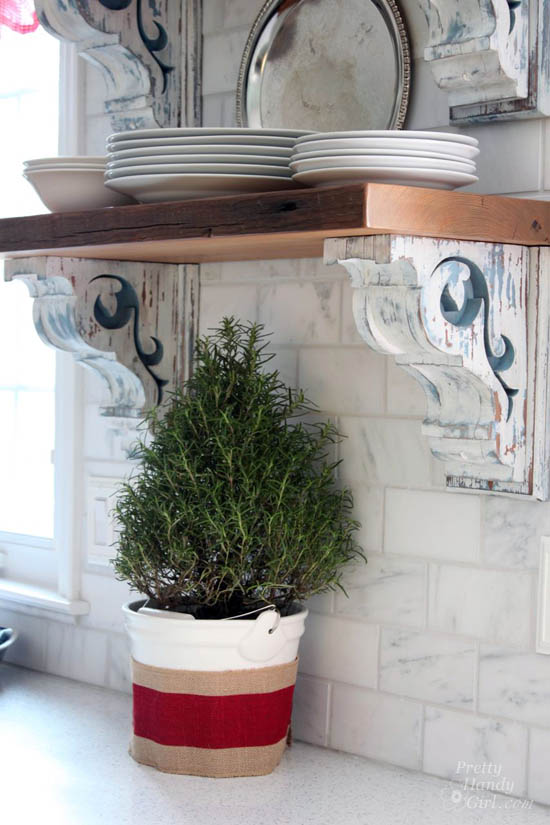
Having open shelving in the Saving Etta kitchen was a no brainer. In my own kitchen I have two open shelves and I love them! For my shelves, I installed corbel shelf brackets after the tile was installed.

DIY Aged Chippy Paint Technique | Pretty Handy Girl

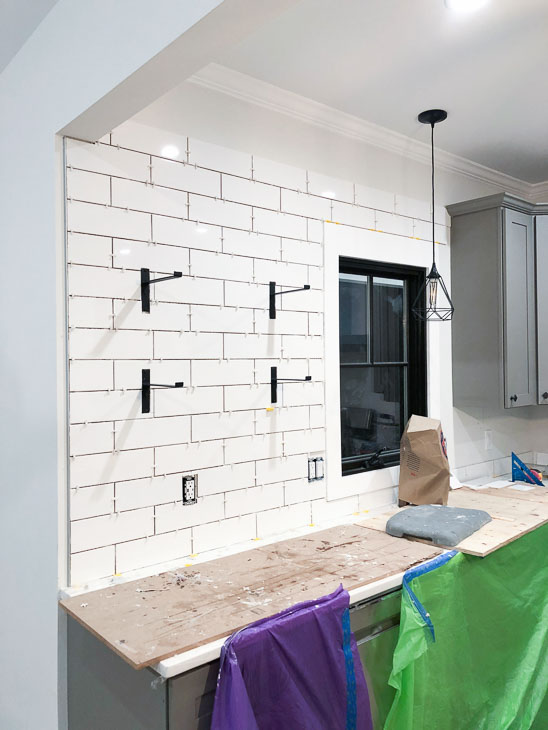
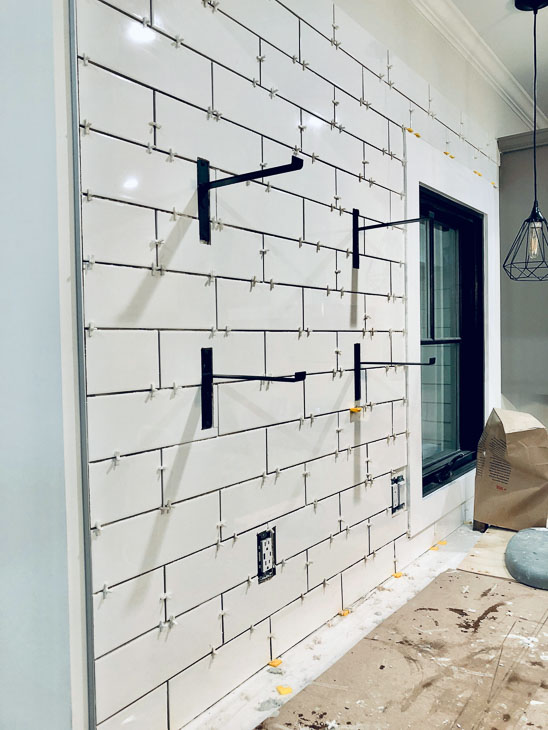
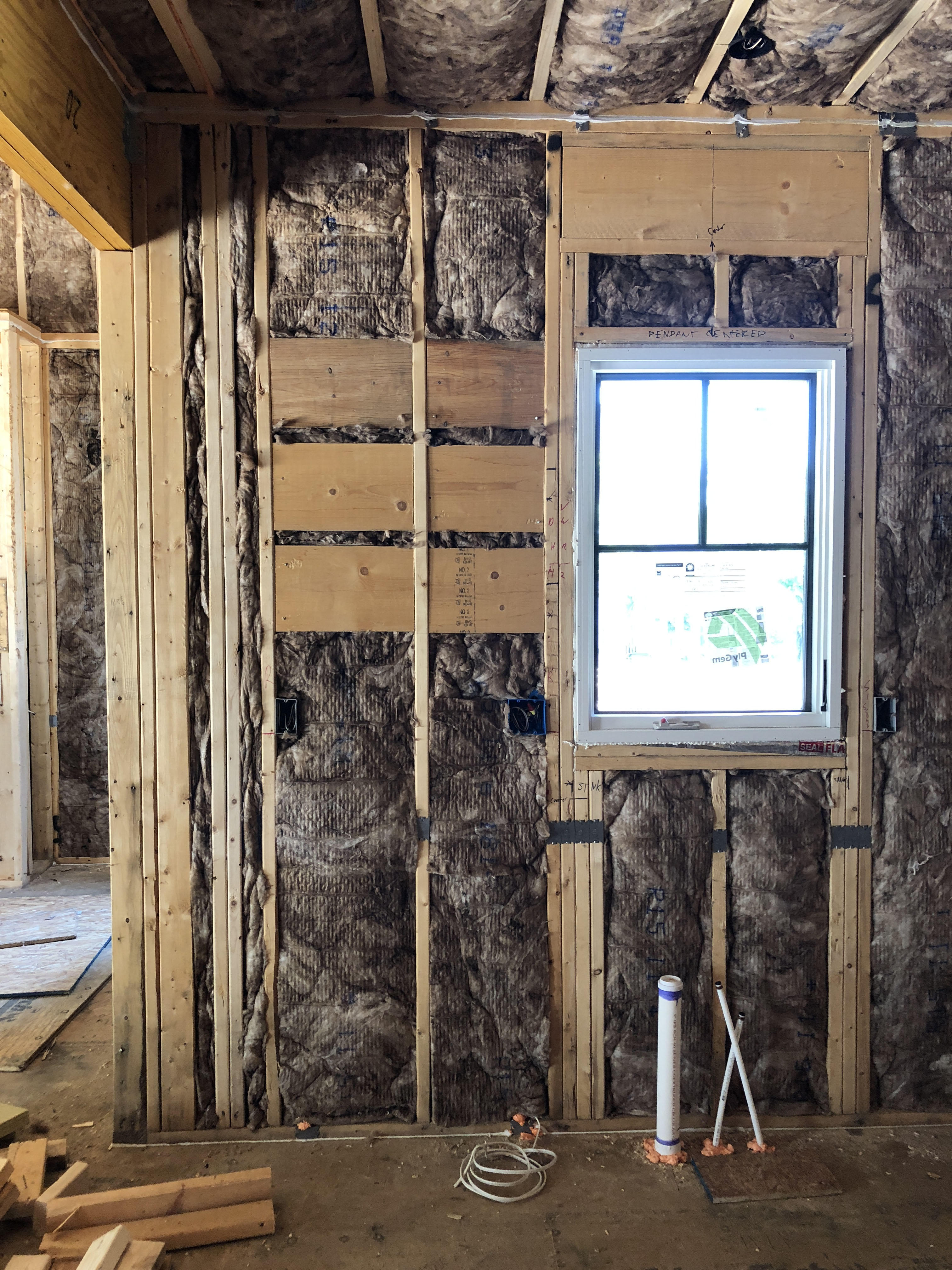
I was planning on doing the same at the Etta house. But, shortly before tiling I stumbled across a tile setter on Instagram who had installed the shelf brackets before tiling. Thinking this guy was a professional and knew what he was doing, I decided to try doing the same thing. After all, it would be easier to locate the studs and blocking before tiling. Truth be told, I had added blocking in the wall where the shelves were going to be mounted, and took a picture before the drywall was hung. (Smart, right?!)

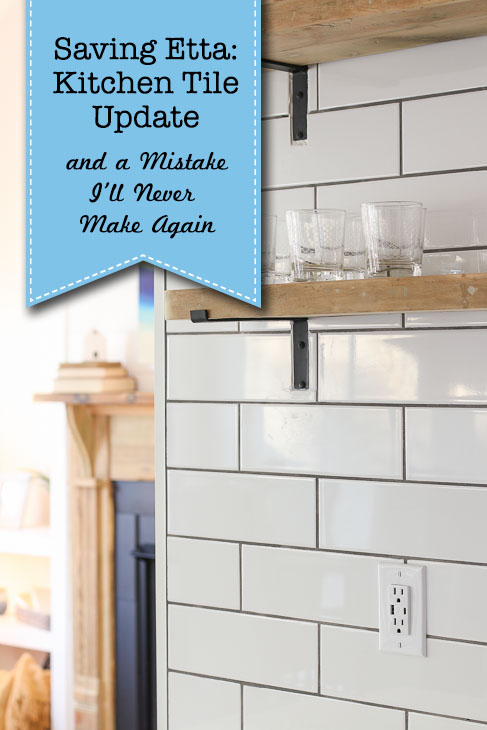
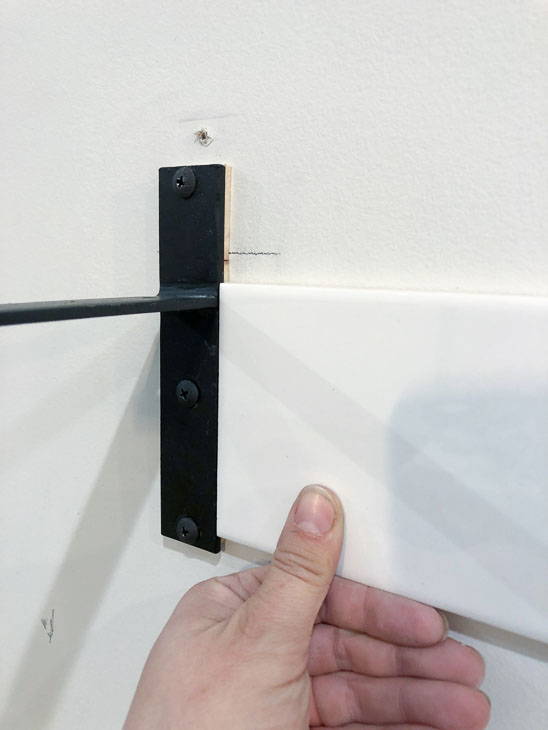
Continuing my claim of having smart ideas, I decided to put a paint stick behind the shelf bracket before securing it to the wall. This would insure the bracket would be at the same depth as the tiles. In theory it seemed like a good idea. Can anyone guess what my mistake was?

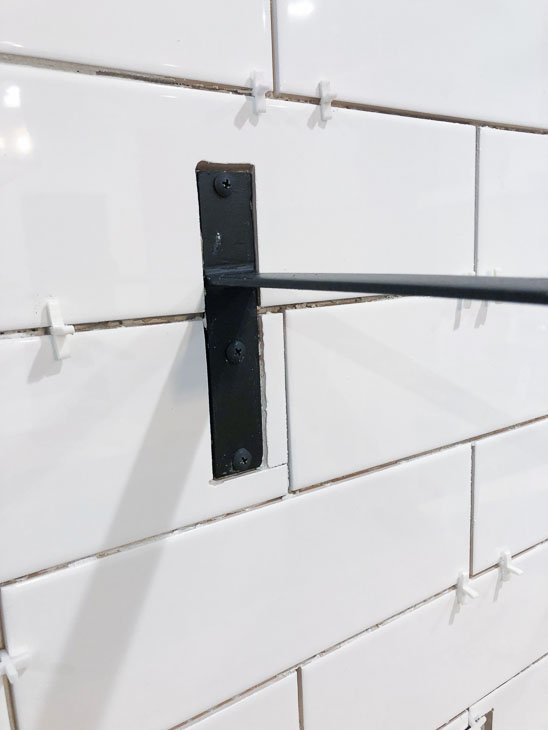
Subway tile next to shelf bracket

There were actually two issues. The first was I failed to allow for mortar thickness. Depending on the size notched trowel you use, the thinset can add anywhere from 1/8″ – 1/4″.  I guess I can be thankful at least I put something behind the brackets or they would have been horribly recessed.

It wasn’t until I began grouting that I realized the second issue with installing the shelf brackets first: sloppy cuts.

tile around shelf bracket

Cutting tiles is not like cutting wood. Where it’s fairly easy to cut shapes in wood, it’s not that easy with tiles. Making perfect 90˚ cuts into tile is tough. As you can see above, I had one tile that needed to be notched. The small leg on the right kept breaking. So I ended up piecing the tile around one of the brackets.

Next came the challenge of grouting around the brackets. After much mental exercise, I chose to put white caulk around the brackets to minimize the cut lines. The caulk hides some of the imperfections, but it still bugs me that they don’t look perfect. In DIY, there are plenty of opportunities to be creative and it also provides plenty of learning opportunities.

I will never make the mistake of tiling around brackets. Next time I will tile first and install the shelf brackets afterwards. (In case you are wondering, these are the brackets I used. They are sufficiently strong to hold shelves with glasses and dishes, but I wouldn’t use them to hold super heavy items like hand weights.)

The next day I finished tiling around the range hood and was able to grout the wall with the open shelves (but needed to wait for the newly set tiles to cure overnight.) By the end of day three I had completely tiled and grouted the backsplash!

counter protected while installing shelf brackets

Despite the few cut tiles around the shelf brackets, I am pleased with the backsplash. I’m keeping you in suspense with the rest of the kitchen reveal until Friday. But, here’s a close up of the tiling around the brackets. It looks okay from a distance, which is all that really matters, right?

White subway backsplash open reclaimed wood shelving

Stay tuned, the next Saving Etta update will be the full kitchen reveal and I can’t wait to share it with you!!!

Disclosure: I worked with Jeffrey Court for Home Depot on this project. I was provided with the subway tiles for the kitchen backsplash. I will always let you know if I was sponsored or compensated. You should also note that I’m very particular about the brands I work with.

Avington Black & White Cement Tiles from TheBuilderDepot.com

Step-by-step installation guide to install cement tiles and handle intricate designs like a pro. Get expert results for any space!

close up of black and white cement tiles

How to Install Cement Tiles

If you’ve been browsing Pinterest lately or flipping through the pages of your favorite home design magazine, you’ve probably seen (and likely fallen in love with) real cement tiles.

Cement tiles are trending, so much so that porcelain tile and ceramic tiles look alikes are popping up at most tile retail shops.

The first thing you’ll notice about real cement tiles, is the price tag can be steep.

What you probably don’t realize is cement tile can be a bit trickier to work with than standard ceramic or porcelain tiles.

Don’t let this dissuade you, because today I’m going to show you how to install those beautiful authentic cement tiles and achieve professional results.

Plus, because we’re friends, I’m going to share with you my affordable source for real encaustic cement tile options.

Cement Tile Look Alike on Bathroom Floor

Cement tiles purchased from most tile retailers can run upwards of $20 per square foot. But, I’m about to let you in on my secret tile source.

Shhhh, lean close so I can whisper it in your ear. “TheBuilderDepot sells real cement tiles for less!”  In fact they sell more than just cement tiles and their prices can’t be beat!

You might remember I used beautiful marble subway tiles from TheBuilderDepot when renovating my kitchen floors .)

The Builder Depot offers popular tiles at a discount because they cut out the middle man. (Here’s a brief explanation on why their prices are lower than other retailers.)

How to Install Cement Tiles and Achieve Professional Results

Seeing those beautiful cement tiles and a great price prompted me to contact my friend at The Builder Depot and ask him about being a Saving Etta sponsor.

He agreed but on one condition; he asked me to write a tutorial on How to Install Cement Tiles and discuss the pitfalls and risks associated with improper installation techniques.

Apparently customers were unaware of the proper way to install cement tiles.

In fact, even seasoned tile installers were making costly mistakes because they were treating cement tiles like natural stone, or ceramic and porcelain tiles.

Both come in a wide selection of intricate designs, but there is a big difference between them.

Cement tiles make perfect choices for a kitchen backsplash, bringing unique character and timeless style to any space.

Their handcrafted appeal makes them a favorite among high-end retailers and design professionals.

What’s the Difference Between Cement Tiles and Porcelain or Ceramic Tiles:

  • Ceramic and porcelain tiles are slick (often shiny) and aren’t absorbent on the surface.
  • Encaustic tiles are highly porous and absorbent from the surface to the base.
  • Porcelain and ceramic tiles can be grouted immediately after the thinset mortar has cured.
  • Cement tiles must be sealed before grouting or you risk the grout staining (or permanently sticking to) the surface.
  • Porcelain and ceramic tiles do not need to be sealed.
  • Cement tiles need careful handling to avoid staining and scratching the tiles.
  • Porcelain and ceramic tiles are forgiving and can stand up to a lot of abuse.
  • Encaustic cement tile patterns are created by pouring different colored clay baked into the tile. It’s not merely a coating.
  • Porcelain and ceramic tile patterns are applied in the glazes (painted on top of the tile).

Here’s a beautiful video showing exactly how encaustic cement tiles are made:

Now that you know more details about cement tiles, you can have a beautiful cement tile floor or install them as a wall tile.

But, you need to follow this tile project tutorial closely. (Almost all these instructions will apply to installing cement tiles on a wall, so keep reading.)

Making Manzanita's tile shower niche cement tiles

Check out this beautiful bathroom makeover with a Cement Tile Niche
by Making Manzanita

How to Handle Your Cement Tiles:

The most difficult part is choosing your desired pattern! There are so many gorgeous styles. You can even include a focal point piece to add to the center of the floor or wall.

Once you receive your cement tiles you’re going to be tempted to rip open the box and rub your grubby hands all over the smooth tiles (or am I the only weirdo that likes to stroke tiles?)

Regardless, before you open the box, wash your hands. Cement tiles are EXTREMELY porous and will absorb oils and stain easily.

Until you get to the sealing step, you’re going to have to handle these tiles with care (kid gloves wouldn’t be a bad idea.) Lest you think you can seal the tiles before installation, don’t try it.

The tiles have to be porous to release moisture while the mortar is curing. If you seal it ahead of time, there’s a good chance your tiles will develop a ghosting appearance.

Cement tiles can scratch easily. For best results, keep the packing material between the tiles until you are ready to install them.

Don’t mark your tiles with a pencil or pen for cutting (unless you will be cutting off the marks.) Even faint pencil lines can’t be easily removed from the tile surface.

How to Prepare Your Floor for Cement Tile Installation:

(I’ve included affiliate links for your convenience. I earn a small percentage from a purchase using these links. There is no additional cost to you. You can read more about affiliate links here.)

Just like when you paint a room, you’ll get the best results if you take the time to prep your space before you begin.

Before laying tiles on your floor, you must put down a substrate to prevent future flexing that can lead to cracks in your grout or worse in your tiles.

Typically tile installers will use cement backer board. But, because the cement tiles are so thick, I chose to use an uncoupling mat to reduce the finished floor thickness.

cutting uncoupling mats.

Measure and cut your mat (or cement board) with a utility knife. Dry fit the mats (or boards) before proceeding.

Whichever substrate you use, be sure to follow the manufacturer’s installation instructions. 

For improved waterproofing, you’ll want to cover seams with the recommended seam tape.

For completely waterproofed floors, add seam tape around the perimeter of the room (as shown in this video.)

Installed uncoupling mats, finding center of room. Marking perpendicular lines.

Next find the center of your room and mark perfectly perpendicular guidelines to use as a guide when laying out your tiles.

Layout cement tiles starting in the center.

Dry fit the tiles with spacers in your room before you begin. Make any adjustments to the tile layout or pattern before you begin.

Dry run. Layout cement tiles before installation

How to Install Cement Tiles:

With your substrate installed, it’s time to install your tiles. Before we begin, make sure you have these tools and materials.

A quick note on cutting the tiles. You can use a score and snap manual tile cutter for straight lines, but nothing beats a wet saw for angled and more complicated cuts.

If you don’t want to buy a wet saw, you can rent one. Tile setting is a one person job, but it helps to have an assistant to speed things along by making cuts and mixing more mortar and grout.

Materials:

Instructions for Installing Cement Tiles:

Here’s a video I made to help you learn how to install cement tiles properly and keep them looking beautiful!

Mix your thinset mortar according to the package directions. (I usually try to achieve the consistency of peanut butter.)

Prepping Your Cement Tiles:

One of the most important tips for working with cement tiles is to soak them in water before installation. Allow them to soak for at least 30 seconds before laying them into the mortar.

If you don’t soak them, the tile will absorb too much moisture from the mortar.

Soak tiles in water tub

Starting from the center of your room, apply the thinset mortar to a small area and use your 1/2” notched trowel to comb the thinset.

Lay your tiles down. Lift one tile to check and see if the mortar is completely covering the back of the tile. If not, your mortar consistency may be too dry.

Avoid the temptation to lay more than a few tiles at a time.

Lay first four tiles in thinset mortar

After your first small group of tiles are set, insert spacers. Check to make sure the tiles are level and the same height.

Then immediately clean any and all thinset off your tiles using a damp sponge.

Now you can move on to installing the next small grouping. Periodically check to make sure your tiles are lined up with each other and there are no lips between tiles. (Using these self leveling spacers will eliminate any lippage on tiles.)

After all your tiles are installed, block off the room and keep off the tiles for at least 24 hours while the thinset hardens.

How to Install Cement Tiles and Achieve Professional Results

Sealing Cement Tiles:

We’ve arrived at the most important step when installing cement tiles! You must seal the tiles before grouting them. Use a penetrating sealer made for porous stone or cement tiles.

Before sealing, make sure your tiles (and the thinset for that matter) are completely dry.

You can test the tiles for any remaining moisture by laying down a piece of plastic on the tiles after installing them.

If there is moisture the next day when you lift the plastic, they aren’t dry enough. Wait for them to dry or you could risk discoloration of your tiles.

Clean the tiles by sweeping off any debris and clean with a ph balanced cleaner (a bucket of warm water with one drop of dish soap is a good cleaner.)

Let the tiles dry. Wipe or buff with a rag.

Pour the sealer into the dish pan. Dip your pad applicator into the sealer liquid. Squeeze off excess sealer against the edge of the dish pan.

Apply sealer with pad applicator

Apply the sealer in thin coats working in one direction. Remove any excess sealer from the tiles BEFORE it dries. (See the streaks below?

Those streaks and any puddling needs to be buffed off to avoid uneven drying.)

Avington Black & White Cement Tiles from TheBuilderDepot.com

Let the first coat of sealer dry completely. In fact you may want to take a break for 30 minutes or so between coats.

Buff off excess sealant from tiles.

Be prepared to apply many coats before your cement tiles are fully sealed. (My tiles needed 5 coats to seal them. Then I had to wait another 24 hours for the sealant to fully cure before grouting.)

It may seem like a long process, but this insures the tiles will withstand regular use and resist stains.

After each coat of sealant dries, you need to test to see if the cement tiles are completely sealed. Drip water onto the tiles.

If the water beads up, they are sealed. However, if the water absorbs into the tiles, add another layer of sealant and try the water test again later.

Water beading up on cement tiles means it's ready to grout.

Once your tiles are fully sealed, wait 24 hours before grouting.

How to Grout Tiles:

Because I work alone, it takes me a little longer to grout. To prevent my grout from hardening too quickly, I like to float my mixed grout container in a bucket of ice water to slow down the setting action.

Load up your float with fresh mixed grout. Holding your grout float at a 45 degree angle against the floor, spread the grout over the gaps between the tiles in a diagonal motion.

Work in small 3 – 4 square foot areas. Then scrape any excess grout off the tiles using a clean grout float.

grouting tiles with grout float

Immediately wipe off any excess grout using a clean damp sponge. Ring out and refresh your sponge with clean water frequently.

It is imperative to get all the excess grout off the tiles or you risk the grout staining or settling into the tiles.

Go ahead and move on to the next section, but go back to the previous tiles and buff off any haze with a dry rag.

Avington Black & White Cement Tiles from TheBuilderDepot.com

After the grout has cured, clean your floors with a pH neutral mild cleanser. Then apply one final coat of penetrating sealer.

A new coat of sealer should be reapplied every 6-12 months for floors, and every 2-3 years for wall tiles.

Avington Black & White Cement Tiles from TheBuilderDepot.com

Cement Tile Maintenance:

To protect your beautiful cement tile floors, clean up any spills immediately. Never leave anything sitting on the floor that could stain or scratch your tiles.

If your tiles get scratched or stained, you can use a fine grit sandpaper to sand off the stain on the surface of the tile. Just be sure to re-seal your tiles after sanding.

Still on the fence about installing cement tiles in your home? This is a good article breaking down the pros and cons of cement tiles.

A big thank you to The Builder Depot for providing the laundry room tiles for the Saving Etta project and for giving me excellent instructions for installing the cement tiles.

What do you think? Do you love the cement tile look? They really add unique character to a home and are the perfect solution for modern kitchens and other high-traffic areas.

Laundry Room with Avington Cement Tile Floor.

I hope you found this tutorial helpful. Happy tiling!

How to Install Cement Tiles and Achieve Professional Results

PIN FOR LATER:

cement tile with text

Disclosure: The Builder Depot is a proud sponsor of the Saving Etta project.  I was provided with materials for this project. I was not told what to write. All opinions and ideas are my own.

 If you haven’t done so already, be sure to *subscribe to my YouTube channel!

Subscribe to my YouTube Channel

*My followers on YouTube get sneak peeks of some of the projects I’m working on, so subscribe today!


If you liked this post, you’ll also find these tile posts helpful:

How to Install Cement Tiles and Achieve Professional Results

How to Tile a Backsplash


How to Install Cement Tiles and Achieve Professional Results

How to Grout Tiles

How to Install a New Window

Installing new windows on your home isn’t rocket science, but it is recommended that you have some construction experience before tackling this project. If you have the skills, the install should only take an hour or less. Today I’ll show you How to Install a New Construction Window in your home.

How to Install a New Window

Installing a New Construction Ply Gem Mira Window:

If you read my article on ordering new windows, you’re probably ready to install that new window. Today I’ll take the mystique out of this process. To install new windows (as opposed to replacement windows) you need to start with the correct rough opening. Ply Gem makes it super simple to figure out the rough opening size for your new window with their downloadable window size guides(This is a sponsored post in collaboration with Ply Gem Windows.) 

After your rough openings are cut and ready, it’s time to gather a few supplies.

Materials:

(I’ve included affiliate links for your convenience. I earn a small percentage from a purchase using these links. There is no additional cost to you. You can read more about affiliate links here.)

Instructions:

Check that the rough opening is level and plumb. If it isn’t, have some wood shims nearby to help adjust the window after it is set in the opening.

level and plumb rough opening

Cut the first piece of flashing tape slightly wider than the window width. Peel off the backing and attach it one inch below the window opening.

window rough opening

Cut a second piece of flashing tape about 8″ wider than your window opening. Center it on the sill of the window opening. Line up the inside edge of the tape along the inside of the framing (allowing the excess to hang out on the exterior side of the window (as shown below). Press the flashing tape along the sill and up the sides of the window. Cut along the corners of the excess tape. Fold the tape out and down, securing it to the outside of the house sheathing as shown below.

flashing new window for installation

Cut two smaller pieces of flashing tape to cover the corners of the tape you secured above. Cut a slit in the tape where it overlaps the opening. Fold the flaps into the window opening and press your hand firmly on all the tape seams to secure.flashing window around bottom of rough opening Time to install the window! Run a generous bead of silicone along the inside of the nail fin frame.  Be sure to add additional silicone at the diagonal corner seams of the nail fin.

Add clear silicone caulk inside nailing flange of window.

Have an assistant help you lift the window into the rough opening from the exterior of the house. (For upper story windows, you can feed the window out from the inside of the house. Make sure one person is outside to prevent the window from falling.) Check the diagonal measurements of your window to make sure they are the same. This will indicate if your window is square or not.

check window diagonals for plumb and level

Use your level to check if the window is level and plumb in the opening. If not, make adjustments by inserting shims from the inside of the house.

measure window level during new construction installation

Once the window is square, level, and plumb, secure it to the house sheathing with roofing nails. (For added weather protection, the nail fin should go over the Tyvek house wrap for the sides and bottom. Along the top, lift the house wrap and nail the fin directly to the house sheathing.) The top flap of Tyvek will be secured later.

Nail roofing nails into Plygem window nailing flange window install

Continue adding nails to every hole in the nail fin. Your window is now securely installed. Time to add the exterior flashing.

two over one window new constructoin

(2.) Cut another piece of flashing slightly wider than the width of the window. Remove the backing and press firmly over the bottom nail fin.

flashing new window

(3.) Cut two pieces of flashing slightly taller than the height of the window. Press the flashing tape over both sides of the nail fin (taking care to overlap it over the bottom piece of flashing.) (4.) Lift the top house wrap flap out of the way. Then add one piece of flashing on the top nail fin (again, take care to overlap the top piece over the side pieces.)

Installed window new construction two panes over one

Let the house wrap flap overlap the top piece of flashing. Secure it in place with a piece of Tyvek tape.

Flap of house wrap overlaps top of window flashing.

Congratulations! Your window is installed and ready for trim and siding.

Twin Pygem windows on second story

Tell me the truth, isn’t this one of the most beautiful windows you’ve ever seen? The grilles look great on this 1900 house.

New Plygem Mira Window Installed

Even up close, they look like true divided light windows. The grilles I chose are the 7/8″ SDL style grilles available on Ply Gem’s Mira Windows.

On the back of the house, I installed a bank of windows and sliding glass doors to maximize the view of the big yard. The homeowners will love all the natural light pouring in from their beautiful Plygem Mira Windows.

Plygem Mira doors and windows on cream house

If you like this tutorial, share the knowledge with a friend by pinning this image:

How to Install a New Window

Disclosure: This post is a sponsored post for Ply Gem. It was written as part of their sponsorship of the Saving Etta project. I was not told what to write. All words and opinions are my own. I am very particular about the brands I work with, and only partner with companies that provide quality materials and/or services.

More Window Resources:

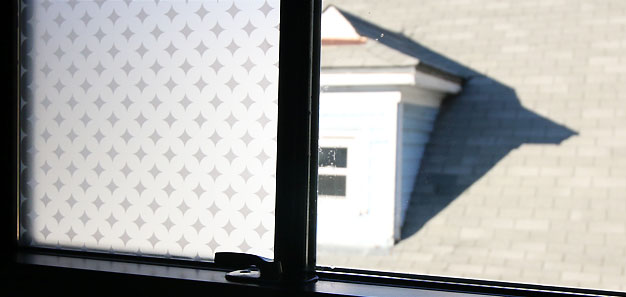
How to Add Privacy Film to Any Window

How to Install Traditional Window Trim or How to Install Decorative Window Casing

How to Clean Your Windows Like a Pro

Things to Consider When Choosing New Windows

Stop! Don’t Replace Your Windows Before Reading This