pair of this end up chairs recovered

This DIY reupholster chair tutorial features a This End Up chair. You can follow the same basic steps to recover and renew similar chairs.


As a parent of two elementary school students, I always ask my kids’ teachers if they need anything for their room. Usually the answer is markers, wipes, or snacks.

But, my kindergartner’s teacher knows about my secret identity after having taught my older son for a year.

So, she didn’t hesitate to ask me if I could possibly recover a few really sad looking chairs that had seen their fair share of kindergarten butts. 😉

(I’ve included affiliate links for your convenience. I earn a small percentage from a purchase using these links. There is no additional cost to you. You can read more about affiliate links here.)


before image of this end up chair

How to Reupholster This End Up Chairs (a Simple DIY)

These poor chairs were still very study and in good shape, but the fabric was nubby, pilled, stained, and not in good condition.

I love a good challenge, especially with a solid piece of furniture, so I took all three of the chairs home over the Christmas break for my next DIY project.

I knew I could give these chairs new life. The first step involved removing the seats and the old upholstery fabric.

Before I touched the seats, I flipped over the chairs and marked the front side of the chair so they would fit together perfectly when I put them back together.
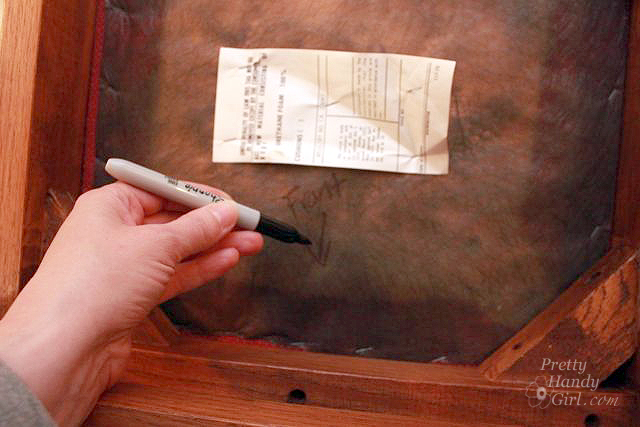
mark_front_of_chair

Next I removed all the screws securing the chair seat to the frame of the chair (all six of them.)

turn chair upside down and look for screw locations

Because of the construction of these chairs, I found it necessary to use a longer bit on my drill to get into each hole.

upside down chair and drill removing screw from under seat cushion on a chair

I pried off the piping from the seat backs with a 5-in-1 painter’s tool and needle-nosed pliers. Then removed the old fabric and old foam.

prying old piping off a this end up chair back

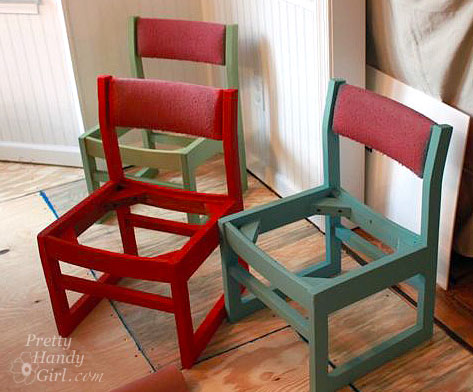
After the seats were removed, each chair got a good cleaning, a little sanding and then a couple coats of Miss Mustard Seed Milk Paint (colors used: tricycle and luckett’s green) and the blue one was chalk painted.

I used the bonding agent with the milk paint to make sure the paint would stick to the chairs.

three this end up style chairs with a new coat of paint in red, green, and blue

Finally, the chairs each got two coats of Minwax Polycrylic because those kindergartners are tough on furniture and this is a great way to give them a bit more protection.

adding a top coat of polycrylic over the red painted chair frame

Now on to the fun part!

How to Reupholster This End Up Style Chairs:

You can pick up the supplies at Home Depot, Lowe’s, or your local craft store.

Materials:

(I’ve included affiliate links for your convenience. I earn a small percentage from a purchase using these links. There is no additional cost to you. You can read more about affiliate links here.)

tools used to refinish the chairs
spoonflower space themed fabric for recovering the chairs

I let my son’s teacher to pick out new fabric from one of my favorite fabric sources, Spoonflower.com.

Not only do they have loads of designs to choose from, but you can also upload your own graphics and create your own custom fabric!

You can also check out your local fabric store.

She picked out adorable space themed patterned fabric: Rocketship fabric and Space Fireworks fabric.

With a primary color palette, they are the perfect fabric choice for a kindergarten classroom.

Instructions:

Cut out fabric, oil-cloth (optional), and any additional batting a few inches larger than the bottom of the chair seat.

The great thing about this project is no sewing machine is needed for this upholstery project.

cut fabric, oil cloth, and batting to larger size than original cushion

Layer the new pieces of fabric face down on the floor. then the oil-cloth next (I put the oil-cloth face up so the fuzzy back side would be against the fabric to keep it from feeling too crinkly.)

Cut a square out of each corner about 1″ from the seat cushion corner.

cut out corners of fabric and batting before folding

Staple one staple into the center of each side. Work across form each other, gently stretching the fabric taut.

Staple fabric onto seat backing in this order. top, bottom, side, and side

Add more staples along each side.

bottom of chair with new fabric stapled to it.

Corners are neatly folded and then stapled to secure them. Hammer any staples that didn’t go completely into the bottom of the seat.

fold over fabric corners on seat cushion then staple

Re-attach the seat to the chair frame by replacing all the screws.

attach the seat bottom with screws driven from the underside

Flip the chair right side up and follow these steps:

  1. Layer batting, then fabric over the chair back. Trim the batting to fit perfectly on the back of the chair.
  2. Cut the fabric about an inch wider on the two sides and the bottom. Fold under the raw edges of the fabric.
  3. Secure the fabric to the chair back by stapling at the top of both sides first.
adding new batting to the chair back, cutting fabric to fit over batting, and stapling the top of the back to hold fabric in place

Next put a few staples into the bottom of the seat back (hidden from view.)

staple fabric from the underside of the chair back

Continue stapling the fabric to the chair along the sides. 

Set your staples as close to the frame as possible so the piping will hide your staples later.

Hammer any staples that stick up.

Add staples to the ends of the seat back.

If you haven’t done so already, make your piping.

The easiest way to do that is to sew your piping following this tutorial. Trim the excess fabric from the piping.

cut excess piping

Peel back the ends of the piping fabric to expose about an inch of the rope inside. Cut the rope.

Then fold the fabric back and tuck the raw edges inside. This will give you a flat section at the end of your piping.

roll back edge, cut excess rope, fold edge of piping
  1. Staple this flat end to the underside of the chair back.
  2. Spread some hot glue on top of the staples along the side of the chair back.
  3. Pull the piping taut and press it into the hot glue.
  4. Secure the end of the piping with hot glue and a staple.
staple, hot glue, and press piping onto chair back. Finish with a dab of hot glue underneath


Secure the piping to the opposite side using the same method. Follow the same tutorial for the second chair.

Refinished chair close up seat back with piping

That’s it! Check out this sweet new chair!

one red refurbished this end up style chair with red frame and space fabric

Would you know that it was the same chair if I hadn’t shown you?

BEFORE:

worn and nubby seat this end up chair

AFTER:

close up seat cushion of a this end up style chair

Good, let’s keep it our little secret ;-).

The next time you see an outdated chair at the thrift store, consider giving it a new look with this easy blog post tutorial.

There is no need for a professional upholsterer. Give it a try. You will be amazed at just how easy it is. Good luck!

The new chairs were such a big hit with the kids. They all rushed to be the first to sit on them.

I think their teacher was happy with the finished product too.

happy teacher posing with a refinished chair

It’s a happy trio of kindergarten chairs!

three this end up style chairs refinished with colorful frames and space themed fabric

PHGFancySign

Pin this image to save for later or share with a friend:

How to Refurbish Old chairs

You might also like this chair makeover with a video tutorial on my YouTube channel:

How to Easily Reupholster Your Chairs | Pretty Handy Girl


Pin for later!

How to Refinish old chairs

Painting chairs - a second chance makeover | Pretty Handy Girl

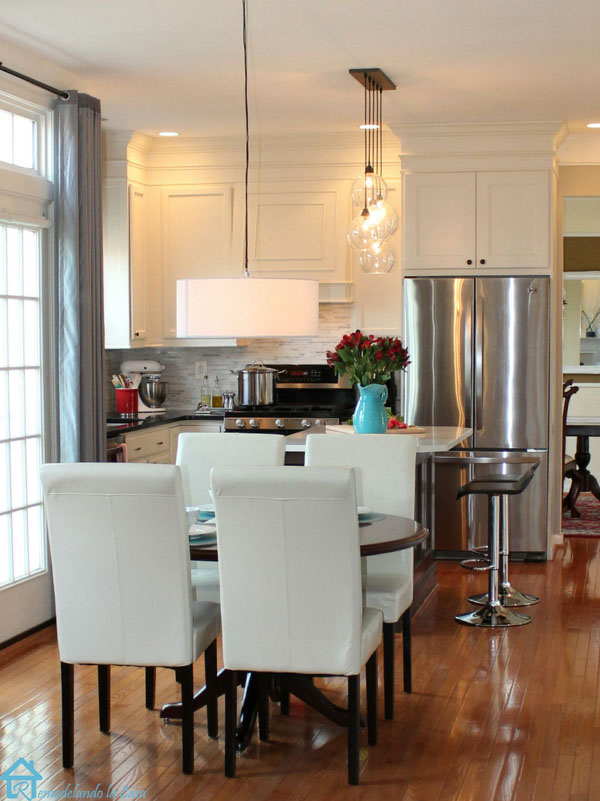
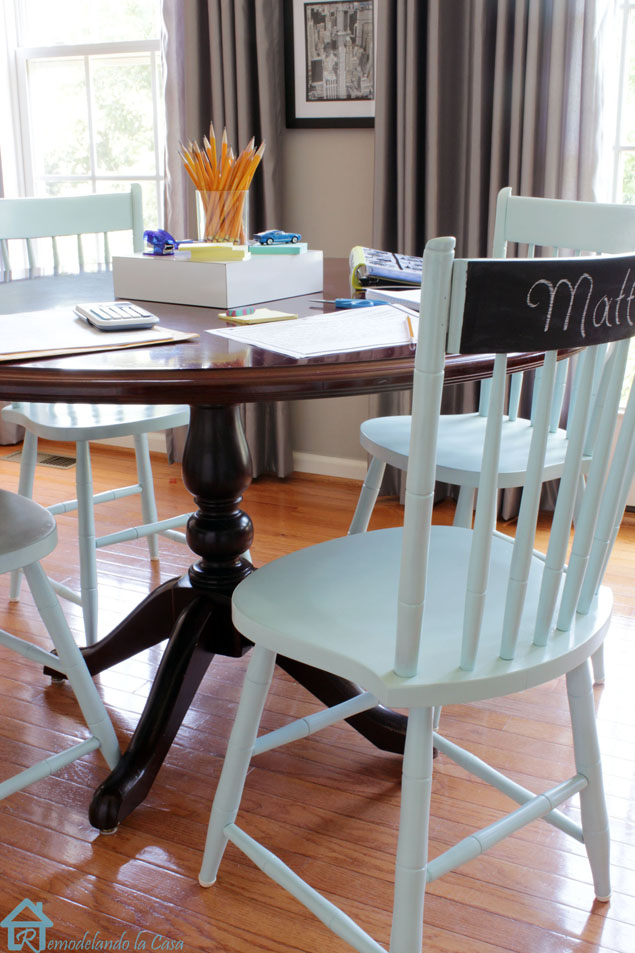
My search for some small chairs for the kitchen table area is finally over!  The chairs I had before blocked the view from my kitchen to the family room and vice-versa, their backs were too high and overall they were too big for that small space.

kitchen area before RLC

I’d seen some pretty, small and colorful chairs from the catalog magazines I receive, but their prices weren’t that pretty. Almost $150 per chair!  Craiglist was my searching place, it almost took me a year but I found them, $5 each!

Painting chairs - a second chance makeover | Pretty Handy Girl

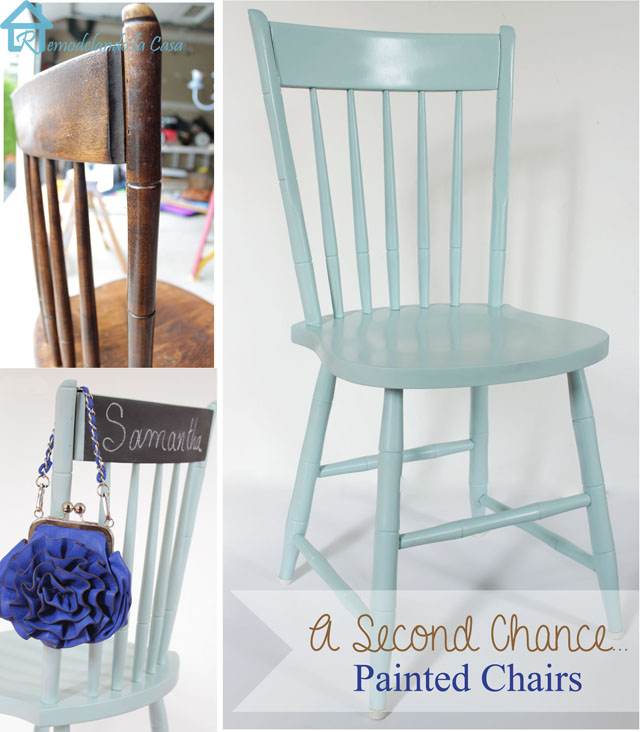
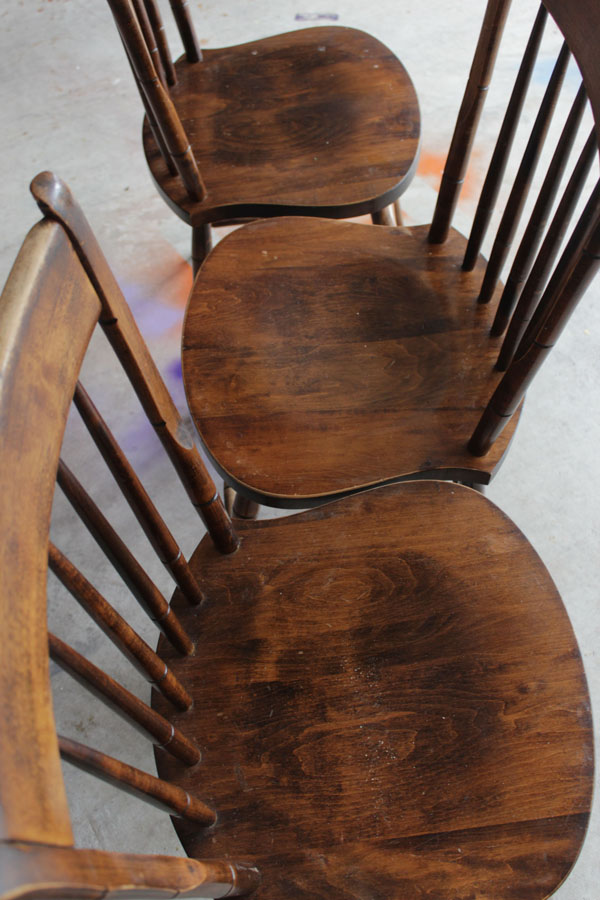
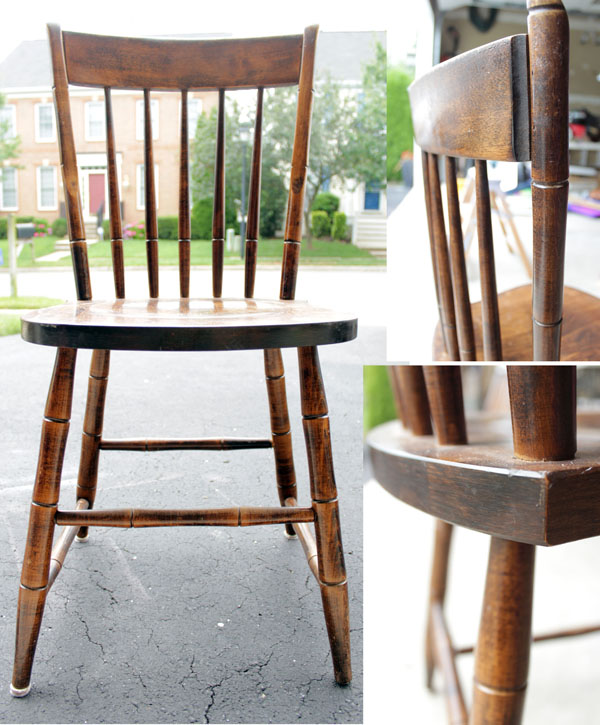
Their condition was good, no squeaky sounds, loosened parts or missing screws. Their appearance was on the drab side, they looked better in these pictures than they did in real live.  At some point they had been re-stained but the job was poorly done because they felt bumpy.

Painting chairs - a second chance makeover | Pretty Handy Girl

I knew they deserved a second chance! And I knew just how to do that.

Painting chairs - a second chance makeover | Pretty Handy Girl

Materials: Read more

Enjoy Your Newly Painted Patio Chairs

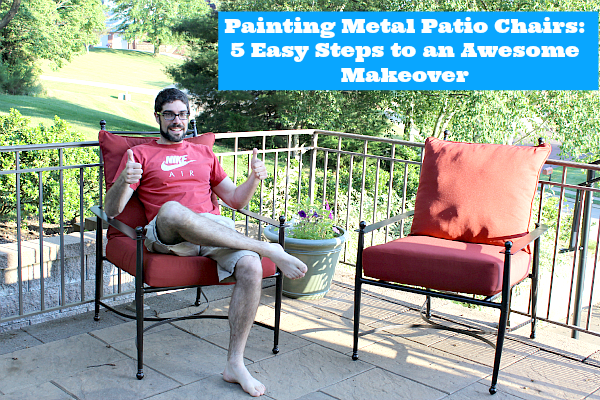
Painting Metal Patio Chairs

What’s worse than a rusted, faded, and drab looking patio chair?

Not being able to enjoy your outdoor space because of them!!

We all want to be proud of our homes and be able to have friends or family over. Don’t let a little paint get in the way of having fun with your loved ones. I’ve made the mistake of thinking that repainting a metal chair will take forever and isn’t worth the time or effort. But I’m here to tell you that if my wife thinks the chairs in this post look good then you will, too.

By the end of this short tutorial you’ll transform your chairs from looking worn out to AWESOME in 5 easy steps. I did make a few blunders though, so please read on so you don’t fall victim to the same mistakes.

Here are the supplies you’ll need: Read more

counter stools

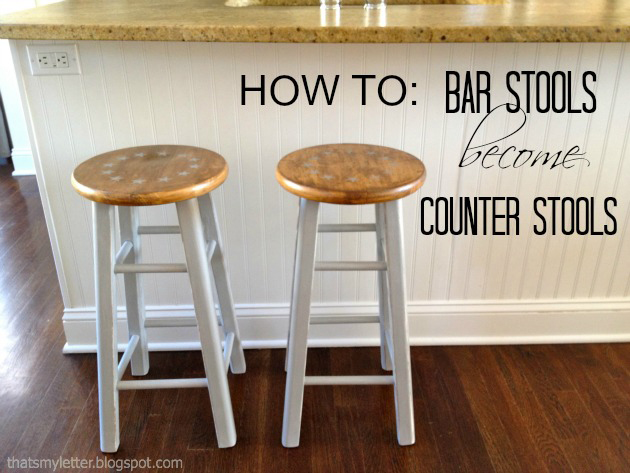
Yes you can make those wood bar stools fit your counter.  Here’s an easy DIY fix to make bar stools into counter stools (and a quick makeover too!).

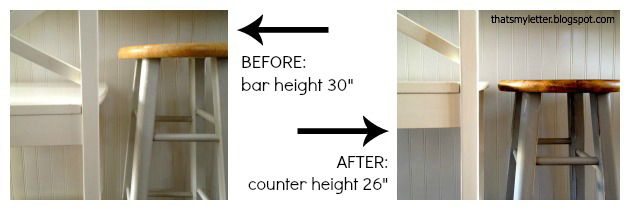
Bar stools typically sit at 30″ high, this is fine and dandy if you have a proper bar where the countertop is elevated higher than the working countertop space.  Kitchen designs are trending now away from the proper bar towards one even countertop surface.  No worries, you can still use those bar stools for your counter by easily cutting off the bottom 4″ to reduce the stools to a counter height of 26″:

counter stools1

(The white stools above are counter height and in the picture for comparison purposes.)

In addition to fixing the height of your stools give them a fresh look with a quick paint job and a new design: Read more

Today I’ll show you the painting technique I used on the chair I stripped yesterday.

Here is a list of suggested materials:
Tarp or drop cloth
Brush
Primer
Rubber gloves
Sandpaper (Fine & Medium grits)
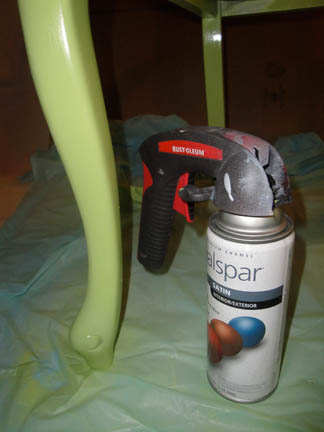
Spray paint (optional handle adapter to prevent hand cramps and spray on your fingers)
Dust mask
White paint
Brown acrylic paint or craft paint
Rag
Polyurethane
Floor protectors (chair glides)

Because I stripped and sanded the chair down to bare wood, I needed to prime the wood so it would accept the paint. If you don’t prime bare wood, then the paint will be absorbed into the wood and won’t leave a clean all over finished look. The primer is also a base that makes the paint stick to it easier. Primer is very good at adhering to lots of surfaces, including your skin. So, be sure to wear gloves or you may look like a reverse dalmatian for a few days.

I’ve used many different primers. Sometimes I use a spray primer and sometimes a liquid primer. Did you know that primer comes in different colors? And it can be tinted? Be sure to ask the paint department next time you are drastically changing the color of a room. They might be able to tint your primer close to the color you are painting so it cuts down on the number of coats you have to use.

For this project I used Bulls Eye water based primer that you paint on. You do not need much, we only had a big bucket left over from painting some rooms in our home.

Primer dries quickly, so work fast. It isn’t necessary to make it look perfect, just get a thin coating on all the wood surfaces and be careful to wipe off any drips.

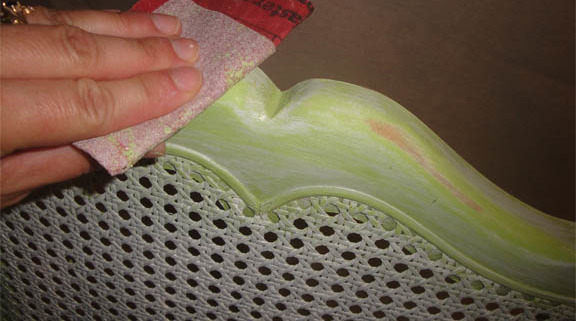
After the primer dries (I used my box fan to speed the process,) you should lightly sand the chair to remove any burrs or drips. This also gives the primer a little scuffing so that the paint has something to grip to. Don’t sand so much that you go through the primer coat.

At this point you will need to “tent” off an area where you will be working. Spray paint will get everywhere if you let it. The good news is that usually the particles will dry in the air, but they will coat everything in the vicinity and will need to be wiped off. If you can spray outside, it will be better for your lungs, but be sure your drop cloth extends at least 4 feet out in all directions from the piece you are spraying.

Now comes the fun part! Grab your paint can in the color you have painstakingly chosen. I used Valspar Pistachio Satin finish in a spray can. I used to use Rustoleum, but it seems that my local Lowe’s has eliminated most of the Rustoleum brand spray paints and replaced them with Valspar. My suspicions tell me that it might still be the same paint but branded for Lowe’s.

I use light coats of spray paint about 8-10 inches away from the surface. The trick with spray paint is to use several light coats instead of trying to cover all at once. This will insure an even finish. You also don’t want to end or stop on the piece you are spraying. I use a smooth consistent sweep across the chair and then release the trigger after my spray has left the chair. If you stop on the chair, you will either get a shiny spot or drips where the extra paint has collected. Here is a graphic to show you how to spray your paint:

I used three light coats to cover this chair. I did sand VERY lightly between coats (using a fine grit 200 grit or higher) to make sure there were no rough spots and to add something for the next coat to adhere to. I also wipe off the chair after sanding with a damp rag. Just be sure to take your time to work up to your final color. This is the point where you may stop and say that you like the final results of your painting job. If you stop now, be sure to finish your painting job off with two coats of polyurethane.
I choose to add some more interest to my chair.
Milk Painting – Adding Depth and Interest
 
After the green spray paint layer has completely dried, I took the fine grit sandpaper (200 or higher) and gently roughed up the surface. Then I wiped off the whole chair with a damp rag and let the chair dry.
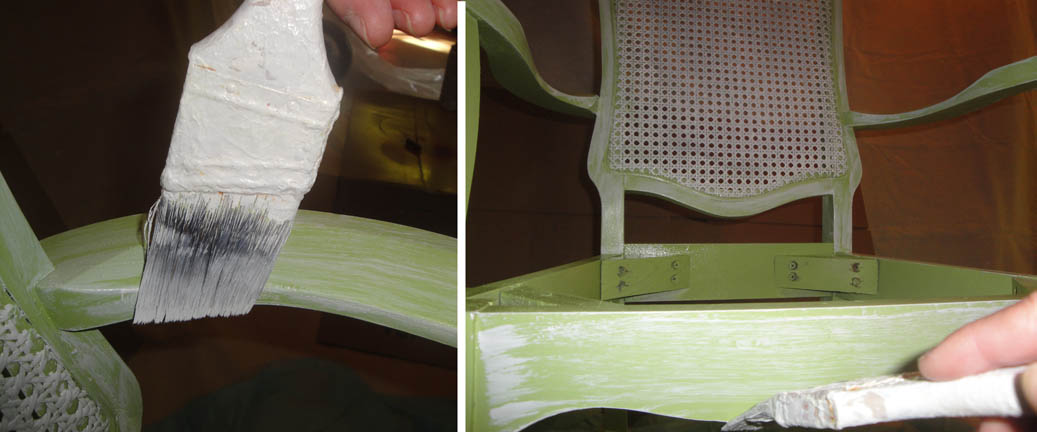
For this step I used some left over white latex trim paint we had lying around. I used a semi-gloss finish because that is what we had, but you can use any white paint you have left over. I dipped the edge of my brush into the paint and then wiped most of it off on the can. Then I lightly ran the brush over the chair in the direction that the wood grain would go. The green paint should show through your strokes. Only go over the area once, unless you really ran out of paint on your brush. If you put too much on the chair, or have areas with too much (see the left edge of the picture on the right below),  you can take a wet rag or baby wipe to clean it off and try it again.

Once the whole chair has the milk paint technique, I let her dry. Once again, this may be the point where you stop painting. But, I really had more distressing in mind for this girl.

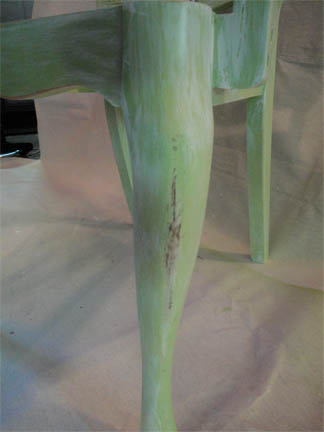
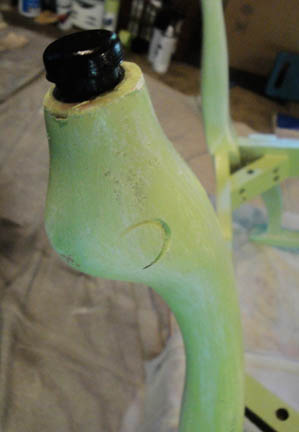
I wanted to let some of her age show through, so I grabbed some medium grit sandpaper (100 – 150 grit) and sanded some edges down to the bare wood. Think about any place on the chair that sticks out and might be rubbed and worn on an antique.

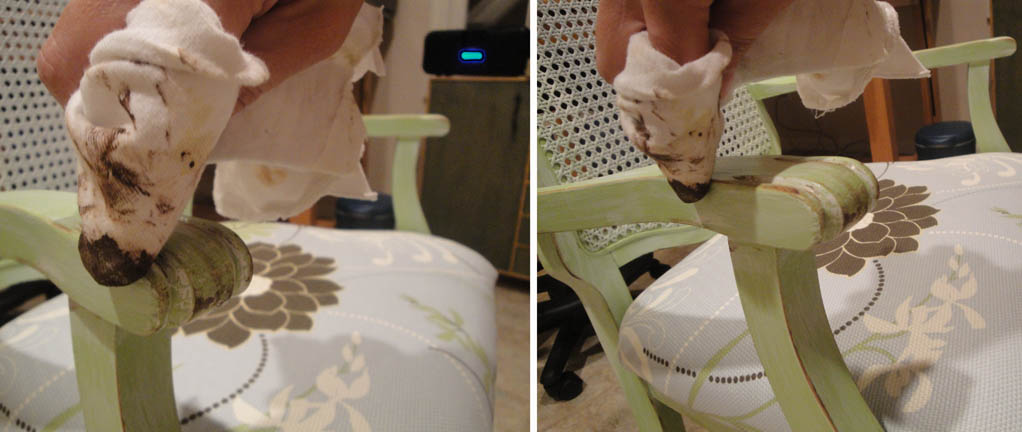
Unfortunately for me, the bare wood on my chair was a little too peachy colored next to the pistachio color paint, and I really liked the look of this leg that was sanded and had a darker brown area showing through. So, I decided to fake the darker brown wood look.

I wiped off the chair again with a damp rag and then ran up to grab some acrylic paint out of my art supplies. I chose the Raw Umber brown and squeezed a quarter size dollop onto my palette. Then I grabbed a clean rag and wrapped it around my finger. I dabbed my rag into the paint and made sure I didn’t have any globs on the cloth. Then I lightly ran the edge of my clothed finger over the edges of the chair where I had sanded.

Uh oh, don’t peek at the fabric on my chair! That is the next step we will go over tomorrow. Plus, it wasn’t a good idea to paint with the fabric on my chair. Too many opportunities to drip or rub paint onto the seat.
Once I was done adding the brown paint, I let the chair dry. Next I took my fine grit sandpaper and sanded the whole chair lightly being careful not to sand off any paint. Wiped the chair down and let it dry.
I really liked the aged beautiful look that my chair had achieved, so I was ready to seal her with 2 coats of polyurethane. I used a water based poly and lightly sanded between coats. At this point you are probably sick of the sanding, but I am a sucker for smooth finishes. I love to caress finished wood and feel the baby softness under my fingers. Plus, this is the chair that I will spend many hours sitting in and working.
After the poly has dried, I do add floor protective legs to my chair. It protects our wood floors from damage. I’m really into protecting our wood (as you can probably guess.) Furniture glides or floor protectors are super easy to add. They go on just like nailing a nail. Be sure you have your glide centered on the leg and that you aren’t nailing it into any metal. Then gently tap it into the leg of your chair.