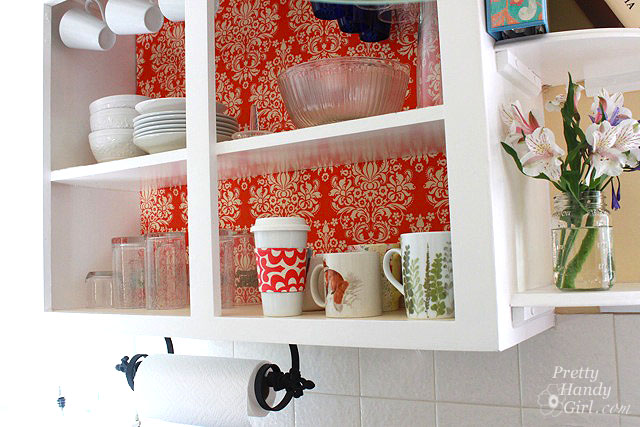
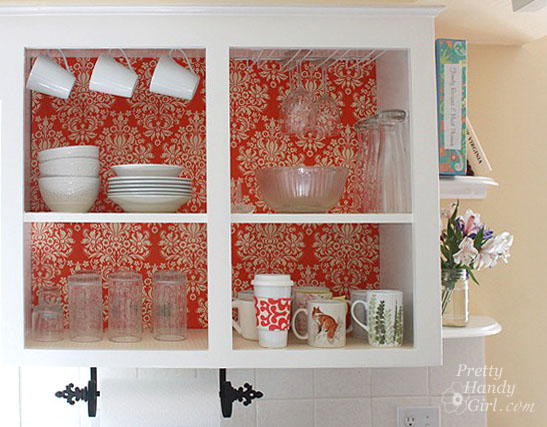
I’m back to show you the updates I made to my kitchen. Remember the plans I shared with you? These fabric backed cabinets made the kitchen new.

Well, they have been implemented and I LOVE the results! Best of all, the materials I bought cost me under $25 and that included the white dish set. But, the cherry on top is that I can easily reverse the changes if we move (or get sick of the look.)

And now, I present to you:
Fabric Backed Open Cabinets for the Kitchen

When we first met these sad cabinets, they were dark, dreary and had an eclectic collection of mugs:
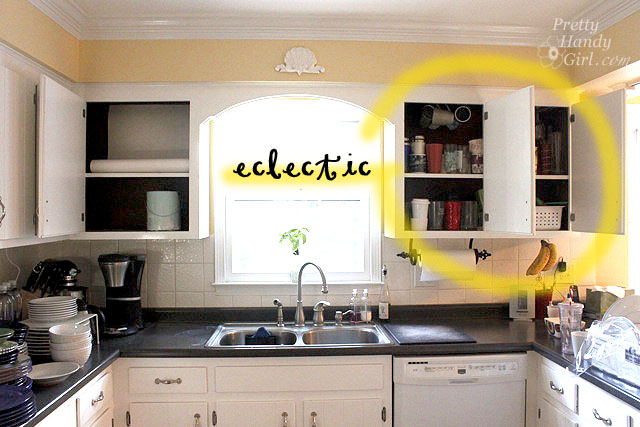
Within only a few hours (minus drying times), I had a stylish new look that is bright and cheery!
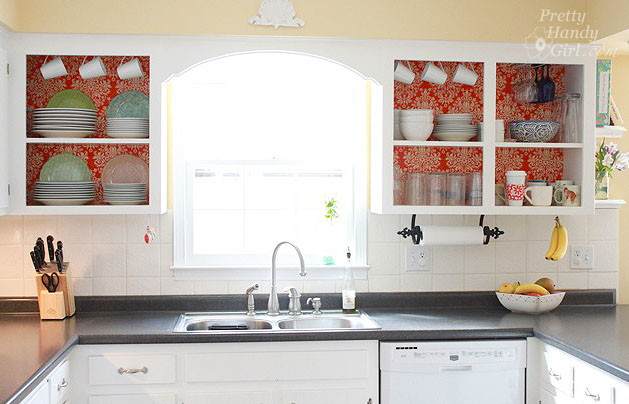
Follow along for the tutorial and the 50 cent tour (please deposit your pocket change on the way out.) Just kidding. I’ll let you in for free.

Materials:

(I’ve included affiliate links for your convenience. I earn a small percentage from a purchase using these links. There is no additional cost to you. You can read more about affiliate links here.)

Optional: 

Difficulty: Easy

Step 1: Empty your cabinets.

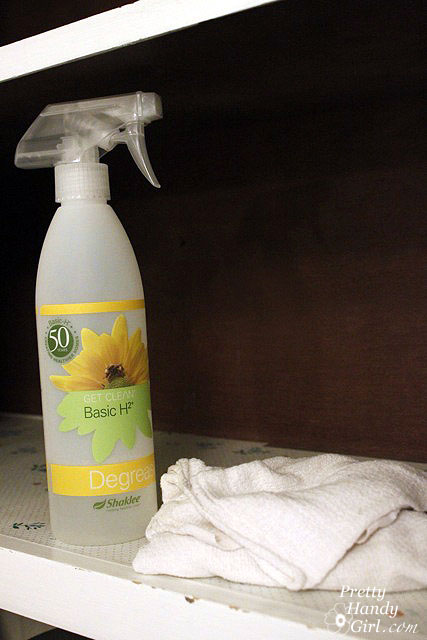
Clean the insides with an all purpose kitchen cleaner.
Step 2. Starting from the bottom, remove the screws from the cabinet door hinges. The last screw should be the very top hinge (to keep the weight of the door from wrenching the screw out of the wood.)
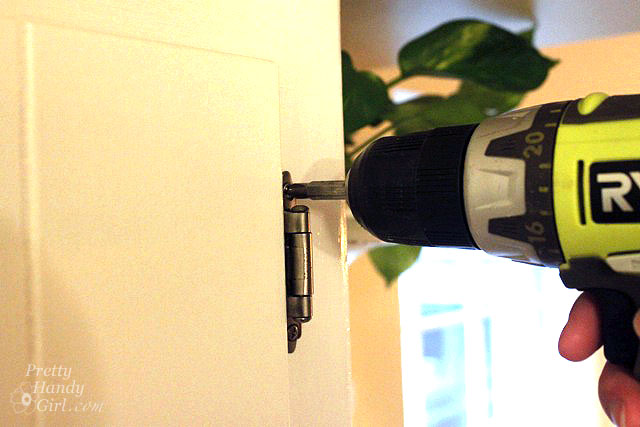
Put screws into a ziplock bag and label your cabinet doors in order so that you can return them to the appropriate cabinet opening at a later date.
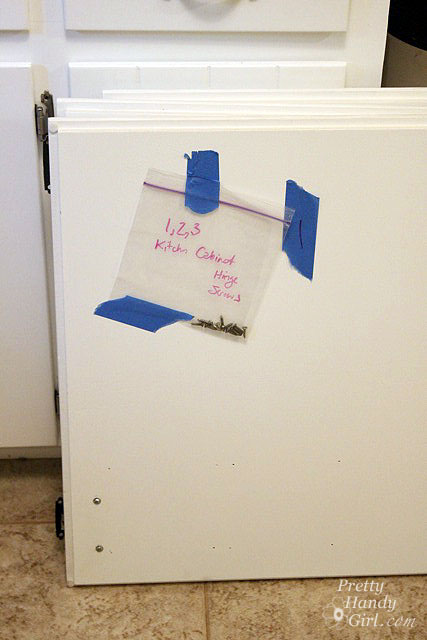
Now you should have a clean slate like this:

Step 3. If your cabinets are dark inside, you may or may not decide to paint the insides. (Be sure to check with your landlord if you are renting.) I chose to paint mine because the interiors were so dark. If you want to skip this step, fast forward to the next step.

Prime the insides by rolling on primer over the flat surfaces. Use a brush to get into the corners and crevices.
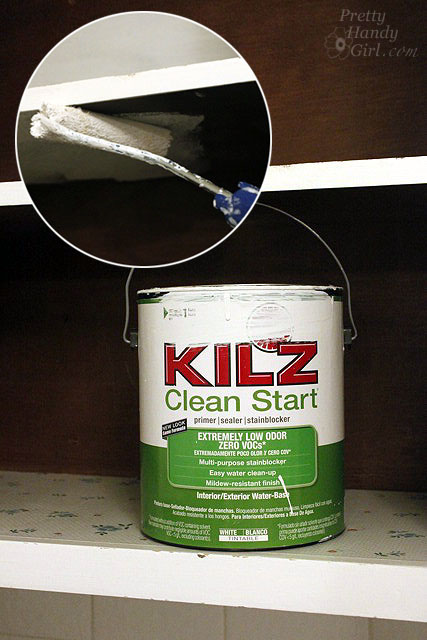
Once the primer has dried, get out the wood putty and putty knife.
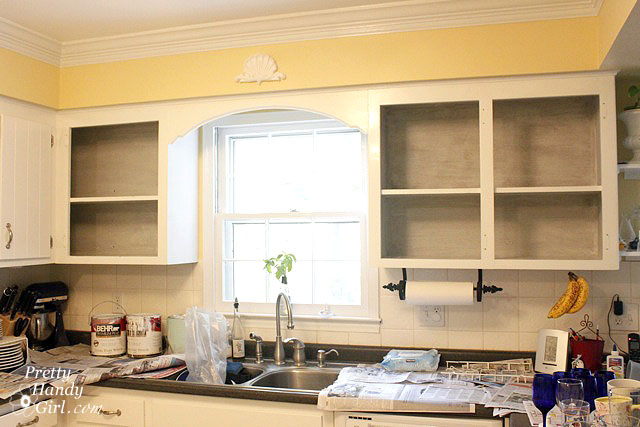
Step 4. Using the putty knife, spread a small amount of putty over the holes where the hinges were. Push the putty into the holes, then scrape the excess off. Allow the putty to dry completely.
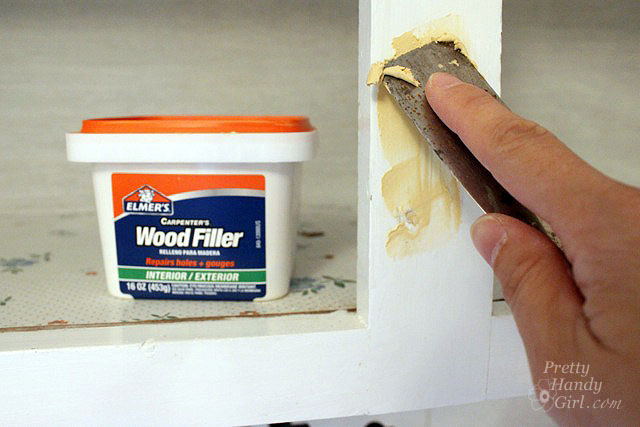
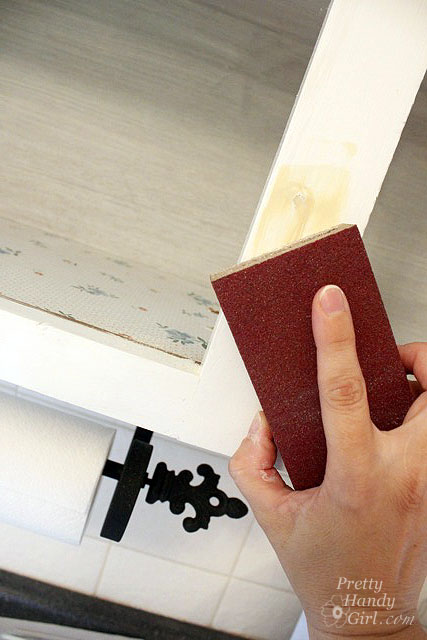
Step 5. Sand the puttied holes until smooth.
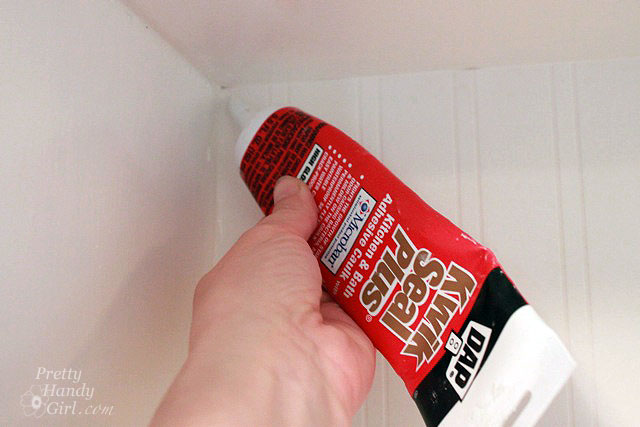
Step 6. Touch up the putty holes with paint or stain. Add caulk to any cracks or seams at the back of your cabinet. Allow the caulk to dry thoroughly.
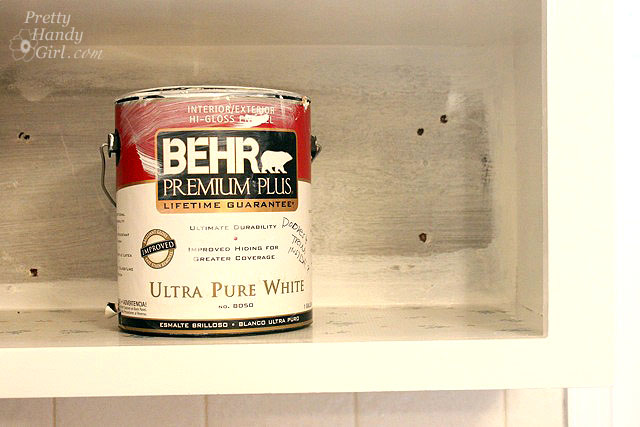
If you are painting the inside of the cabinets, roll on paint with the small roller and use the brush to smooth out the paint and get into the grooves.
Step 7. Measure the dimensions of the back of your cabinets. Make sure your measurements are precise (measure twice, cut once is a good adage.)
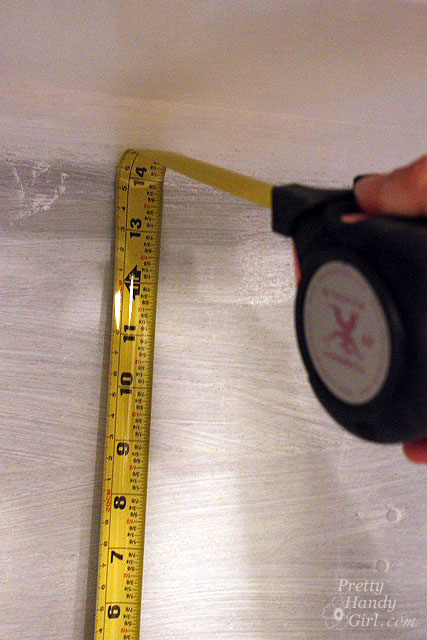
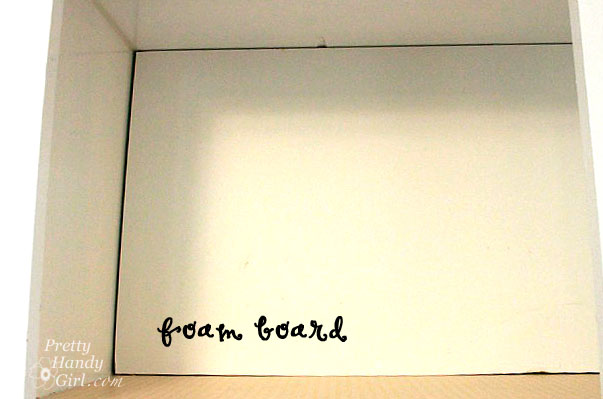
Cut a piece of foam board using the measurements you just took.

Test fit the foam board into the back of the cabinet. If your cabinet’s face frame is smaller than the cabinet back, you will probably have to bend the foam board to get it in.
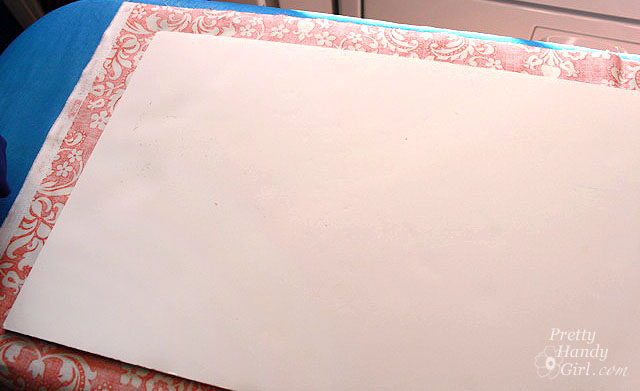
Step 8. Iron your fabric. Make sure to iron all the wrinkles out.

Cut the fabric 3 inches wider than the foam board. Lay the foam board on top of the fabric (wrong side facing up.)
Step 9. Tape the edges of the fabric onto the back of the foam board. Be sure to pull the fabric taut.
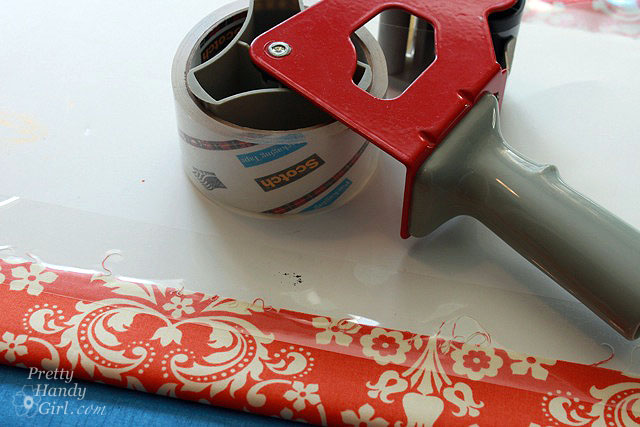
Fold the edges of the fabric as you would on a gift. Tape the ends to the back of the foam board.

Step 10. Insert the foam board into the cabinet.
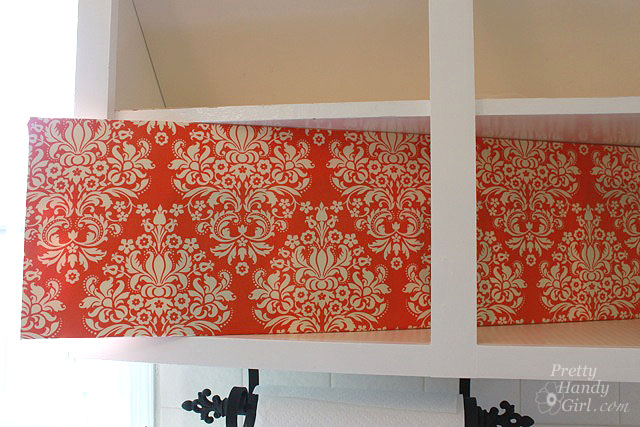
Push the foam board firmly against the back of the cabinet. The tension of the fabric and the board against the edges of the cabinet should hold it in place, no need to tape or glue anything!
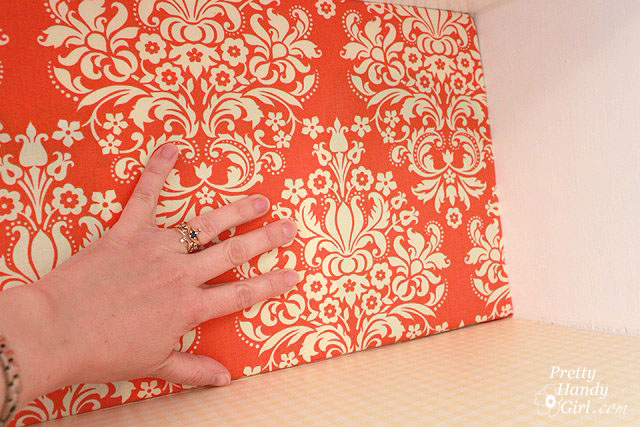
It is a good idea to try to line up your pattern if you have multiple shelves. (Do as I say, not as I do.)
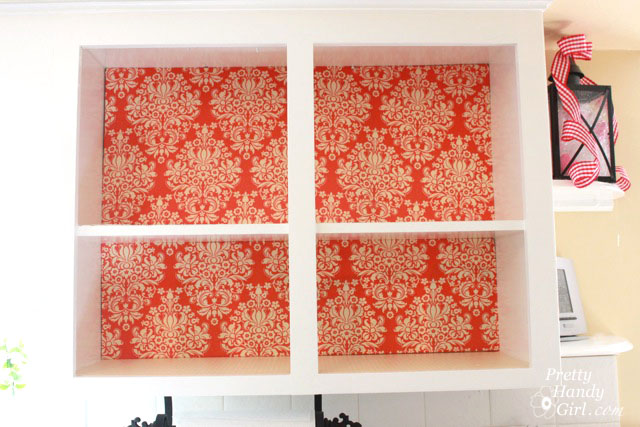
Start putting your coordinated dishes back into the cabinet. Think about displaying them as you might see in a store to complement these fabric backed cabinets.
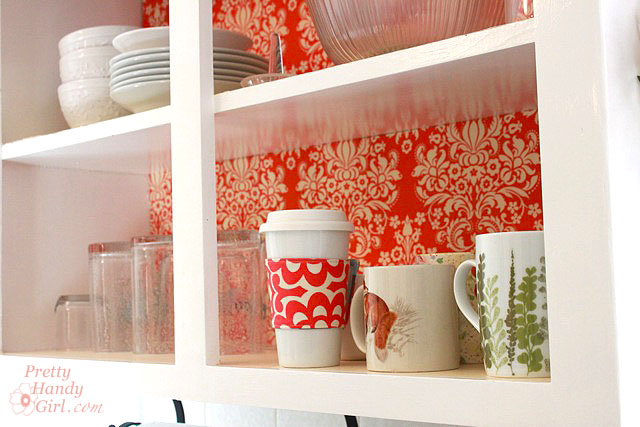
For visual interest and extra storage, I hung some mugs from the top of the cabinet.
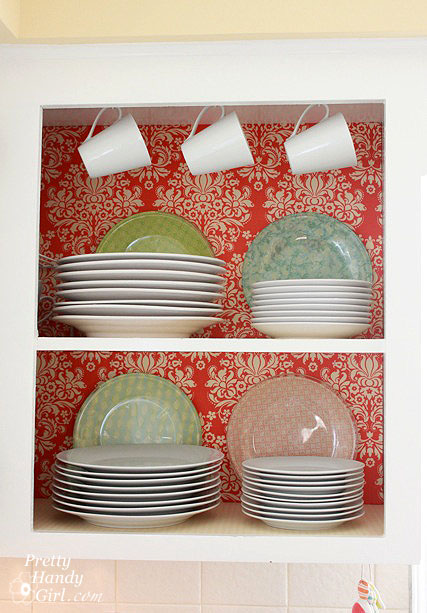
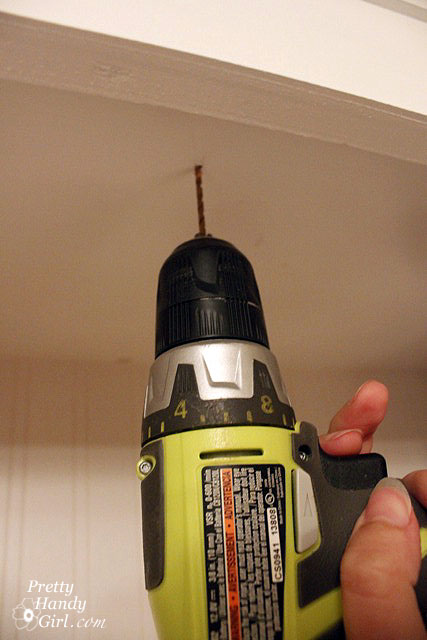
It was as simple as pre-drilling some holes and screwing in white cup hooks. (I did measure the same distance back from the face frame and spaced the hooks evenly. But, I’m a perfectionist like that.)
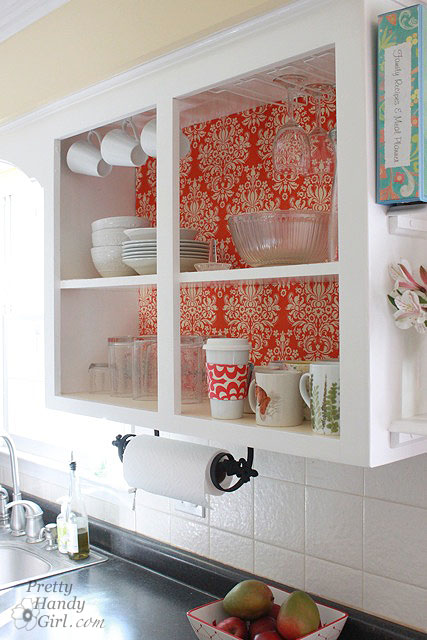
I am in love with my new kitchen! And all it took was less than $25 in supplies and a few hours.

What do you think?

The best part about this project is that I can easily remove the foam boards…
…or tape new fabric onto the back when I want to update the look!
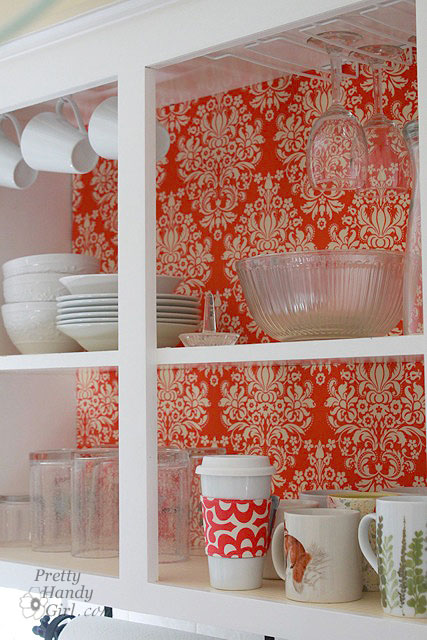
Can you imagine a cheaper, easier or more glamorous update to your kitchen?

Are you an apartment dweller that is restricted from making permanent changes to your home? Or does your budget limit the renovations you’d really like to make? Why not make a few frugal changes that reflect your own style. These fabric backed cabinets are a win for any kitchen!

Apartment Guide has changes you can make that won’t break the bank:

Want to find even more design tips for your home? Apartment Guide has budget friendly ideas and DIY how-tos for people in any sized home on https://www.movingtoday.com and https://www.apartmentguide.com/blog/

Disclosure Statement:

Apartment Guide and owner Consumer Source, Inc. partnered with bloggers such as me to participate in their monthly blogger program.  As part of that program, I received compensation.  They did not tell me what project to create or what to purchase. Nor did they influence my opinions! We believe that consumers and bloggers are free to form their own opinions and share them in their own words. Consumer Source’s policies align with WOMMA Ethics Code, FTC guidelines and social media engagement recommendations.
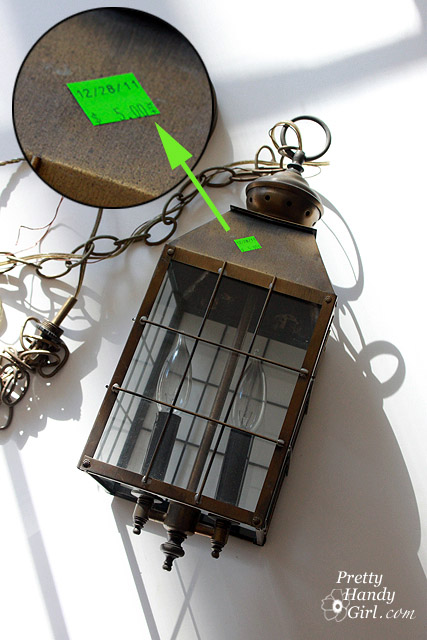
Thanks to my Facebook fan, Heather H., for the ultimate compliment on this lantern. She asked if I got it at Pier 1! Nope Heather, I got it at the Habitat ReStore and it found its way into my hands in this condition:

After a Women Build meeting at the Habitat ReStore a month ago, I spied that dusty relic. An old discarded hanging light fixture. I grabbed it and promptly paid $5 for it. Then I got to chatting with the clerk at the ReStore and absentmindedly walked out without my lantern. By the time I remembered, the ReStore had already closed. It was sad… it was tragic… I didn’t know when I’d be reunited with my light fixture because the ReStore is about 25 minutes away from my home. But, there is a happy ending to my story, my mother-in-law (who gives a good name to all MILs out there) offered to swing by the ReStore the following day to pick up my lantern for me. Hugs to her for reuniting us. But, I had to laugh at the look of skepticism she gave me as she handed over the dusty light. She couldn’t see its true potential, but I could.

How about you? Would you have passed this light fixture by? Or would you have seen the potential?

Well, next time you see a light fixture like that, grab it and I’ll show you how to transform it.

Materials:

  • Old lantern style light fixture
  • Pliers
  • Wire cutters
  • Two screwdrivers (at least one needs to be flat head)
  • Damp rag
  • Sandpaper
  • Plastic drop cloth
  • Kilz spray primer
  • Rustoleum Lagoon spray paint
  • Rub n’ Buff Gold Color
  • Paper towels
Difficulty: Easy
Step 1. Disassemble the lantern by unscrewing all the parts.

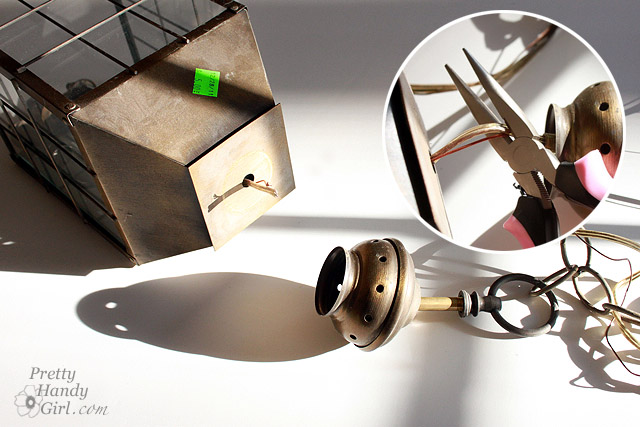
Step 2. Use wire cutters to cut the wire to the light housings.

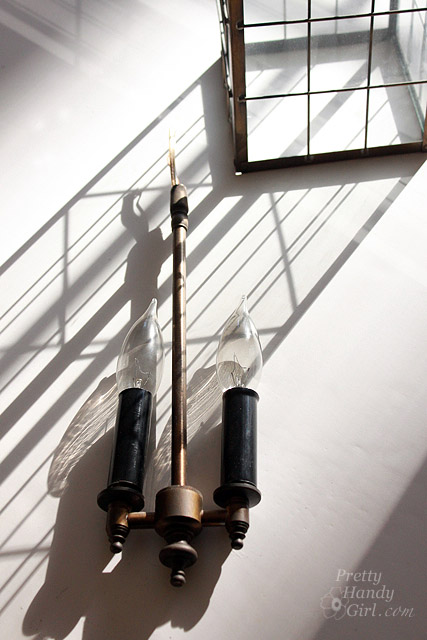
Step 3. Pull the light sockets, bulbs and lighting out of the lantern.

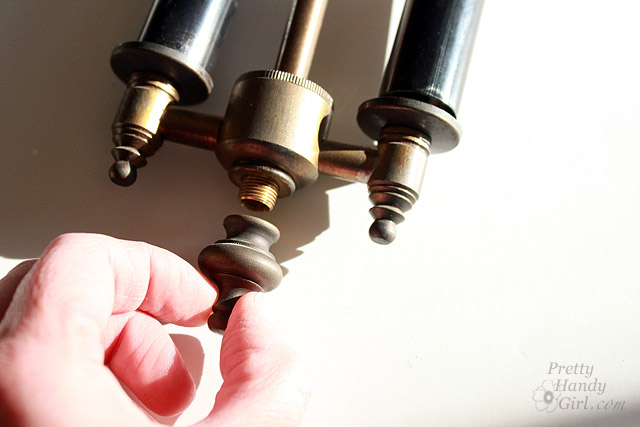
Step 4. Remove the finial from the bottom of the lighting and set it aside with the lantern. Discard or keep the lighting parts for some other project.

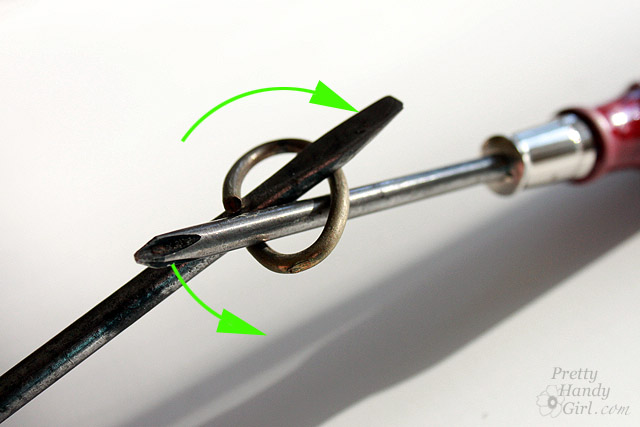
Step 5. If there is a chain attached to the lantern, insert the two screwdrivers into the link attaching it to the lantern. Rotate the two screwdrivers in opposite directions as shown to pry the chain link apart.

Step 6. Pry up the tabs on the lantern that are holding the glass in place. Remove the glass panels and set them aside.

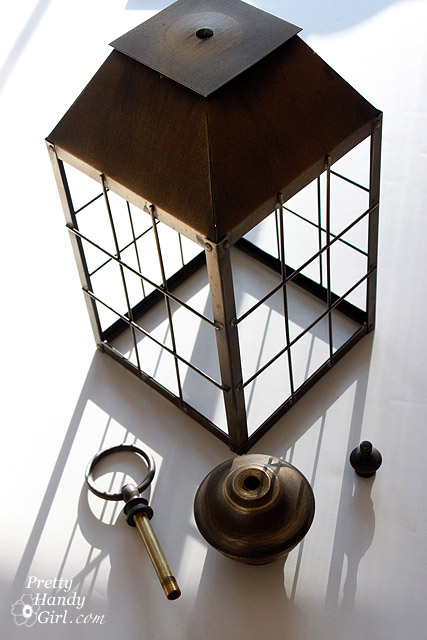
These are the parts that I kept for the lantern:

Step 7. Wipe all the parts with the damp rag to remove any dust and debris. Then scuff the lantern parts with sandpaper and wipe off any remaining dust.

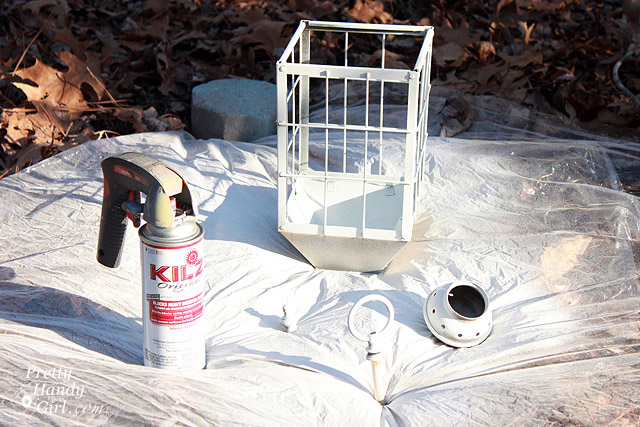
Step 8. Set the lantern and parts outside on the drop cloth.  Spray them with Kilz primer, flip the pieces over and spray again.

Step 9. When the primer has dried, inspect the lantern for any paint drips that need to be sanded smooth.

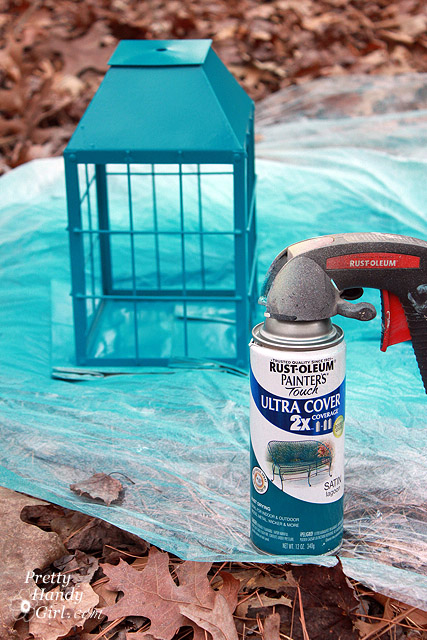
Step 10. Spray paint the lantern and parts with Rustoleum Lagoon. Flip everything after the first coat is dry and spray a second coat of paint.

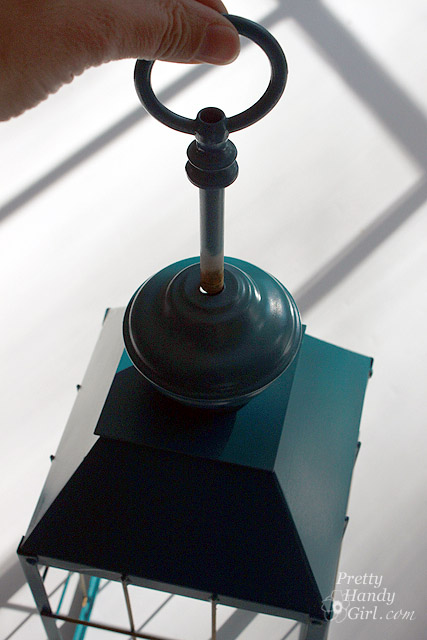
Step 11. After the lantern has dried thoroughly, reassemble the lantern.

Screw the finial onto the inside of the lantern where the lighting used to attach.

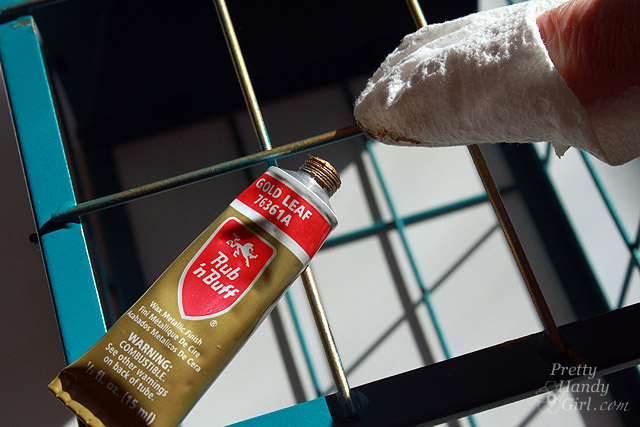
Step 11. Wipe a small amount of rub n’ buff on a dry paper towel. Rub it on the cross bars of the lantern.

Step 12. Clean the lantern glass with windex and a clean rag. Then insert the glass panels back into the lantern.

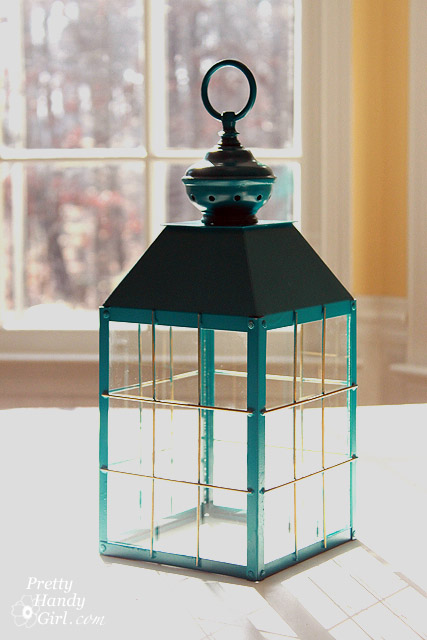
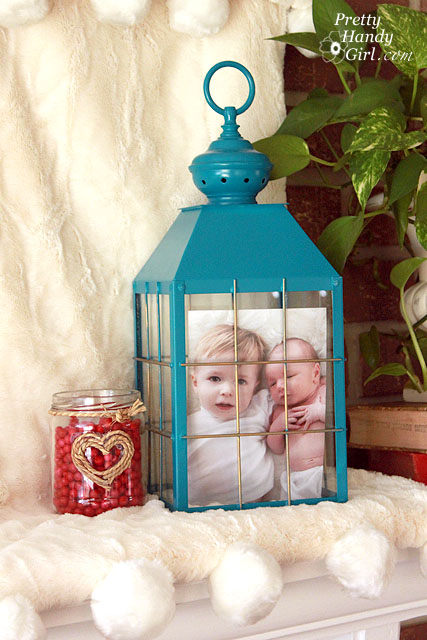
Admire your new aqua beauty!

The hardest part of this project was trying to decide where to display my lantern. I could see it in every room of our home!

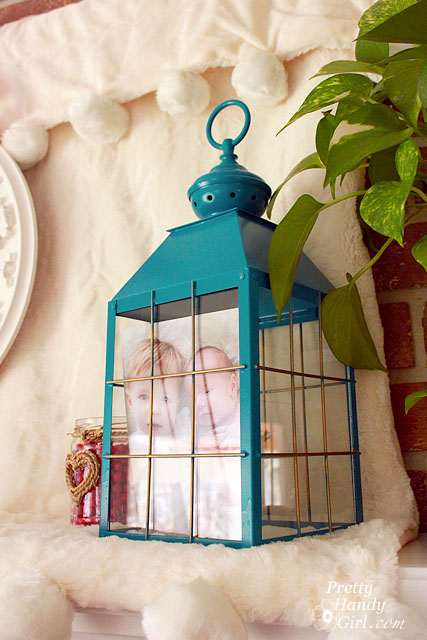
But, ultimately I gave it a place of prominence on our mantle. And included an old picture inside it.

Have you seen these old light fixtures? Could you ever guess that they could be turned into beautiful decorating gems?
Have a great weekend y’all. I hope you make a trip to your local Habitat ReStore and search for your own lantern.

I hope you’ll join Heather and some other friends on Facebook so you can see what I’m up to next!

Sharing with Tater Tots and Jello Weekend Wrap Up Party


I’ve been keeping a secret from y’all and I just can’t live with it anymore. I have a miracle stain remover recipe that has time and again proven to work on some of the most stubborn stains. Plus, find out why we don’t need dryer sheets anymore!

miracle stain remover

Miracle Stain Remover and a Healthier Alternative to Dryer Sheets

Recently, Pretty Handsome Guy came back from a business trip with a stained button-down shirt. It had wing sauce on it AND it had been allowed to settle for a few days AND he hadn’t pre-soaked it or used any stain remover. (Have I not taught him anything?! Sigh.) I thought for sure the shirt was a goner. But, I decided to put my miracle stain remover recipe to the test. Low and behold after 24 hours of soaking in the concoction, the stain was magically gone! No scrubbing, it was simply gone. Can I apply for a magic wand now?

I can’t lay claim to the recipe. I found it on our local “Mommy” message board back when I was a new mom. But, this recipe has worked on more stains than I can count.


I mixed up a batch today to try on one of my son’s shirts that got blueberry jelly on it. My mom tried to wash it to get the stain out, but it was still there after laundering. Normally once a stain goes through the dryer it is set in. But, that didn’t deter the me from trying my Miracle Stain Remover. Sit back and learn young Jedis (we watched Star Wars last week, so it is on my brain.)

Miracle Stain Remover…

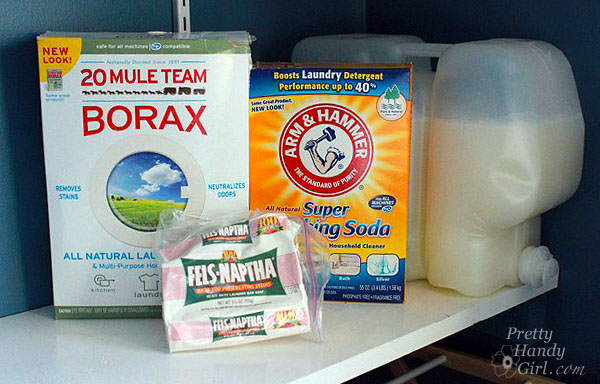
Ingredients:

(I’ve included affiliate links for your convenience. I earn a small percentage from a purchase using these links. There is no additional cost to you. You can read more about affiliate links here.)

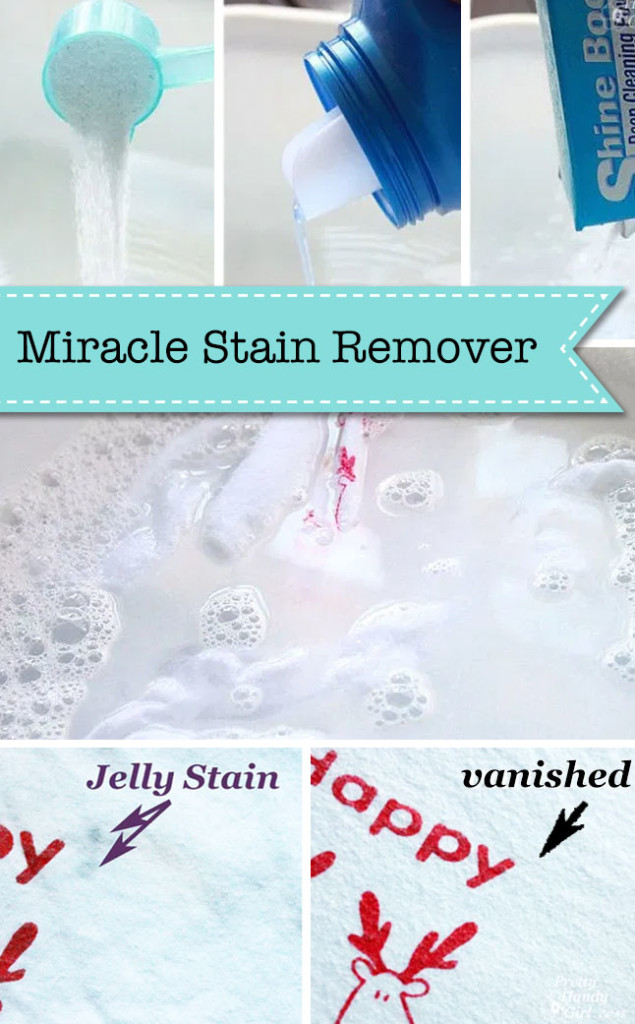
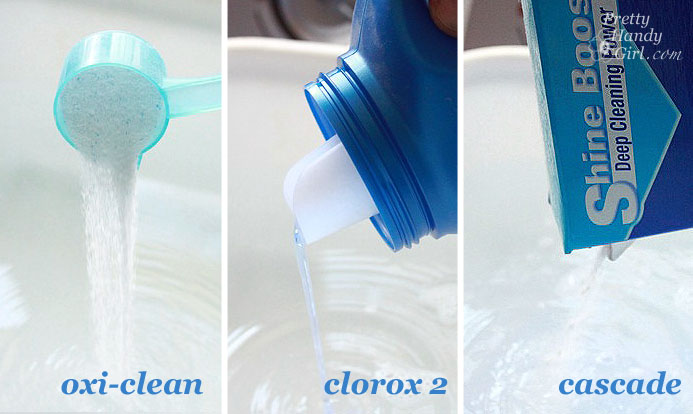
Fill your basin with warm water then add the Oxi-clean, Clorox 2, and powdered Dish Detergent. Give it a swirl and mix until the powders dissolve and bubbles form.

Place the stained garment into the mixture, being sure the stain is submerged. After two hours you can take a peek! My stain was gone.

For tougher stains, let it soak overnight. Remove the clothing to behold the miracle! Normally I will throw the garment into the wash, but you could simply rinse and dry it.

And, this formula is also safe for colors as well!

Laundry Detergent…

In the spirit of sharing, I also have this recipe for Making Your Own Laundry Detergent for only $1.25 per year! I mean, have you seen the price of laundry detergent lately?! 200 oz. for “gulp” $35! Whereas the recipe I made yielded 250 oz. for….are you ready for this…$0.61! This is a 97% saving on detergent by making your own.

And the best news is that it is safe for HE washers. You only need 1/4 cup per load. Click Here to Get the Recipe for Making Your Own Laundry Detergent for $1.25 per year!

Drying clothes…

And since I’m talking laundry today, this post wouldn’t be complete without mentioning my secret weapon for drying clothes.

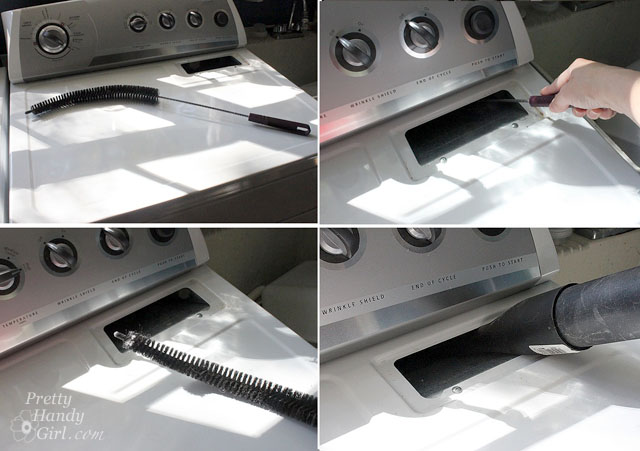
I use two of them! They may look like medieval torture devices or rabid animals, but these little hedgehog dryer balls have completely kicked our fabric softener sheets to the curb! I haven’t used dryer sheets in over 9 years now! At first I was concerned about static (the bane of my hair’s existence), but then a friend told me that you can eliminate static by not letting your clothes over dry. Simply shut off the dryer when your clothes are about 95% dry. Don’t let the dryer run and run and run until the clothes are piping hot and there isn’t a spot of dampness on them. Instead, let the moisture sensor (if you have one) do its job and it should shut off right before the clothes are dry. The waistbands in jeans or sweatpants may feel slightly damp, but everything else feels dry. And most importantly, pull out fleece, polyester, or synthetic clothes about halfway through the cycle.

The dryer balls (you should use two) work together to punch, separate, fluff, and dry your clothes. They also help keep wrinkles to a minimum, but I’m not afraid of a few wrinkles (see my no iron solution to wrinkles post.) The Dryer Balls cost less than $10, but the cost savings of not using dryer sheets is definitely worth it. Plus, you don’t have to stress about the chemicals that are in dryer sheets. These little wonder balls (I can’t believe I just typed that) last for a long time, but it’s good to have three in case one hedgehog loses a nose (it can happen.) I have been using mine for over nine years. They start to get darker on the nubs from dye in your clothing, but it doesn’t transfer and it doesn’t hurt their effectiveness.

I hope you found these laundry tips helpful. Please share with a friend!
miracle stain remover

The other day I was lamenting the condition of our laundry room. It was beautiful about a year ago, but continual use and lots of cleaning paint brushes had left the wall looking like this.

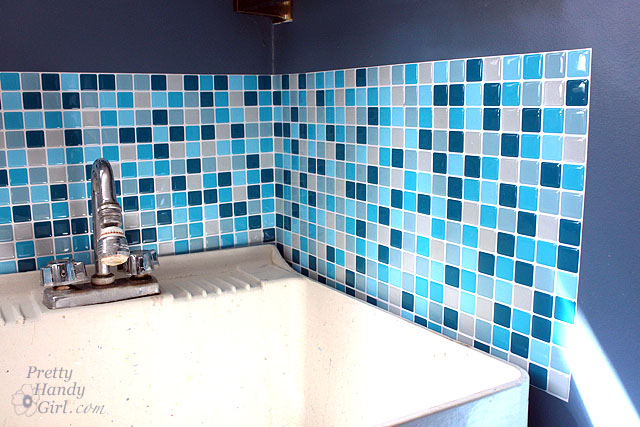
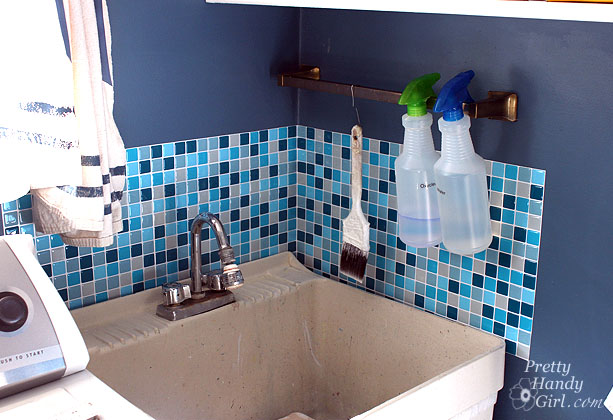
Since Jackson Pollock walls are not in style, I decided to give the utility sink a quick face lift. Of course glass mosaic tiles would be really fab here. But, I didn’t have the time or desire to grout the walls and tiles. Luckily I had some Smart Tiles patiently waiting for me to try them. I chose the Lagoon Mosaik tiles for my laundry room. But, there are a wide variety of colors and sizes to chose from. These self-adhesive tile sheets have the look of mosaic glass tiles but not the hassle and mess of mixing grout, laying tile, and cleaning the grout afterwards.

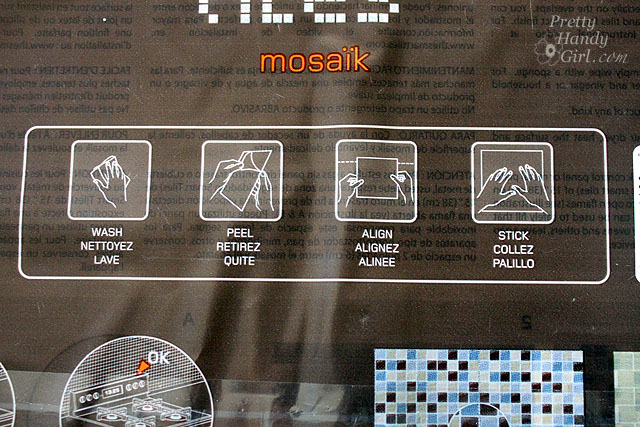
Installing them is a cinch. It is as simple as wash, peel, align and stick! See:

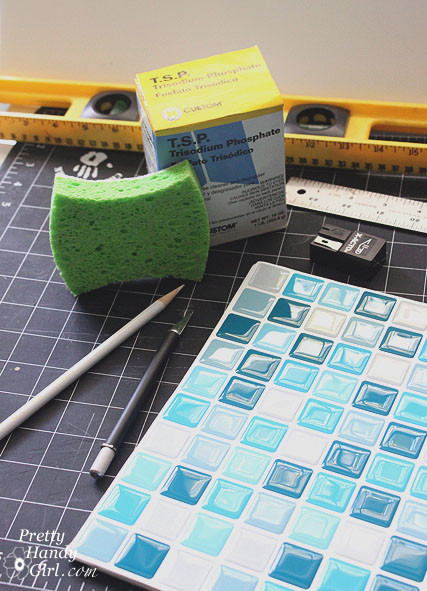
You’ll need a few materials before you start:

(I’ve included affiliate links for your convenience. I earn a small percentage from a purchase using these links. There is no additional cost to you. You can read more about affiliate links here.)

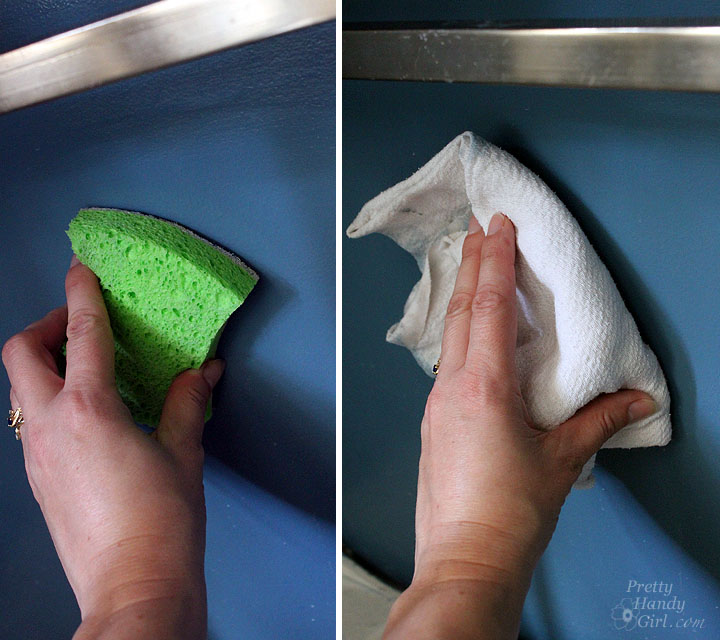
Clean the walls according to the directions on the TSP cleaning solution box. Wipe the walls dry.

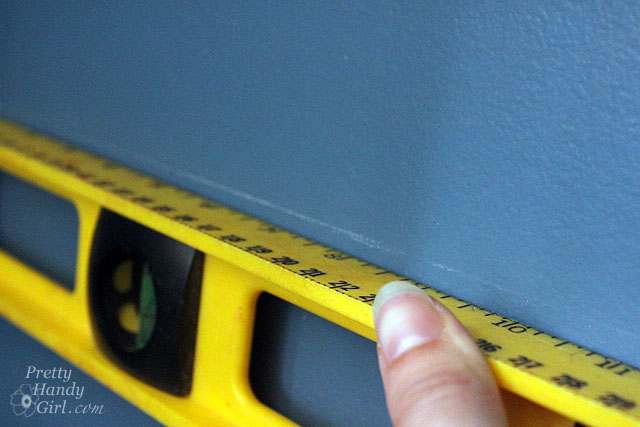
Use a level and a pencil to mark a line where the top of the smart tiles will be installed.

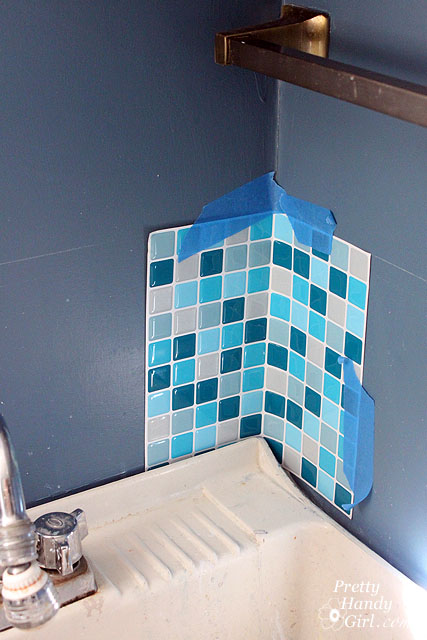
Dry fit all the tiles sheets. Start in the corner (if you have one.)

 Tape up all the tile sheets using painter’s tape.

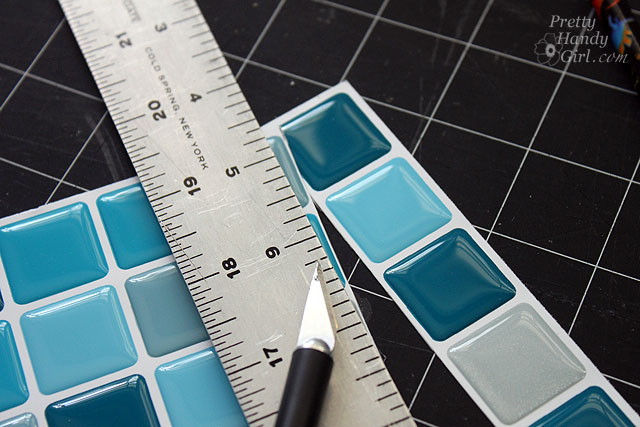
Cut any excess off the sheets and cut any additional tiles needed for the installation.

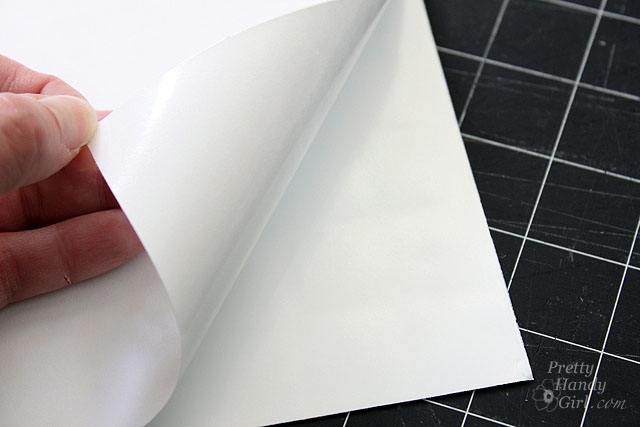
Peel the backing off and carefully adhere the tile sheet to the wall. Try very hard not to touch the adhesive backing.

Line the tile up with the level line.

Press firmly against the wall and smooth your hand over the sheet to remove any air bubbles.

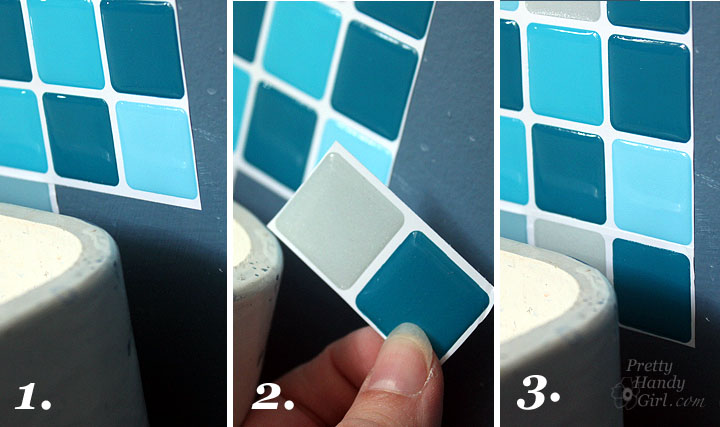
For any holes: 1) Count tiles for the hole. 2) Cut out that many tiles. 3) Stick them on and admire how well they blend with the existing tiles.

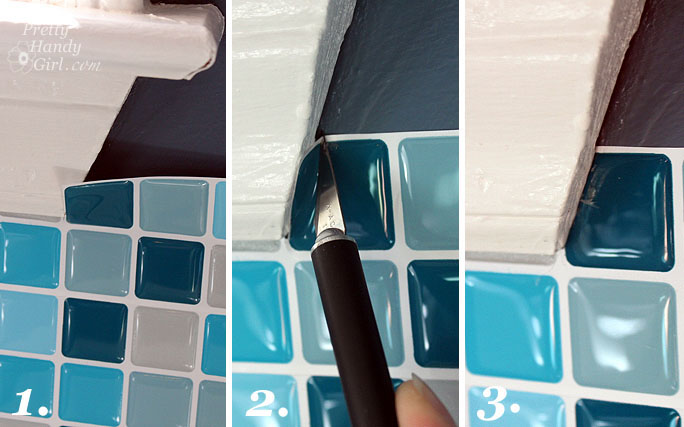
Another reason the Smart Tiles are a breeze to install is because they are flexible, you can wrap it around an object, then mark the cut and use an X-ACTO knife to cut away any excess.

That is all there is to it! Stand back and admire your handy work!

I loved the ease and simplicity of the Smart Tiles. They look real until you get up real close and notice that they are not as thick as glass tiles on the side. To fake the sides, you could fit a thin piece of molding on the sides and the top to give it a more finished look.

Although these tiles are easy to install, they cost about the same as the real thing. However, you will save money on grout. And you will definitely save time (and we all know that time is money!)

The tiles I installed have wiped off very easily and they don’t show splashes. A few of the corners have started to peel up where I wasn’t  careful about not touching the adhesive backing. The rest of the seams are holding tight.

If you are looking for a quick and easy solution to update your backsplash, I highly recommend the Smart Tiles.

That being said, if you want a more permanent solution, I recommend spending about the same amount of money and take the time to install glass mosaic tiles.

Note: They cannot be installed inside a shower where the conditions are very wet. In the kitchen, if installing behind a gas range without a back panel, you need to leave a safety zone.

You can purchase them at your local Home Depot in the US,  online, or at these locations.

Update: The Smart Tiles I installed eventually started to peel and didn’t look so smart. I’d recommend this for a temporary backsplash, but for a more permanent solution go ahead and tile your backsplash. It may be a little more work, but it’s not difficult to tile.

Disclaimer: I was sent one packet of 6 Smart Tiles to try. This is not a paid review, all opinions and the project are my own. If I don’t like a product, you won’t see a review on my blog. For more information about product reviews and my disclosure, read this.

When last we left our gal, Pretty Messy Girl was embarking on a journey into the bowels of her garage. There were crevices and corners that hadn’t seen a shop-vac in years. Dead spiders and centipedes lurked in their dark and dusty hideaways. Fearlessly, she dove head first into the task at hand and with her hero, the Bagster at her side, she overcame the clutter despite the odds!

How did she do it you ask? Well, come with me (if you dare) to see how she took a cluttered disaster of a garage and made it into a serene DIY work haven (okay, that might be stretching it a bit.)

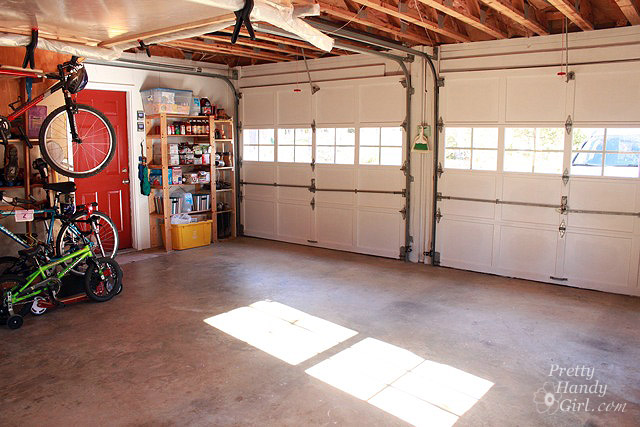
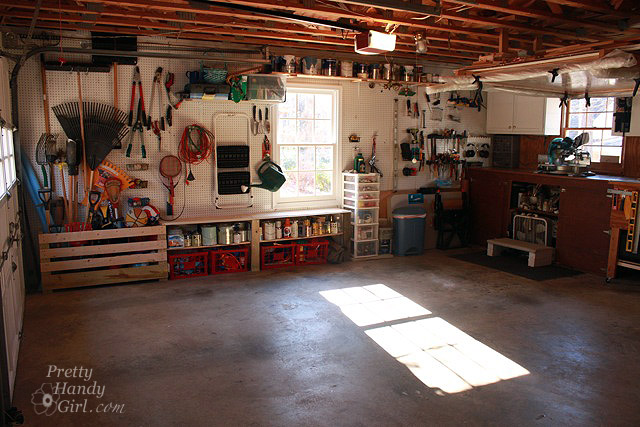
Here is how she shoe-horned lawn equipment, garden tools, four bikes, two scooters, safety gear, sports equipment, balls galore, games, swim and outdoor activities, beach things, shoes, food storage, paint, paint and more paint …(deep breath)…AND an entire power tool laden workshop into this small space.

First she cleared out the entire garage. What was left was a dusty, dirty, and dark cave. All the “crapola” was placed into the Bagster. A little comment from Pretty Messy Girl:

I must say that I really didn’t mind having Mr. Bagster hanging out next to our driveway for a few months. It weathered the rain and wind. And gladly accepted anything I put into it (with the exception of certain items that you can’t dispose of: paint, appliances, and a few other hazardous waste materials.) Now, if I had a big dumpster blocking the view and creating an eyesore for the neighbors, that would be a different story!

The bag was super easy to set up and it held the items inside. Occasionally a side would flop over, but if I put big and ridgid items inside the edges, the sides would stand up better.

A few trips were made to Goodwill and a few more trips into the attic (don’t ask what lurks up there. Gulp!) Once the garage was cleared, she gave it a good cleaning with the shop-vac.

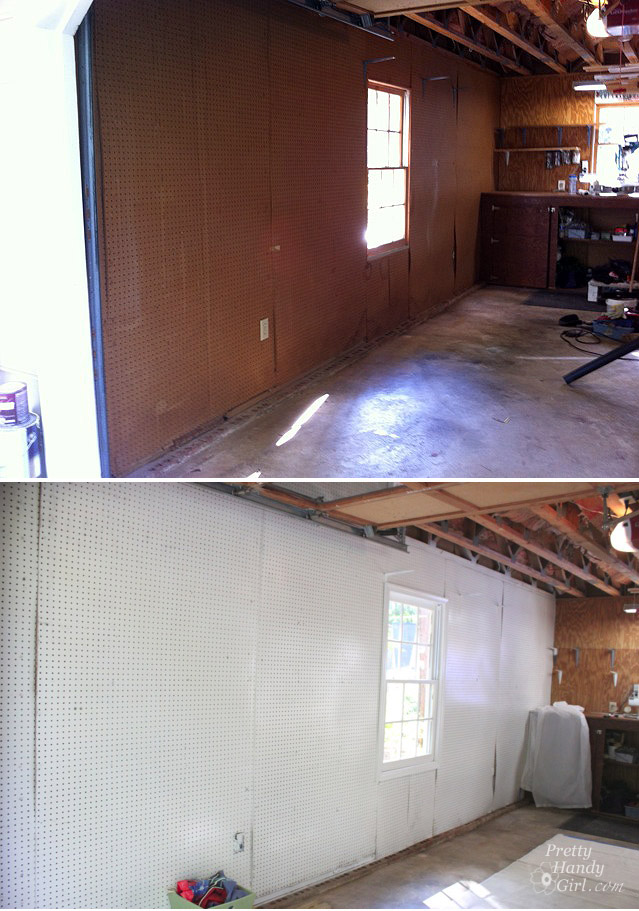
Then she decided that she MUST paint the walls of the garage. Pretty Handsome Guy thought she’d fallen off her workbench. I mean, why paint the inside of a garage? Well, let’s just say that you can thank her later. The results speak for themselves. The amount of light in the garage now makes it a lot easier to photograph tutorials.

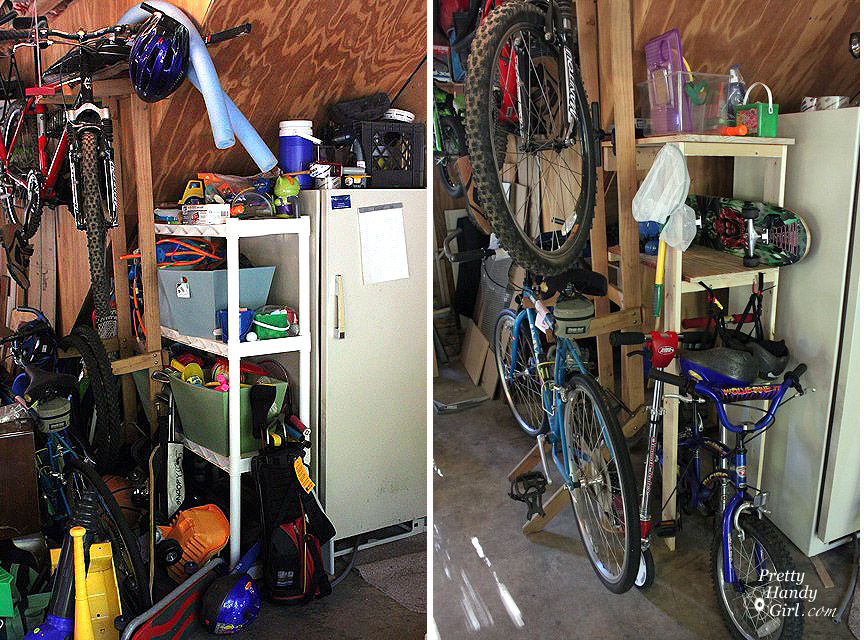
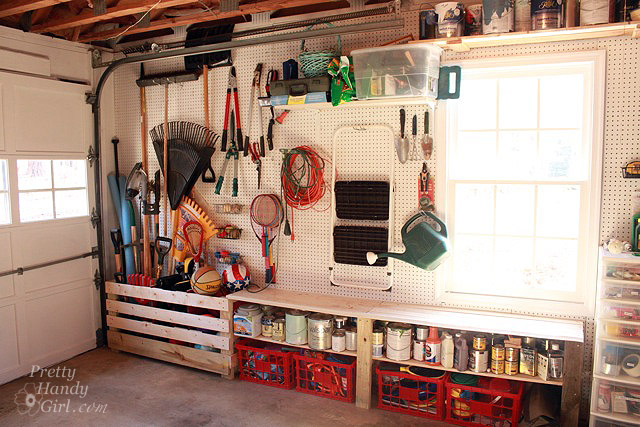
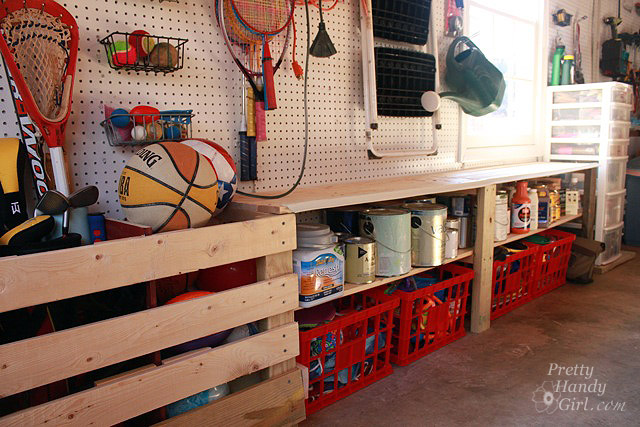
Next came the quest to squeeze a gallon worth of stuff into a quart sized container. Pretty Messy Girl uncovered several nooks and crannies that were not being utilized in the garage. And she built several custom shelving units to take advantage of the wasted space. One for the bikes and safety equipment:

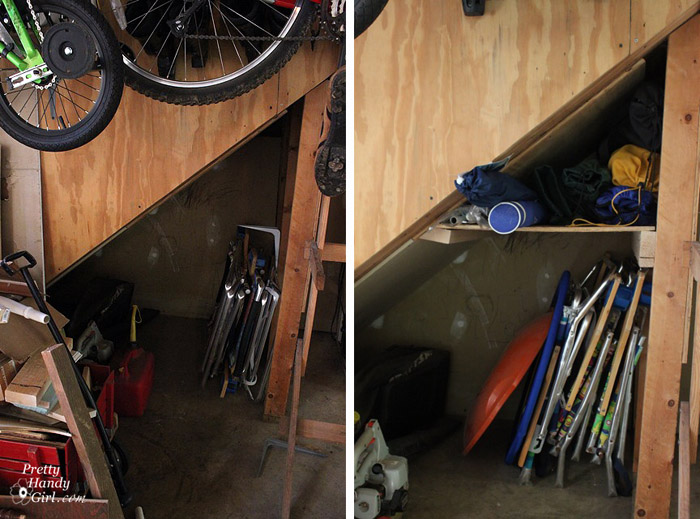
A shelf for the beach umbrellas and folding chairs (did you see that empty space above the beach chairs! That was a crime! Wasted space has no business in this garage.

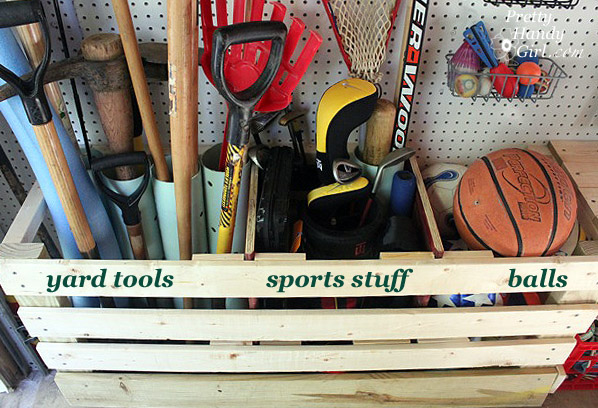
She also designed a yard-a-sport-o-ball collector. But, it is easier to just say the corral.

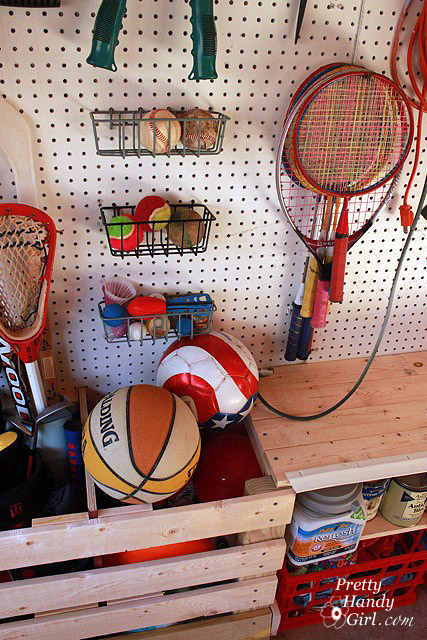
The corral was created to maximize storage for those items that are always grabbed for on a regular basis. The rakes and yard tools used to each have separate hooks on the peg board, but that took up a whole wall worth of space! Now, they take up a small 4′ x 2′ space.

To hold the tools upright, she bought the cheapest and widest piece of PVC pipe she could find. Then cut the drainage pipe into 4 equal lengths. After bolting them together at the top and bottom, screwed them to a 2″x4″ that was attached to the wall. Voila! Perfectly upright storage for yard tools!

Two more compartments were created in the corral by nailing small scraps of 1×4″ boards and then cutting a piece of plywood to slide between the scraps and create a separate compartment for sports “sticks”. And another compartment for all the balls that come standard with two small boys! What is it with boys and their balls? (Wait, don’t answer that!) I don’t think I owned more than two balls as a child. (Now I’m getting myself into innuendo-trouble.)

Attached to the corral are two built in shelves specifically sized for all the paint. Yes, she has an ever growing paint collection! (An artist has to have options, ya know!) And plastic milk crates below store water toys and games.

garage organization

Do you remember the paint storage before? She’s extremely lucky no one called the Shelf Protective Services Division. That is just cruel and unusual punishment!

The plastic storage shelves have been sent out to pasture to retire in a life of ease (holding empty plant pots under the deck.)

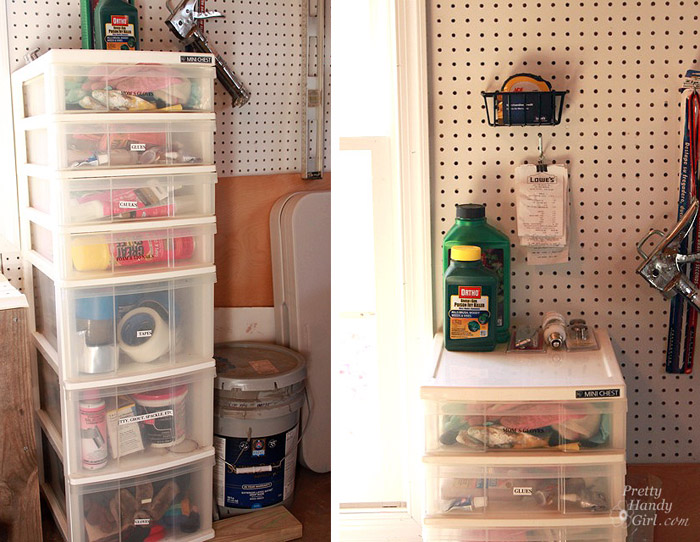
Where the paint used to be, she pulled  a plastic storage chest from the attic (Yes, there is an entire store to shop from up there.)

The plastic drawers are perfect for housing tape, caulk, glue, gloves, etc. And in a stroke of genius — not really, but why she didn’t think of this before, we’ll never know — she added a binder on a hook to hold all the home improvement receipts. AND this is also where all the items to be returned wait (for the one day that they will be reunited with their family on the store shelves.) When that day arrives, and months have past, she can store all the merchandise credit cards in the little wire shelf. (She does a little jump kick every time she raids that stash of pre-paid cards.)

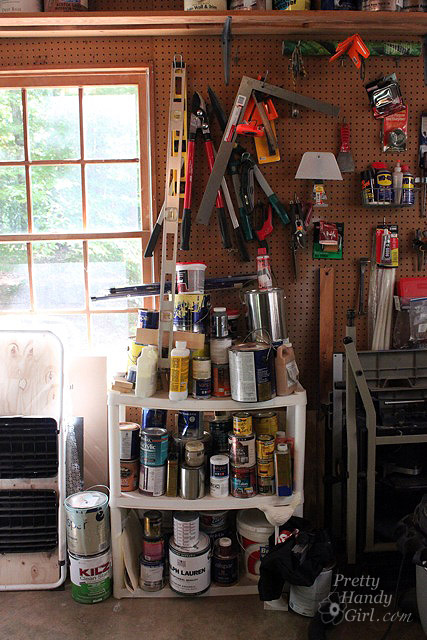
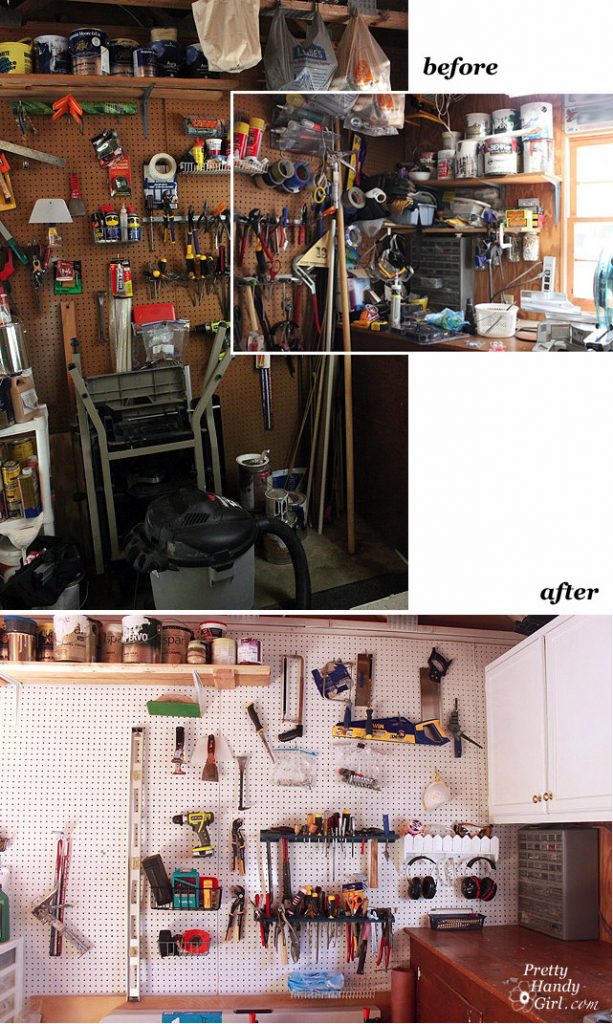
Moving right along, this was definitely the most disorganized section of the garage. The tool storage near the work bench. What a crying shame. What DIY woman could live with that? (Obviously Pretty Messy Girl, that’s who.) Well, it is a mess no more. With some new tool storage and some thought put into tool useage, she tamed the tool clutter.

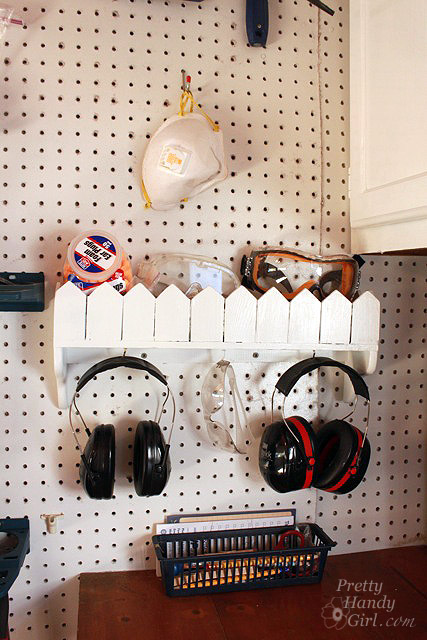
And a special spot was chosen for all the safety gear (to be a constant reminder of how important it is to wear them)! Right Meri-K?

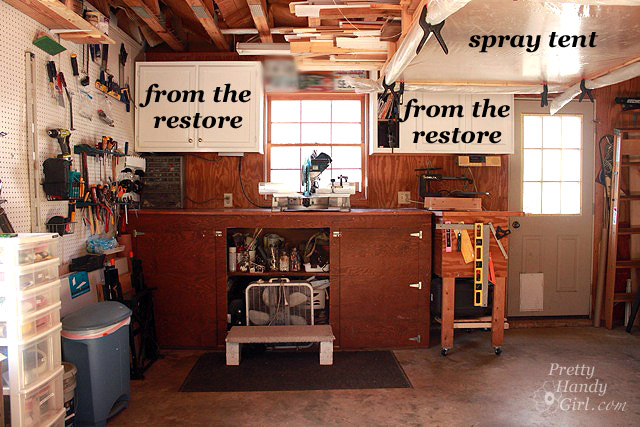
We come now to the dust protection area. With the miter saw being Pretty Messy Girl’s right hand man, this area had seen mountains of sawdust. Cans of paint, and anything that was on the open shelving always had a 1/4 – 1/2 inch of accumulation. But, not anymore! Two cabinets were purchased from the Habitat ReStore and hung on the wall. (The price was a real steal! $50 for both.) A fresh coat of paint gave them new life. Someday she hopes to paint the wall and workbench to match. Some day (a girl can dream can’t she?) In addition to sawdust, paint dust can become a real problem in her lair. One time she and a friend spray-painted some chairs and the entire garage and everything in it looked like a coal mine. A spray tent was added to the underside of some rafters. Plastic sheeting simply tacked up with 1×2″ boards and the sides are rolled up and secured in place with extra large clamps. (PVC pipes inside the plastic help make rolling up neat.)

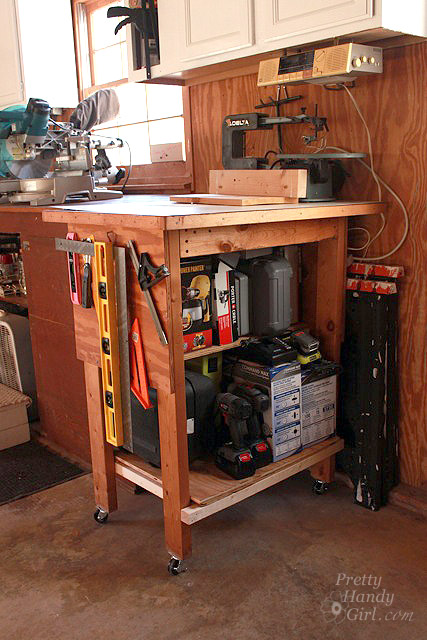
The rolling tool caddy is tucked away on the right side of the workbench. Moveable storage for all the power tools.

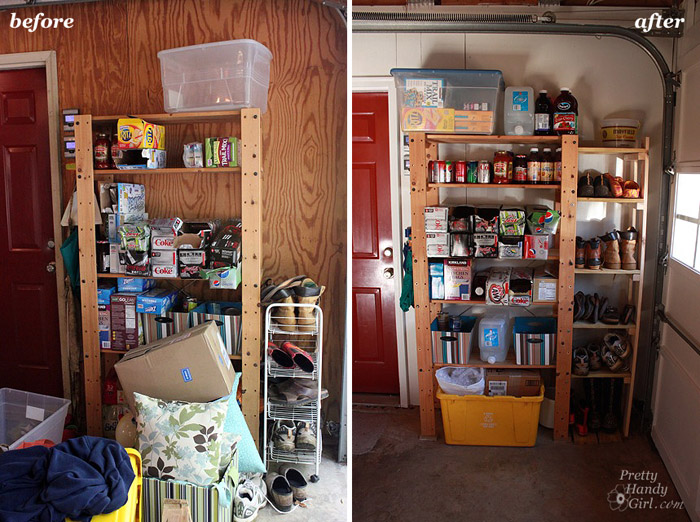
An annex was built onto some IKEA shelving for shoes and boots. (And excess food storage.)

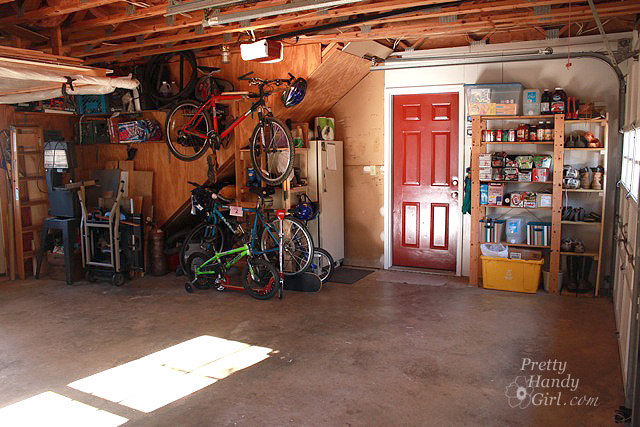
And that brings us back to the beginning.

This is one useful garage once again.

And Pretty Messy Girl has now reclaimed her title of Pretty Handy Girl! Woot!

What do you think? Did you get any ideas for storage solutions? Is there anything that could work for your garage or workshop? If you need to clean out some serious “junk”, think about buying the Bagster. It is like a dumpster in a bag! For $29.95 you can purchase it at your local hardware or home improvement store. Pick up charges vary from about $79 – $159 depending on your location. It was really nice to be able to just toss the stuff inside and call a handsome young man to come haul it away!

And the bonus comes when the truck arrives to provide entertainment for mom your children. Watching the crane arm pick up the Bagster is really really cool!

And now the moment y’all (well at least me) have been waiting for: a video of the Bagster Bag being lifted up and taken away by crane. Pretty Handy Girl says,

I am seriously such a geek, I was über excited to watch this. I even told Waste Management to have the driver call my cell phone so I could be there to watch. My 5 year old son had to hold my hand and keep me from jumping up and down. Eeeeeekkkk!

I almost forgot the best part: There is now room for Pretty Messy Mobile! I don’t think there is any hope for the car. Any mom knows that there is no such thing as a clean car when you have kids. Old cheerios and raisins have a final resting place in between the seats of this carpool vehicle.


The End!

Here is a little more information about our superhero, The Bagster:

While households look for ways to save money, more homeowners are tackling projects themselves from bathroom remodels to flooring projects to spring cleaning. The Bagster® bag is an innovative, convenient and affordable solution for smaller home improvement projects.

The Bagster® bag is a highly durable, woven bag designed for disposing as much as 3,300 pounds of debris and is big enough to hold full sheets of plywood, doors and even a bathtub.

The Bagster® bag is a convenient choice for any home improvement project.

  • – Often times construction debris can’t be picked up from the curbside, so consumer now have a great solution when a dumpster is too large for the project.
  • – The Bagster® bag is ready when you are – great for last-minute projects or ones that need an extended period of time to complete.
  • – Consumers can use the bag for as long as they like, then schedule a collection when the bag is full or their project is finished. The bag and collection service are always ready, putting consumers in control of their projects.
  • – Collection can be scheduled online at www.thebagster.com or by calling 1-877-789-2247, and Waste Management will collect the bag within three business days.

The Bagster® bag is an affordable solution for homeowners and a great way to save money on do-it-yourself projects.

  • – Bagster® bags cost just $29.95 and the flat rate collection fee ranges from $79 to $159 per bag, depending on your area – 50 to 70 percent less than a dumpster rental.

Waste Management has made the Bagster® bag a simple solution for waste and debris removal.

  • – Consumers can purchase the lightweight bag at more than 2,000 locations across the country, use it for as long as they like, then schedule a collection online or over the phone whenever they are ready.
  • – The Bagster® bag is sold at local home improvement and hardware stores, including participating The Home Depot, Lowe’s, Ace Hardware and True Value. To find a local retailer near you, visit www.thebagster.com.

* For more information, visit www.thebagster.com.


Disclosure: Waste Management partnered with bloggers such as myself to participate in its The Bagster® Bag Blogger Challenge. As part of the program, I received compensation. They did not tell me what to purchase or what to say about the products used for the The Bagster® Bag Blogger Challenge. Waste Management believes that consumers and bloggers are free to form their own opinions and share them in their own words. Waste Management’s policies align with WOMMA Ethics Code, FTC guidelines and social media engagement recommendations. You should know by now, that I will never write about a product that I didn’t like.