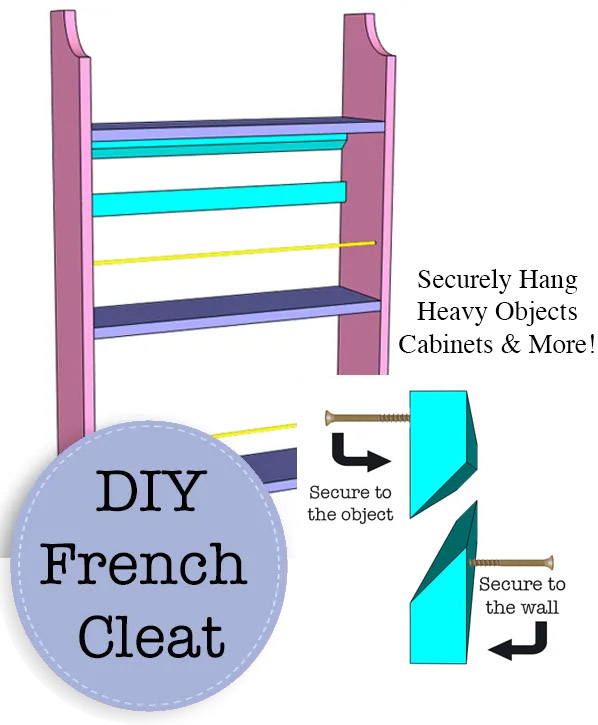
diy french cleat

I am going to teach you how to securely hang heavy objects on the wall with a board and a few screws. Using a French Cleat has been a tried and true method for hanging heavy objects and is used by professional cabinet makers and DIYers alike. It can be incorporated into the item being built or added after the fact.

DIY French Cleat

How to Make a French Cleat

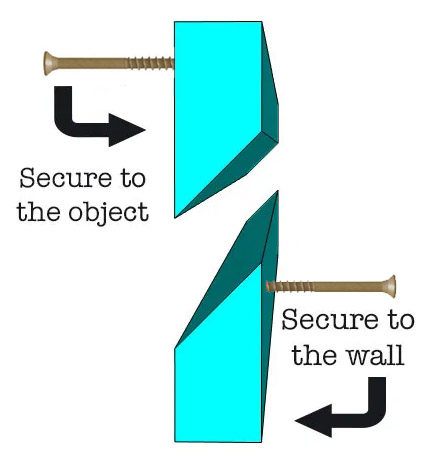
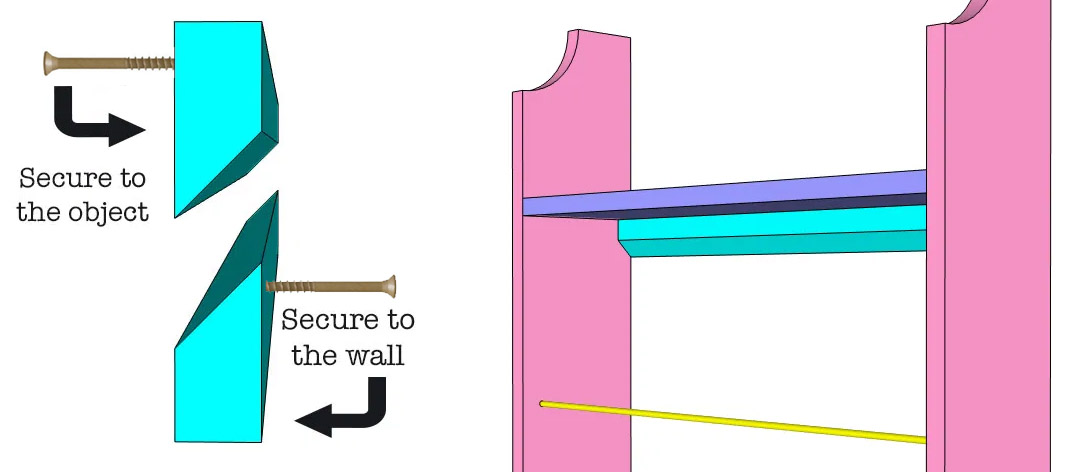
What is a French Cleat?  A French Cleat is a board or molding with a 30°-45° bevel cut attached to the wall along with a corresponding beveled board or molding attached to the object to be hung on the wall. That sounds a little confusing but check out the diagram below and it will all make sense. First let’s grab a few supplies.

DIY French Cleat

Materials:

(I’ve included affiliate links for your convenience. I earn a small percentage from a purchase using these links. There is no additional cost to you. You can read more about affiliate links here.)

  • 1″ x 3″ board or 3/4″ plywood strip (3″ minimum width)
  • 2″ screws

Tools:

Instructions:

Step 1:

Measure the length that you need your French cleat to be. Typically a french cleat is the length of the item to be hung on the wall and spans the length of at least 2 studs in the wall that the item will be secured to.

Step 2:

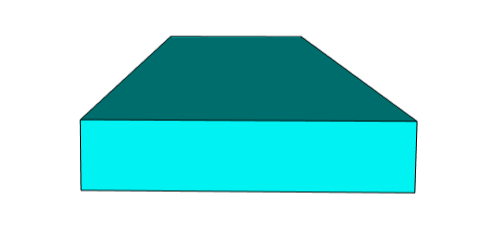
Adjust your table saw or circular saw to a 30°-45° bevel and rip your board along the center. (For tips on using a table saw safely, read this article.)

Step 3:

Secure the top piece of the cleat to the item to be hung (see diagram shown below). This can be done with pocket-holes, glued under a shelf, or with screws to the back of the item. (You may want to pre-drill your holes to avoid splitting the wood.)

DIY French Cleat

Step 4:

Choose the height at which you want to hang the item on the wall and mark where the bottom cleat will be placed. Mark the studs that the cleat will be screwed into and secure the cleat to the wall using wood screws and a level in the orientation shown above. (Again, you may want to pre-drill your holes to avoid splitting the wood.)

Step 5:

Gently place the object above the wall cleat and lower until the two pieces are securely nested together.

Often times the weight of the object and the angle of the beveled cleat is enough to keep the object securely in place. But, if you’re worried about children lifting the item, you can add a screw through the hanging object into the cleat or a wall stud for peace of mind.

DIY French Cleat

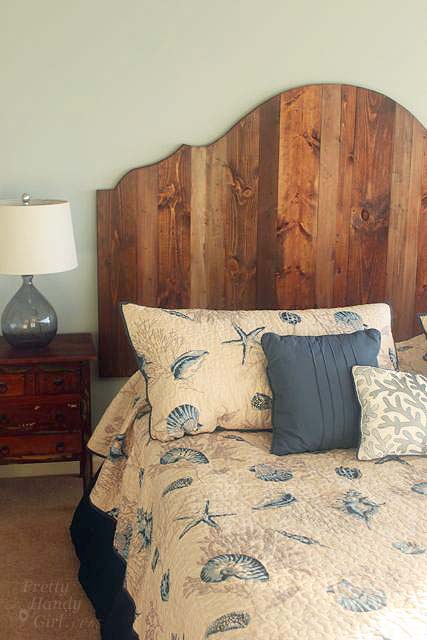
And if you’re excited about using a French Cleat, you might like to make a headboard that is hung on the wall using a French Cleat!

rustic-king-headboard-side-view

This is a great tip for hanging cabinets on the wall as well. I hope you try your hand at making and using a French Cleat soon. Let me know how it goes!

Hi! I’m Kristen, from In Her Garage, and I am a self-taught woodworker and DIY fanatic from Minnesota where I live with my husband and our two daughters. Between being a wife, mom and, registered nurse, I try to make as much time for DIY as possible. My love for building came after our family built our current home in 2015. After we moved in, we needed furniture and instead of spending massive amounts of money to order the pieces we wanted I decided that I would build them myself. I started with a buffet table plan from the fabulous Ana-white and quickly set out to remodel my entire home office.

Since then I have started a side business building furniture for the people in my community. I love hearing my clients talk about the pieces they wish they had whether it be a rustic buffet table, a one drawer side table, or a toy box and then making it a reality for them. While starting my small business it made perfect sense that I would document my building journey so I simultaneously launched the In Her Garage blog and I love sharing my plans, tips and tricks.

Making something beautiful with your own two hands through a little preparation and determination is an amazing feeling and I hope to bring inspiration and know-how to those looking to tackle a big or small project.
I am so glad that you found me here and please feel free to connect with me on PinterestInstagram, Facebook, and Youtube to see what I am working on right now.


modern boho side table

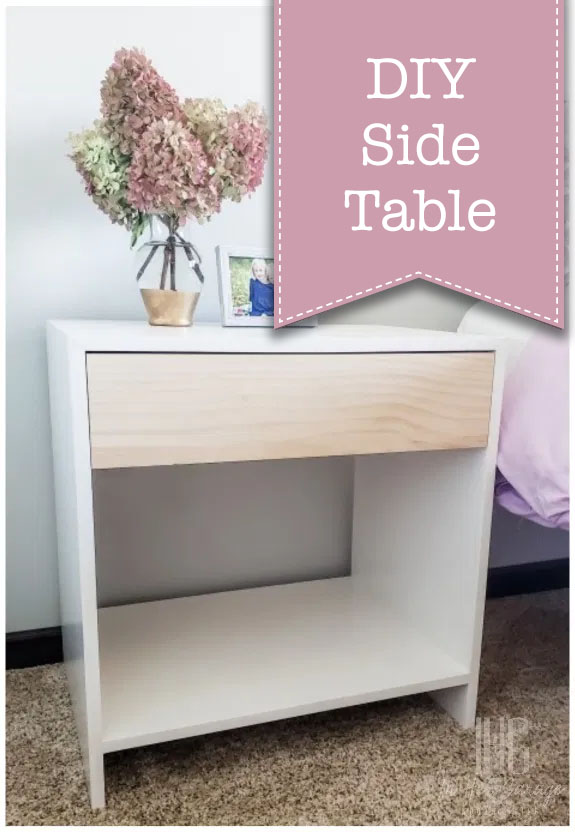
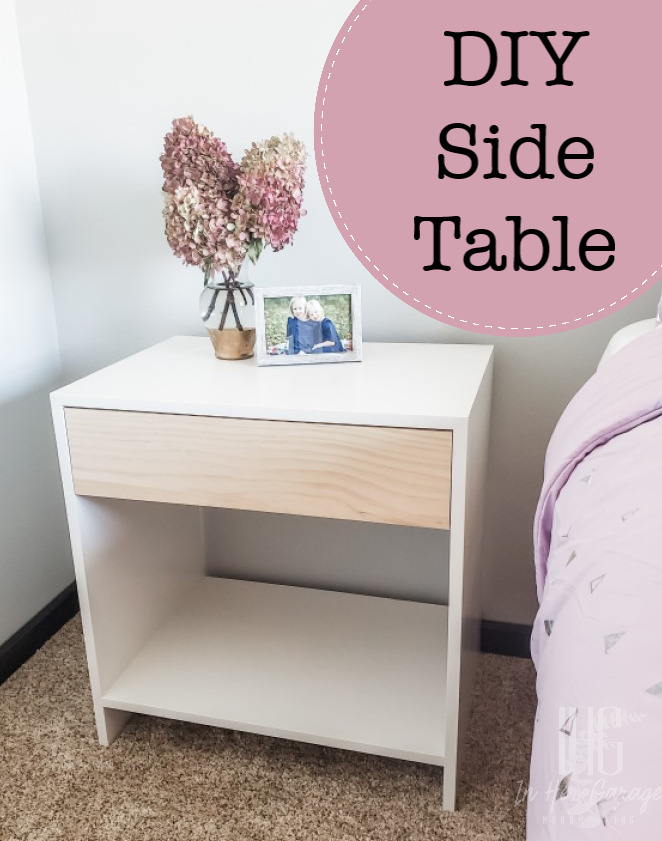
I built this side table as part of the bedroom furniture set for my daughter’s new room. It may look a little complicated, but can be built with a circular saw or a table saw.  Let’s make this DIY Modern Boho Side Table!

diy side table

DIY Modern Boho Side Table

Hello again! This is Kristen from In Her Garage and I am going to show you how I built this simple DIY side table (or nightstand). I built this as part of the bedroom furniture set for my daughter’s new room. We decided that we liked the Boho furniture trend and think it complements the bedding she picked out.

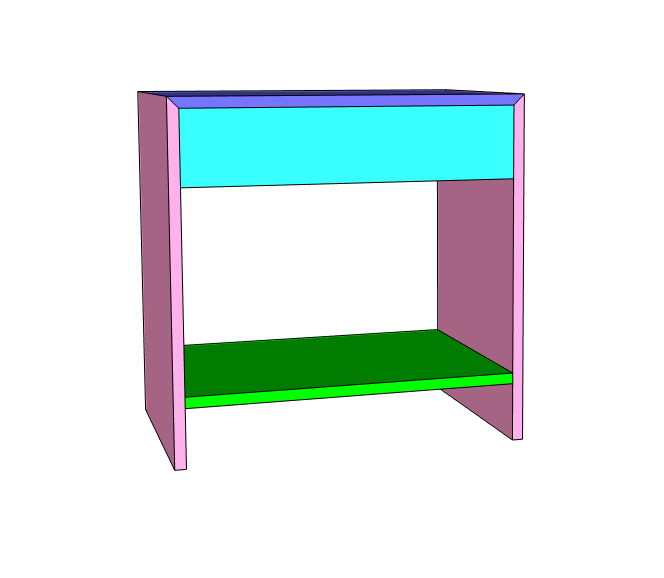
This side table is small but can be customized to your desires. It measures 24″w x 24″h x 17″d and is made from birch plywood. The side table incorporates beveled edges (which I think gives it a crisp and clean look).  It may look a little complicated, but these corners can be achieved using a circular saw or a table saw.  Let’s get making!

How to Build a Side Table

Materials:

(I’ve included affiliate links for your convenience. I earn a small percentage from a purchase using these links. There is no additional cost to you. You can read more about affiliate links here.)

Tools:

Cut list:

  • 2- 3/4″ x 24″ x 17″ – with a 45° bevel along one short edge (sides)
  • 1- 3/4″ x 24″ x 17″ – with two 45° bevels along both short edges (top)
  • 1- 3/4″ x 22 ½” x 17″ (bottom shelf)
  • 1- 3/4″ x 22 ¼ ” x 5″ (drawer face)

Instructions:

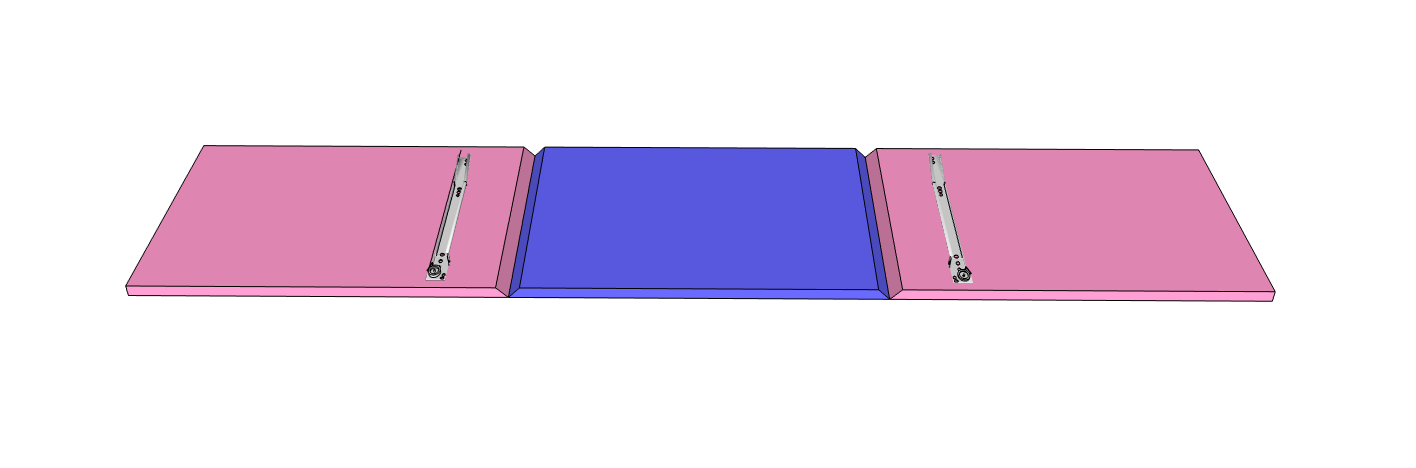
Step 1: Cut the bevel into the top and side panels of the side table.

  • Using either your table saw or your circular saw, adjust the blade to cut at a 45° bevel.  To get this measurement exact I use a Wixey Digital Angle Finder which is helpful but if you don’t have this tool then feel free to use a speed square or protractor.
  • Each side panel should have one bevel cut along the top edge
  • The top panel should have a bevel cut along each side as pictured below

Step 2: Add pocket holes to the shelf panel

  • Using your Kreg Jig, set to 3/4″ depth, drill three pocket holes into each side on the bottom of the shelf panel.  This is how your shelf will attach to the sides of the side table.

Step 3: Edge banding

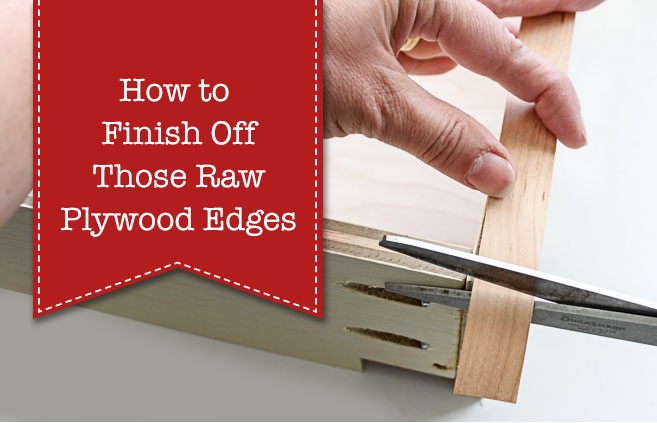
I won’t go over all of the steps for applying iron-on edge banding in this tutorial because the Pretty Handy Girl has already done this for me! If you are new to edge banding check out Brittany’s Edge Banding Tutorial.

  • You will need to edge band the front edge of each panel (side panels, top panel, and shelf panel). This will finish the visible sides.
  • You can also edge band all edges of the drawer face if you wish.  This piece will be inset into the side table, so the edges won’t be visible when the drawer is closed but you’ll see them when open.
  • Another option would be to use a solid piece of 1×6 for the drawer face to avoid needing to band the edges all together. (I used a scrap piece of 1×6 so it didn’t need edge banding.)

Step 4: Install drawer slides to table carcass

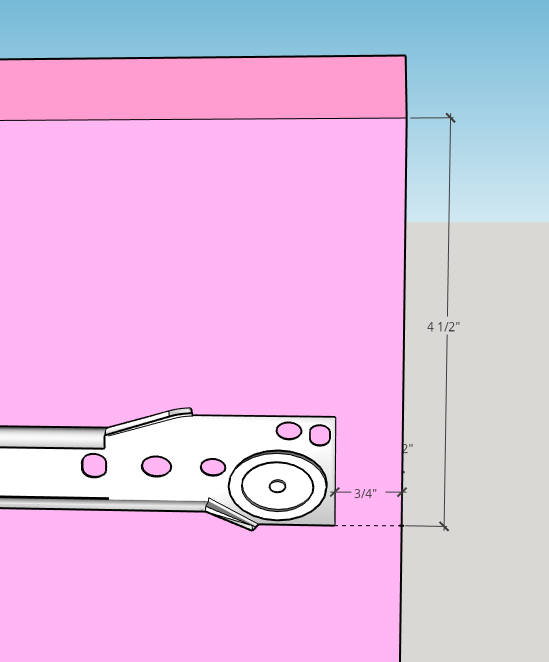
  • Install the drawer slides (meant to attach to the cabinet) on the inside of each side panel measuring down 4 ½” from the top of the bevel and 3/4″ in from the front edge as shown.  This is the step where the self-centering drill bit is really helpful to have!


Step 5: Assemble the sides and top panels. The table will be upside down during assembly

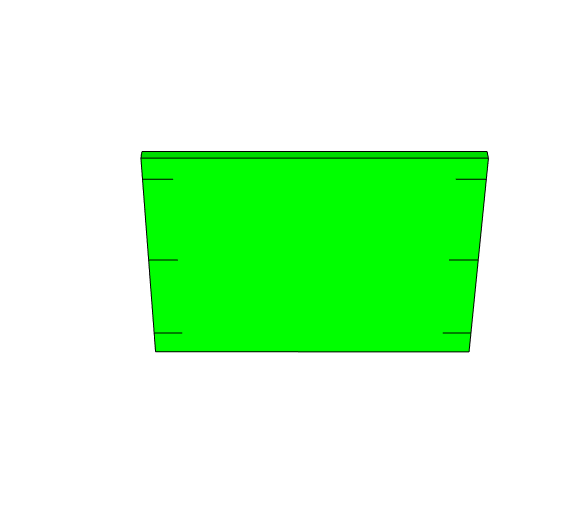
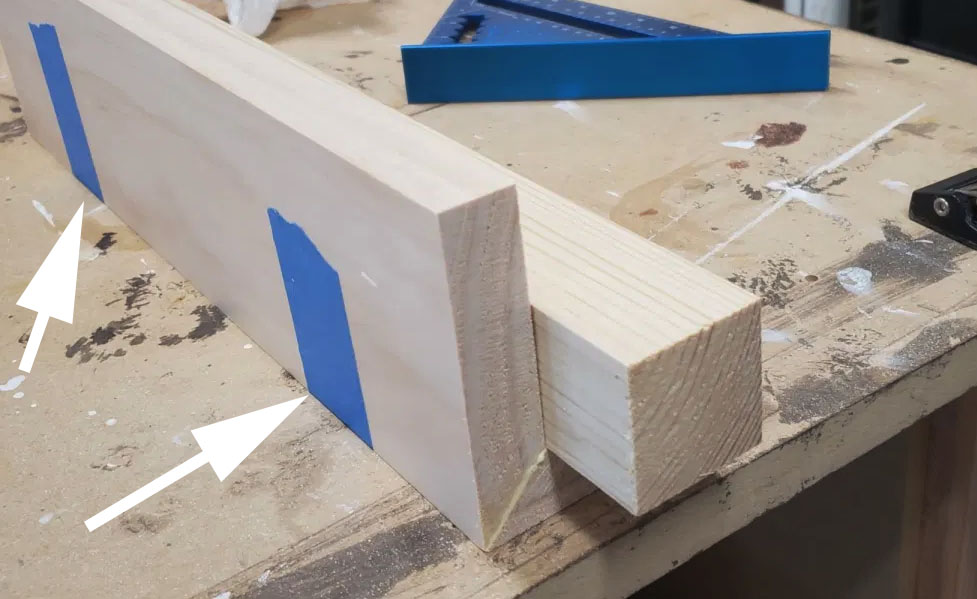
  • Add two pieces of painter’s tape to each of the two outside edges of the top panel, perpendicular to both beveled edges.
  • Set the top panel down on your work surface upside down, sticky side of the tape facing up, and place the two side panels with the beveled edges touching the top panel’s beveled edge, also being sure to align the front and back of the panels. Press down firmly so the tape sticks to all three panels.

  • Add an even bead of glue to both beveled surfaces and then lift one side panel as if closing a book. The two beveled edges will meet, and the tape will hold it in place (see photos below). Repeat this step for the other side panel.

The photo below is from another project, but shows how to use painter’s tape for holding the bevel joint in place.

tape back for bevel joints

  • You can add a few 1 ¼” brad nails to the joint to help hold it in place. Use wood putty to fill in the brad holes and sand smooth.

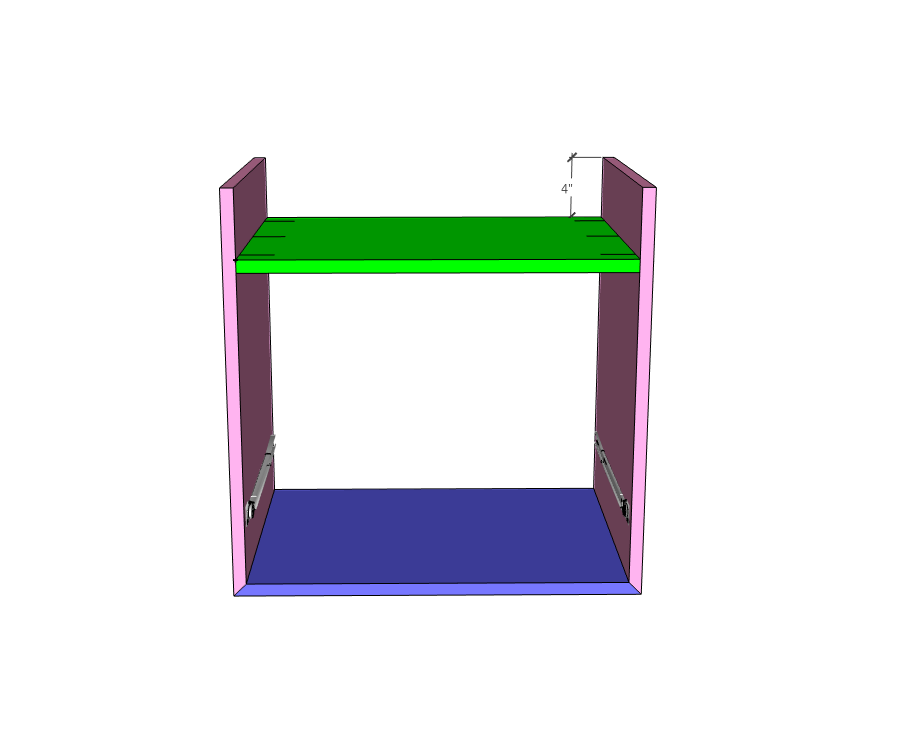
Step 6: Install shelf panel

  • Install the shelf 4″ from the bottom of each side panel using wood glue and 1 ¼” pocket holes.
  • This step is easier to accomplish with wood clamps or by carefully laying the table on one side.

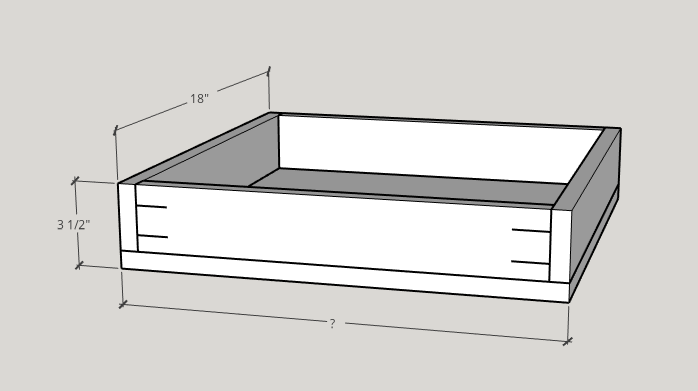
Step 7: Build the drawer

  • There are several different ways to build drawer boxes. The dimensions for this drawer are 3 ½” tall and 18″ deep. The width of your drawer depends on the specific drawer slides that you’ve chosen to use. I have provided a diagram for a simple method of building drawer boxes. (Or you can follow this tutorial for building drawers.)


Step 8: Paint or Stain and Finish

  • Once the side table carcass is assembled and the drawer face has been edge-banded (if that is what you chose to do) then you can paint or stain your DIY side table.  I chose to paint the carcass and apply a gloss top coat to give it a pretty shine. I left the drawer face a natural wood color because this is what looked best in my daughter’s room.

Step 9: Install the drawer face

  • Once the carcass and drawer face are finished to your liking then you can slide the drawer box into place.
  • Attach the drawer face using super glue and simply eye-balling the top and side gaps. Hold the drawer face firmly against the drawer box until they adhere together.  Then gently pull the drawer out and drive two 1 ¼” wood screws from inside the drawer into the back of the drawer face.

  • Feel free to add a pretty drawer pull or knob if you want. My daughter liked it without, so we decided to leave it as is.

Check out the entire furniture collection that I created for my youngest daughter’s bedroom.

DIY Platform Bed and DIY Quote Sign

Stay tuned for the DIY Hanging Bookshelf that I will be teaching you how to make next month!

Hi! I’m Kristen, from In Her Garage, and I am a self-taught woodworker and DIY fanatic from Minnesota where I live with my husband and our two daughters. Between being a wife, mom and, registered nurse, I try to make as much time for DIY as possible. My love for building came after our family built our current home in 2015. After we moved in, we needed furniture and instead of spending massive amounts of money to order the pieces we wanted I decided that I would build them myself. I started with a buffet table plan from the fabulous Ana-white and quickly set out to remodel my entire home office.

Since then I have started a side business building furniture for the people in my community. I love hearing my clients talk about the pieces they wish they had whether it be a rustic buffet table, a one drawer side table, or a toy box and then making it a reality for them. While starting my small business it made perfect sense that I would document my building journey so I simultaneously launched the In Her Garage blog and I love sharing my plans, tips and tricks.

Making something beautiful with your own two hands through a little preparation and determination is an amazing feeling and I hope to bring inspiration and know-how to those looking to tackle a big or small project.
I am so glad that you found me here and please feel free to connect with me on PinterestInstagram, Facebook, and Youtube to see what I am working on right now.


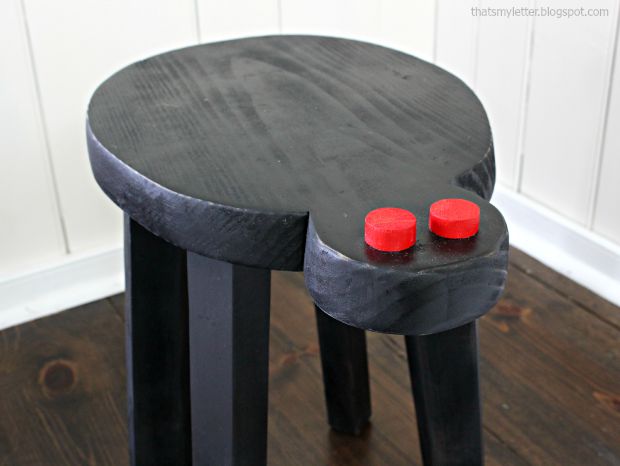
Halloween is lurking around the corner like a stray black cat. Luckily I’m here with the perfect project for Halloween that will use up some of your scrap wood pieces. Let’s make a DIY Spider Stool!

spider stool title

DIY Spider Stool

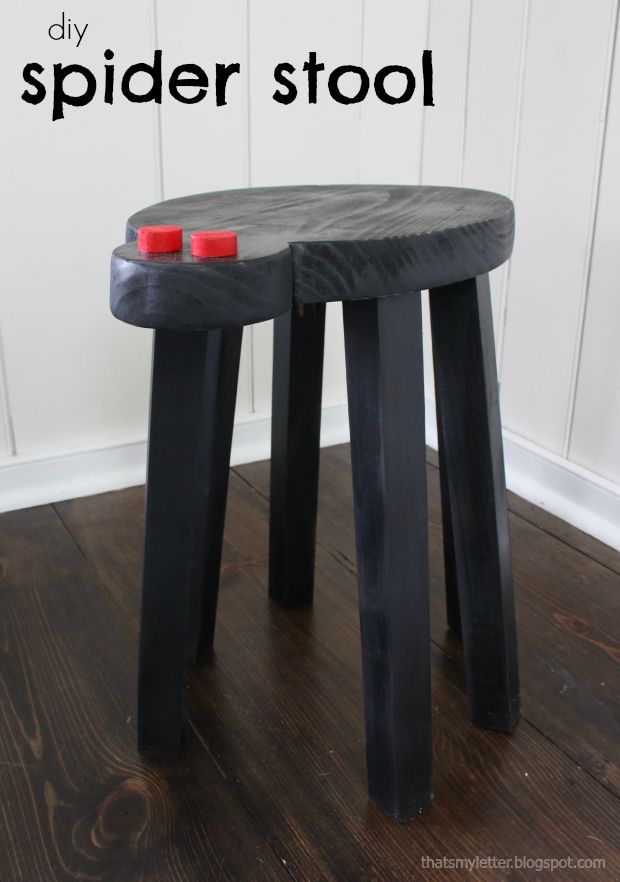
I have a spooky little spider project today being that Halloween is on the horizon.  I’m Jaime from JaimeCostiglio.com and I’m here to show you how to build this cute little spider stool.

spider stool 1

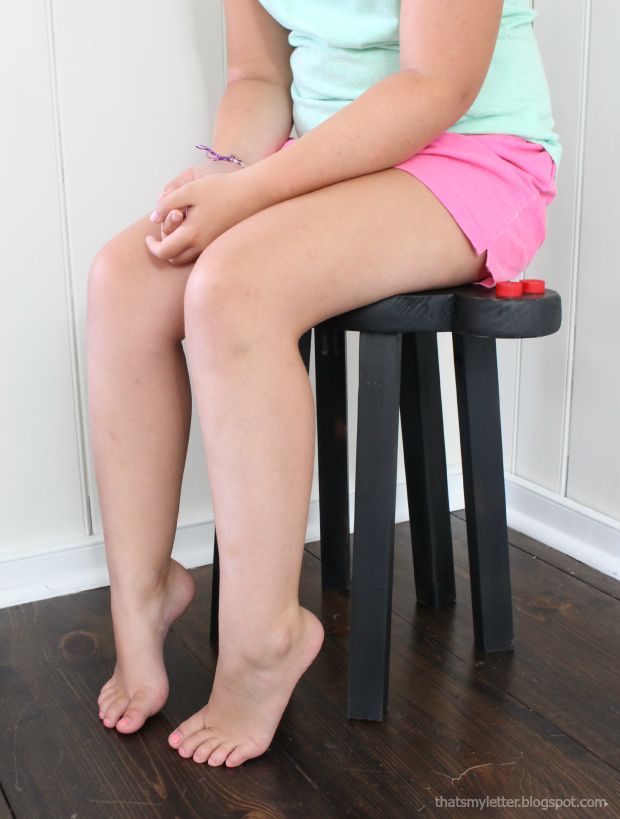
We all know Miss Muffet sat on a tuffet, when along came a spider —but, this time we’ll turn that nursery rhyme on its head. Let’s sit on that spider instead! This little stool is perfect for adding some themed decor to your kid’s playroom or a great spot to rest the treats near the front door on Halloween.  This spider stool is fairly simple to make and although most spiders have eight legs this one only has six. Shhh, don’t tell anyone. If you truly have an aversion to spiders,  you can always paint the body red with black spots and it would make a cute little ladybug stool.

spider stool with kid

Materials:

(I’ve included affiliate links for your convenience. I earn a small percentage from a purchase using these links. There is no additional cost to you. You can read more about affiliate links here.)

Instructions:

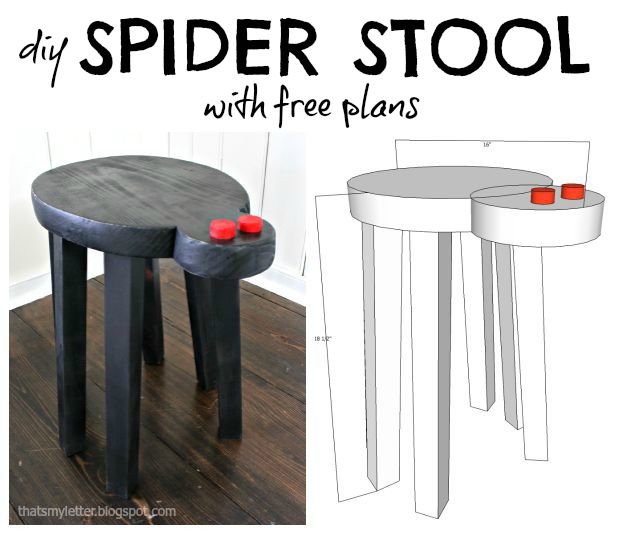
spider stool dimensions

spider stool body

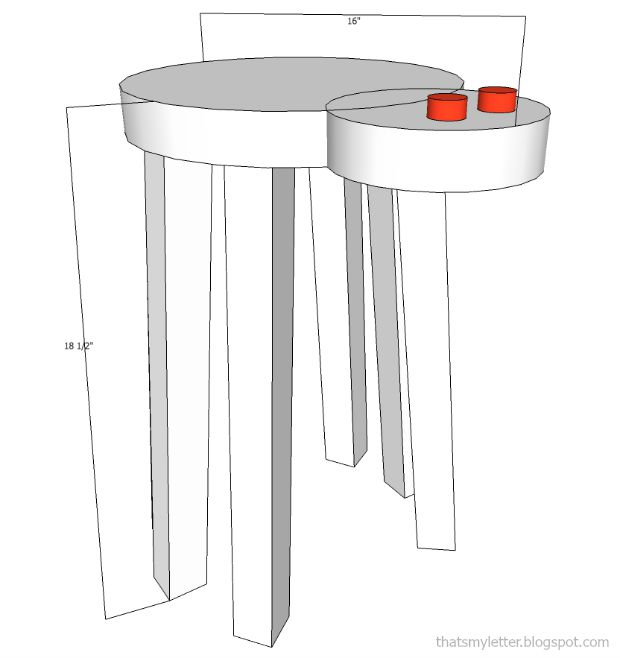
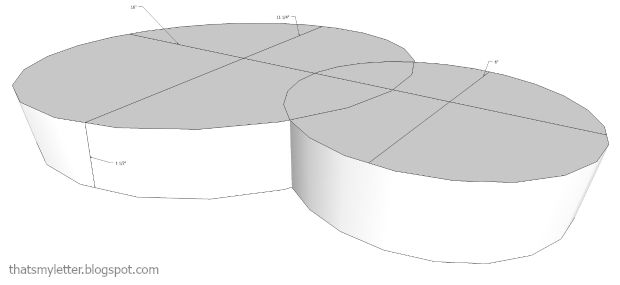
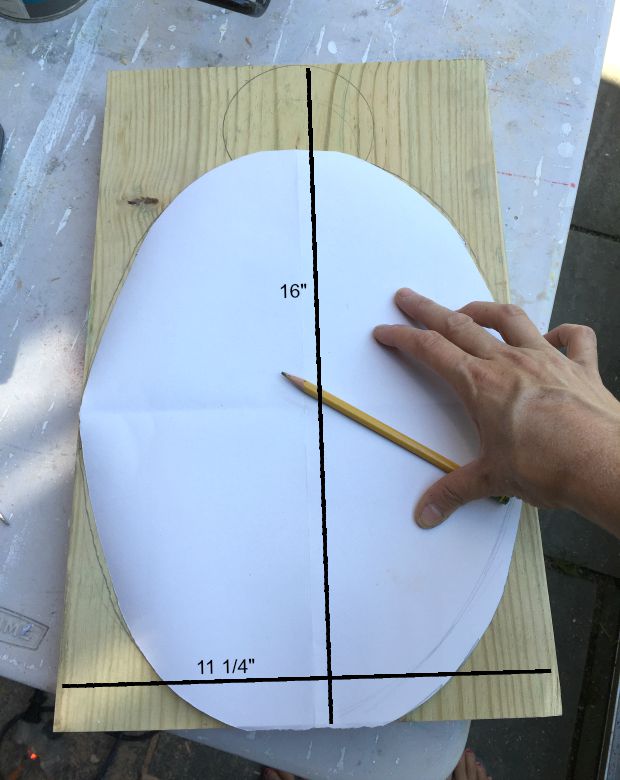
Step 1: Sketch the spider body shape on the 2×12. You can draw a large oval for the body and trace a drink glass or can for the head. The full length of the body and head equals 16″. The width is 11 ¼”.

spider stool layout

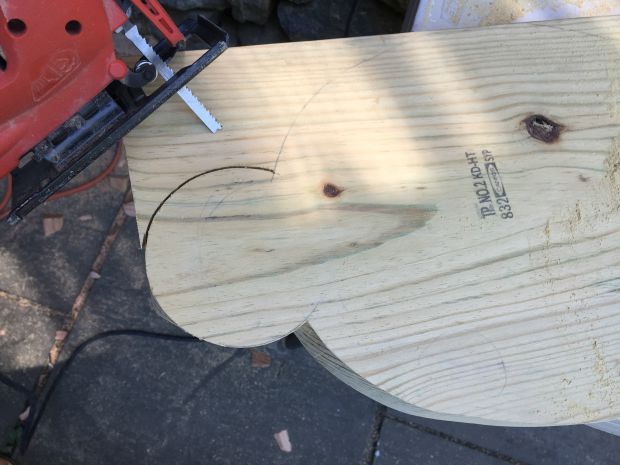
Step 2: Use a jigsaw to cut out the spider body.  Go very slow through the 1 ½” thick material and flip over to refine your cut if necessary.

spider stool cutout

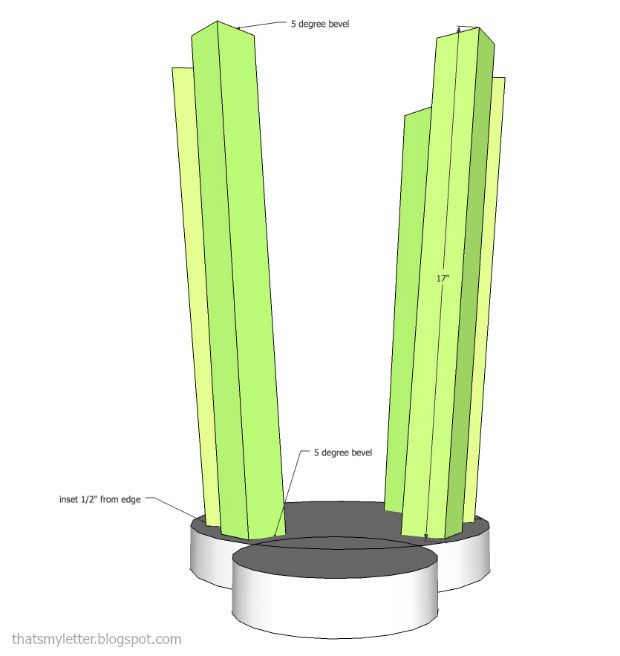
Step 3: Cut 6 legs with 5-degree bevel at both ends, parallel measuring 17″ from end to end.

spider stool legs angles

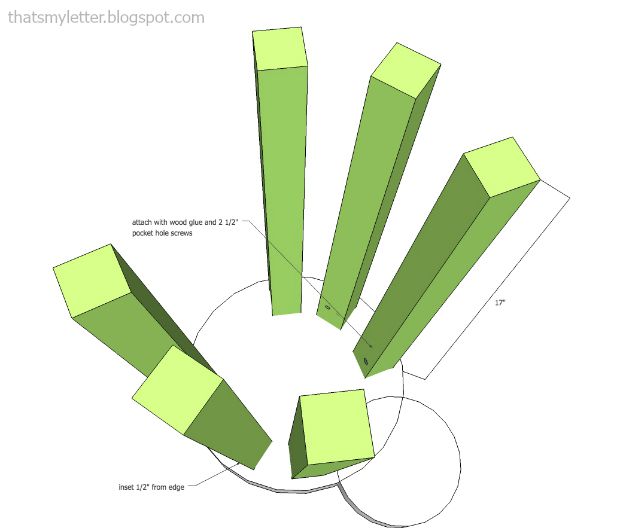
Layout the legs on the underside of the body inset 1/2″ from the edge.

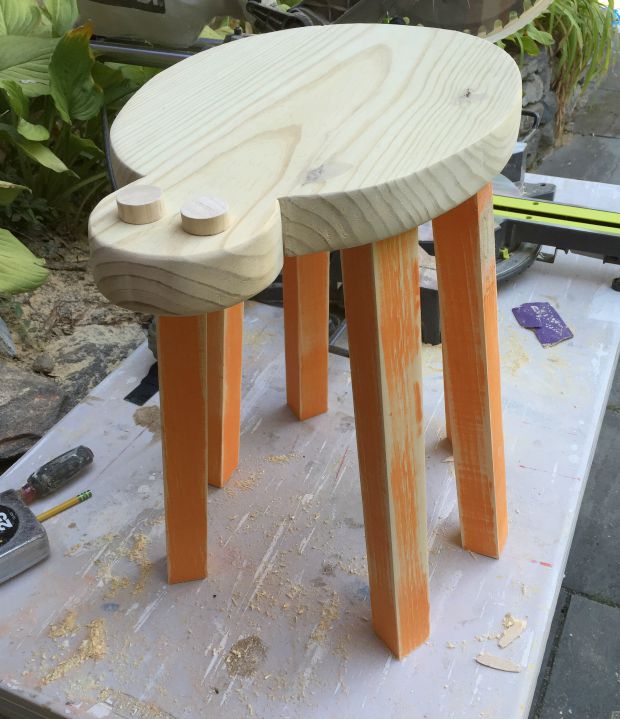
spider stool legs

Apply wood glue to the top of each leg and attach legs using 2 ½” pocket hole screws.

spider stool unfinished

Step 4: Sand the stool, then finish with black spray paint.

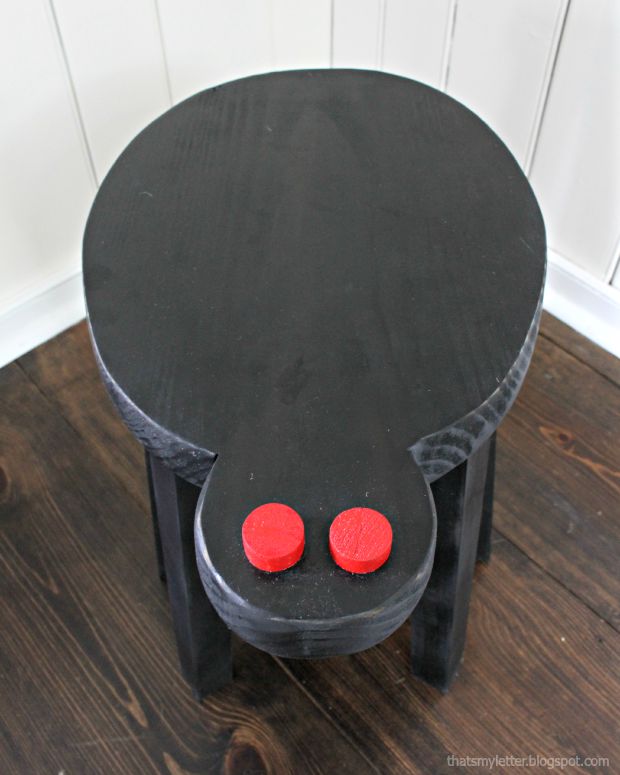
spider stool top

For an extra spooky factor paint 1″ circular dowel pieces bright red and glue onto the head portion.

spider stool collage

Hope you enjoyed this fun spider stool project! If you have more scrap wood, why not make some more spider friends or insect friends for your DIY Spider Stool!

Jaime signature

Jaimes_headshot

Hi, I’m Jaime and I write JaimeCostiglio.com, a DIY project focused blog with an emphasis on building, painting and sewing.  All my life I’ve been painting, drawing, crafting and making things.  I grew up in Minnesota and then majored in Studio Arts at a liberal arts college on the East Coast.  While there, I worked in the costume shop for the theater department, met my now husband of 18 years and then went on to work for an interior design firm in New York City.  We have 3 young children and now that they are all school age I have shifted my focus to do what I love – build, paint and sew.  The real turning point came when we renovated our kitchen in the summer of 2010.  One project led to another and I started blogging about all my projects one by one which has ultimately led to a small business.

My goal with each project is to work smart, efficient and economical.  I love a good challenge whether it be designing a build to fit the space (entry locker unit), solving a logistical solution (portable lego tray), constructing a craft using unconventional supplies (plastic tablecloth rosette garland) or just a simple makeover with paint (front door makeover).  And I firmly believe you can do it too which is why write a majority of my posts as tutorials in an effort to share my experience with readers.

You can connect with me on Facebook, TwitterPinterest, YouTube, and Instagram.

Read all of Jaime’s Pretty Handy Tutorials.

Pin for later!

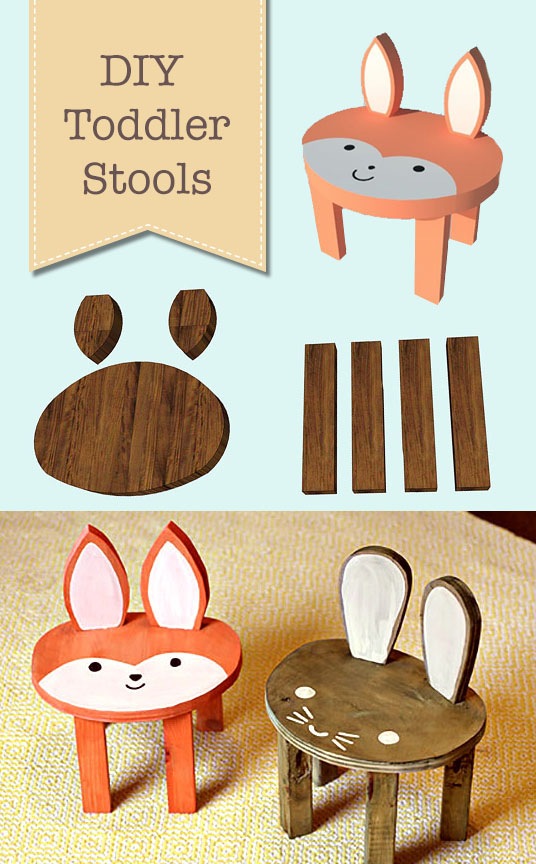
If you liked this tutorial, you’ll probably also love these cute little DIY toddler stools:

Cute DIY Animal Toddler Stools | Pretty Handy Girl

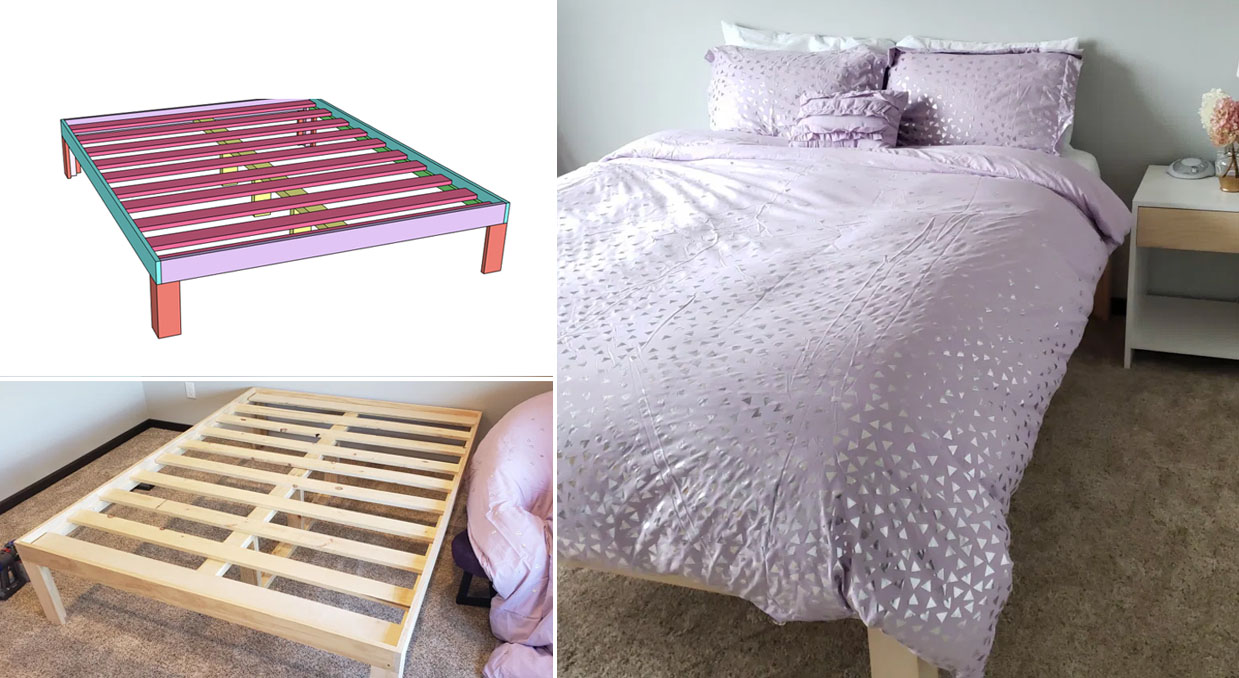
DIY Platform Bed

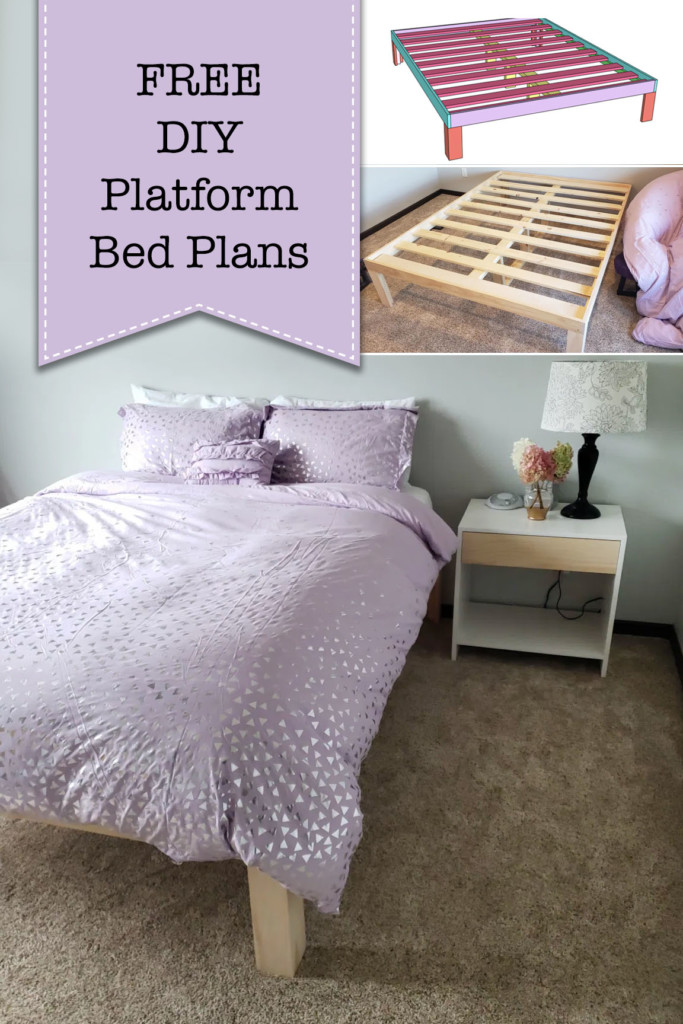
Build this simple DIY platform bed for your home!! This platform bed is a minimalist’s dream and it fits in perfectly with the new and trending BoHo decor style.
DIY Platform Bed

DIY Platform Bed

Hey everyone, this is Kristen from In Her Garage and I am going to show you how to build an adorable platform bed. This is the bed I built for my daughter in about an hour and a half.  In my home, we are once again changing my girls’ bedrooms (because why wouldn’t I take down the uber-cute loft beds I just built them back in March?! )My kiddos are lucky I’m a sucker for building furniture. Be sure to follow me on Instagram if you want to keep up with all my furniture building adventures!

Since my girls are moving into separate bedrooms we decided each would have a queen size mattress. We purchased a queen mattress without the box spring in the interest of saving money.  But, all the platform bed frames I found were either too expensive or too short. I still wanted her bed to be at a standard height so I decided to throw together this really simple platform bed.

The simplicity and natural look of the popular BoHo style pairs really nicely with the bedding for my daughter’s room. I used the more expensive pine boards from the local big box store (less knot holes and higher quality) to construct the bed legs and frame.  These boards are so pretty and I love the color so I chose not to paint, stain, or topcoat them.  This is why you won’t find a “Finish” step in this tutorial.  But, feel free to finish your bed however you like! Let’s make it!

How to Build a DIY Platform Bed

Materials:

(I’ve included affiliate links for your convenience. I earn a small percentage from a purchase using these links. There is no additional cost to you. You can read more about affiliate links here.)

Tools:

Cut list:

Bed legs:

  • 8 – 1″ x 4″ @ 12″
  • 4 – 2″ x 2″ @ 13 ¼”

Bed Frame:

  • 2 – 1″ x 4″ @ 60″
  • 2 – 1″ x 4″ @ 80″
  • 2 – 1″ x 2″ @ 75 ¼”

Slats and center support:

  • 10 – 1″x 4″ @59 7/8″
  • 1 – 2″ x 4″ @ 78 ½”
  • 3 – 2″ x 4″ @12″

Instructions:

Step 1 – Build the Platform Legs

The legs for this bed are meant to provide a base for the bed frame to rest on and attach to. Attach two  1″ x 4″ x 12″ boards at a 90 degree angle to each other with a 2″ x 2″ x 13 ¼” board glued into the center for added support as shown below.
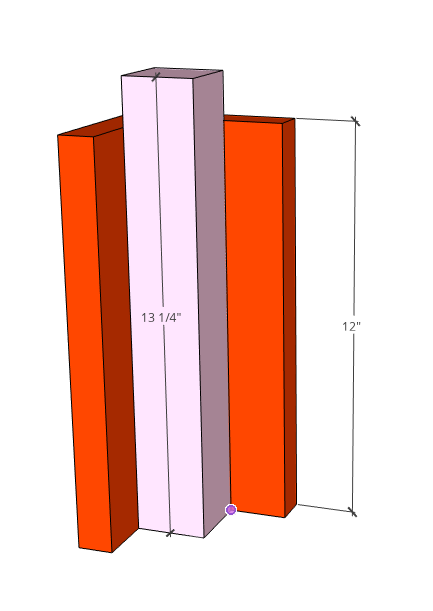
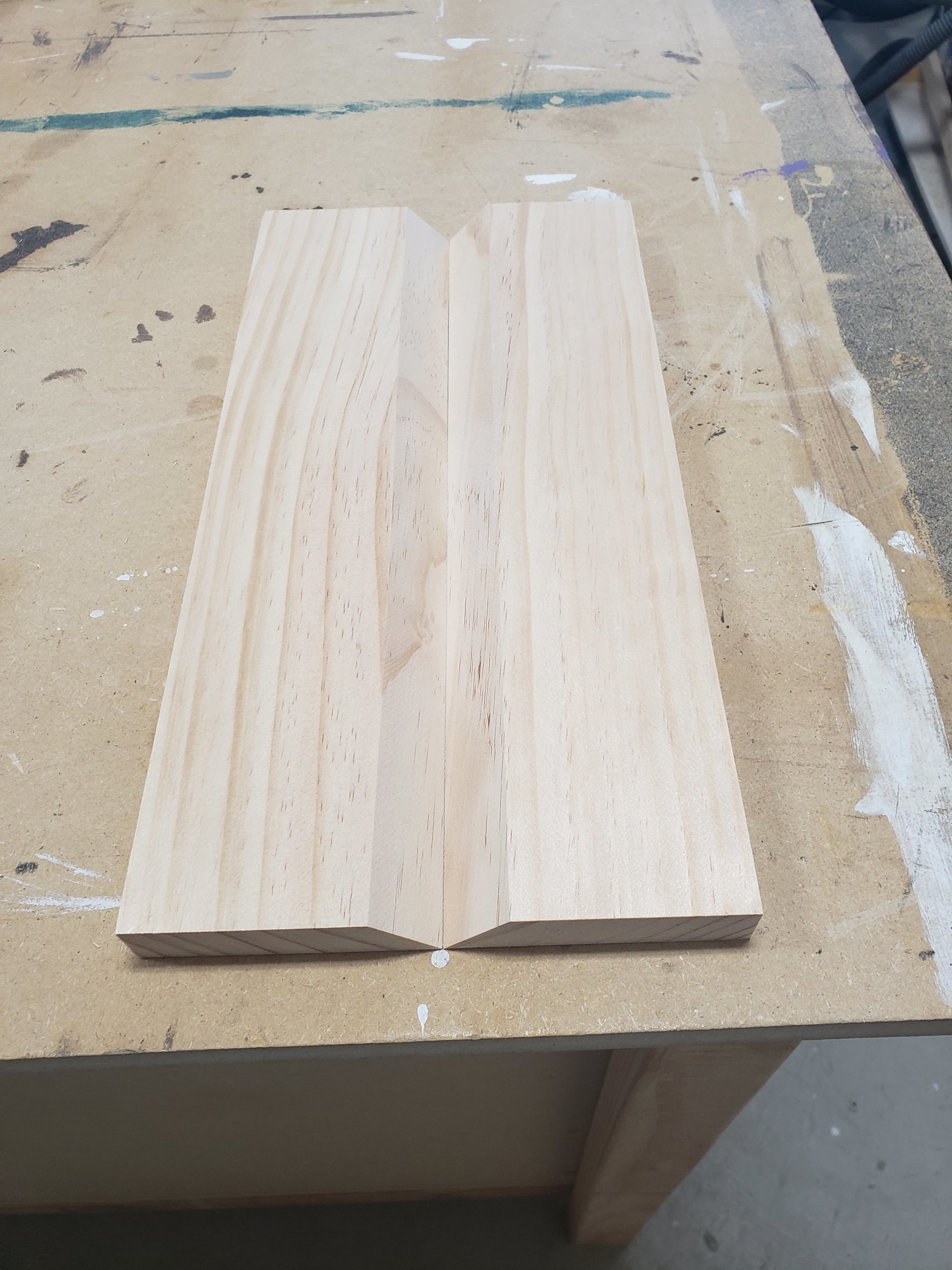
I chose to use my table saw and cut the 1″ x 4″ x12″ boards at 45 degrees along one long edge to create a miter joint between the two boards. This creates a cleaner look but you are more than welcome to use a butt joint instead. Look at the pictures below to see the difference.

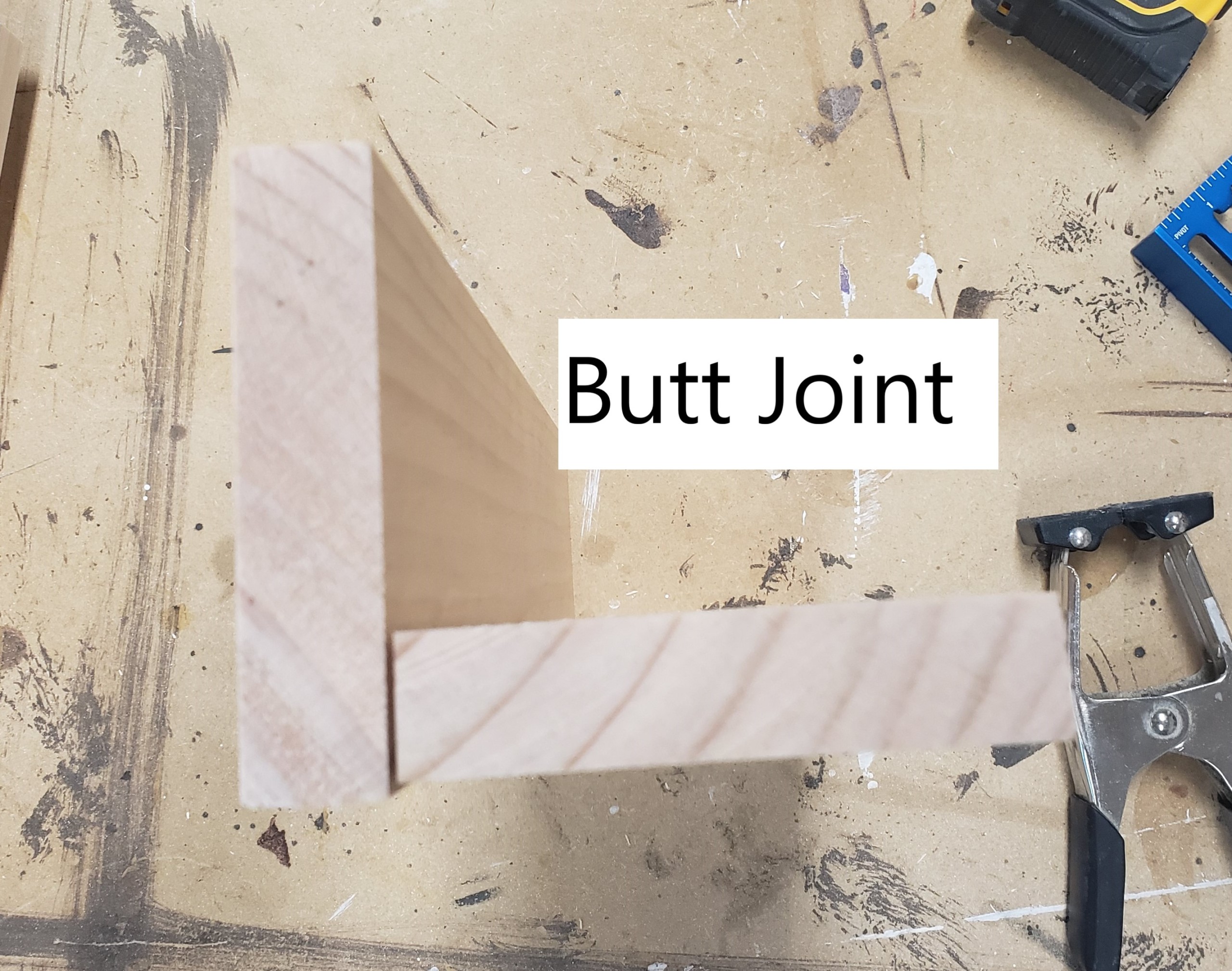
If you are also choosing to bevel the corners of the bed legs then continue reading to see how I put this joint together with ease. If not, go ahead and assemble the legs using the butt joint, wood glue, and brad nails.

Mitered Joint Leg Assembly:

After cutting all eight 1″ x 4″ x 12″ leg boards to 45 degrees, add two pieces of painters tape to the back of the board running perpendicular to the beveled edge.

Set the board down on your work surface, sticky side of the tape facing up, and place another leg board with the beveled edge touching the first board’s beveled edge, also being sure to align the top and bottom of the boards. Press down firmly so the tape sticks to both boards.
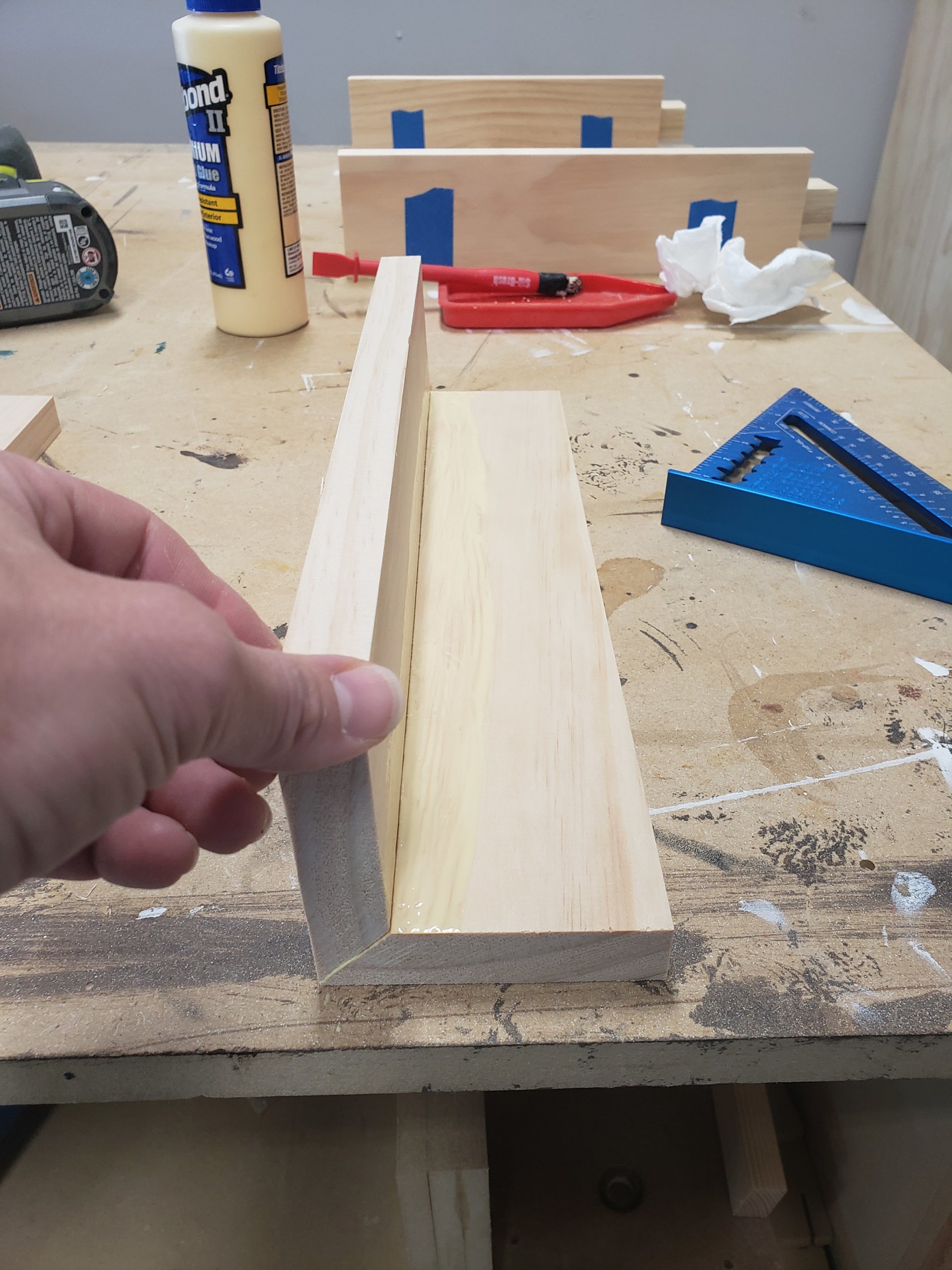
Add an even bead of glue to both beveled surfaces and then lift one board as if closing a book. The two beveled edges will meet and the tape will hold it in place.

Now place your 2″ x 2″ x 13 ¼” board in the corner of this joint using wood glue. Shoot the brad nails through the 1″ x 4″ into the 2″ x 2″ to secure in place. No need to use screws here as there is plenty of surface area for the wood glue to create a strong joint (once cured).  Congratulations, you completed one leg for the platform bed frame to rest on!
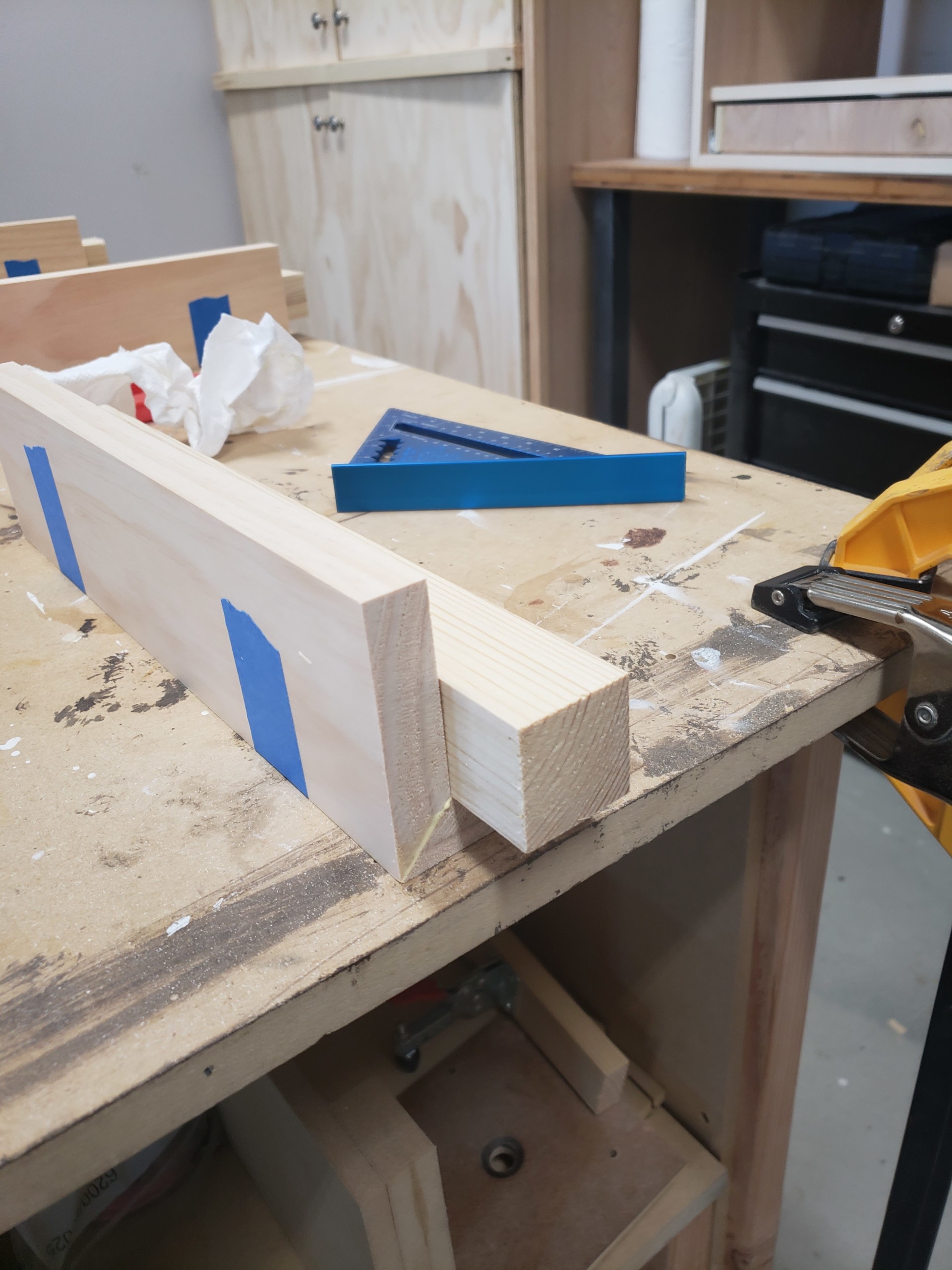
Repeat these steps for the other 3 legs. After the legs are built, use wood putty to fill in the brad holes and sand smooth.

Step 2- Building the Bed Frame Components

Let’s build the side rail supports for the bed slats to rest upon. Start by marking the center of the 1″ x 4″ x 80″ board and the center of the 1″ x 2″ x 75 ¼” board.

Lay the 75 1/4″ board along the bottom of the 80″ board and align the two center marks. Using wood glue and 1 ¼” wood screws fasten the 1″ x 2″ x 75 ¼” board to the 1″ x 4″ x 80″. Repeat for the other side rail support.
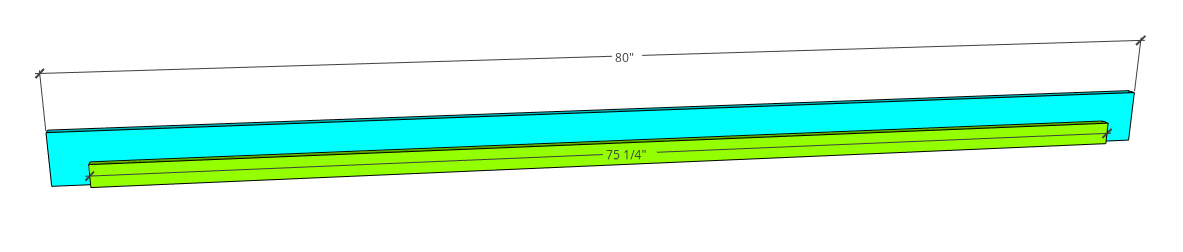
Step 3: Building the center support

The center support will run parallel to the side rails (and perpendicular to the bed slats) in the center of the bed. Therefore, it will run between the headboard and footboard of the bed frame.

Pull out your 2″ x 4″ x 78 1/2″ board (this is your center support). Now pull out the 2″ x 4″ x 12″ pieces and evenly space them under the 2 x 4 center support.  Use 2 ½” wood screws to secure the 2″ x 4″ x 12″ legs under the center support).

Note: You might notice in later pictures that my center support looks a little different than what is shown below. I accidentally cut my legs too short and had to add another 2 x 4 to the bottom of the legs to raise it to the correct height.  Oops!
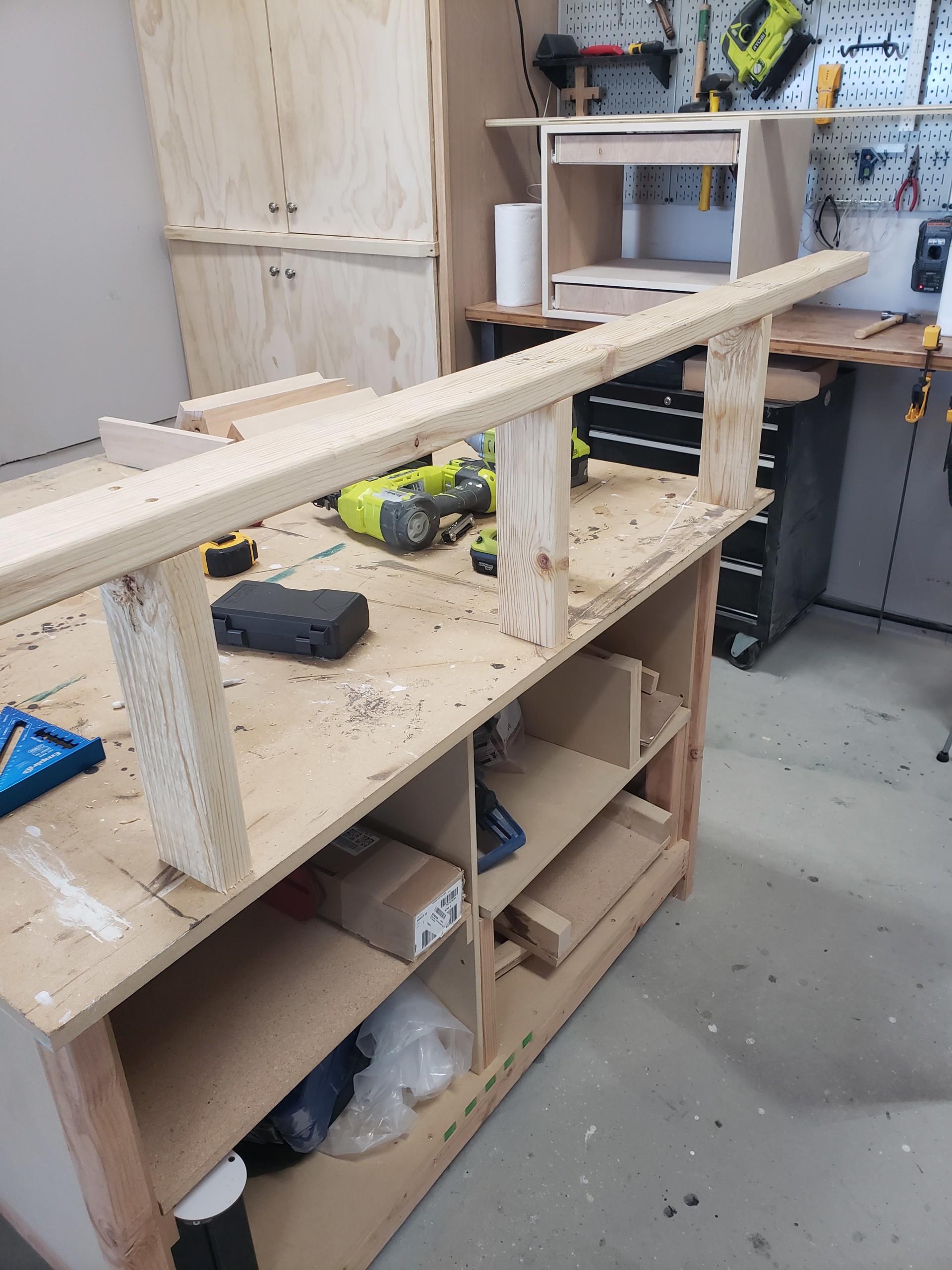
Step 4: Assembly Time

Pre-drill 2 holes into each end of the 1″ x 4″ x 80″ side rails where you will attach the headboard and footboard. (If you don’t have much room to work, you can do this step shortly after building the side rails. This will make assembly easier when you’re up in a small bedroom.)

Carefully bring all of the components up to the bedroom. Don’t forget to grab your drill, 1 ¼” wood screws, and brad nailer.

Assemble the bed frame by attaching the side rails to the headboard and footboard pieces. Drive the 1 ¼” wood screws through the pre-drilled holes you made.

(Note: You may have noticed the scrap 1″ x 2″ boards attached to my headboard and footboard below. I did this extra step for my bed because I like using up all my scrap pieces as much as possible, but structurally it doesn’t really make a difference. If you do this added step be sure to allow for this additional thickness when building the center support.)
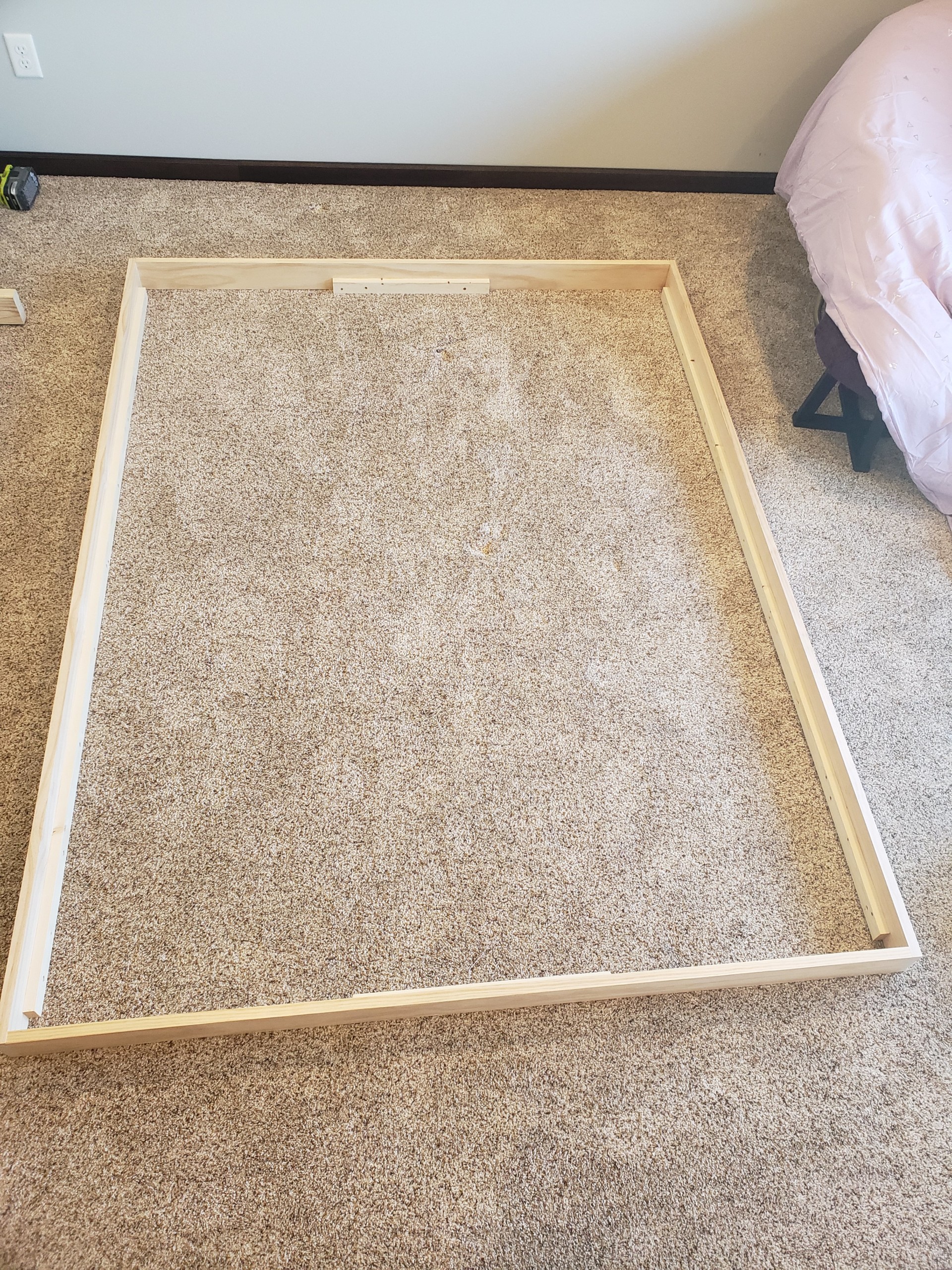
Lift the frame and place a leg into each of the four corners of the bed frame. Attach the frame to the legs using 1 ¼” wood screws. You should use 2 screws per leg (one on each side of the corner). This will secure the legs in place firmly and prevent any rotating.

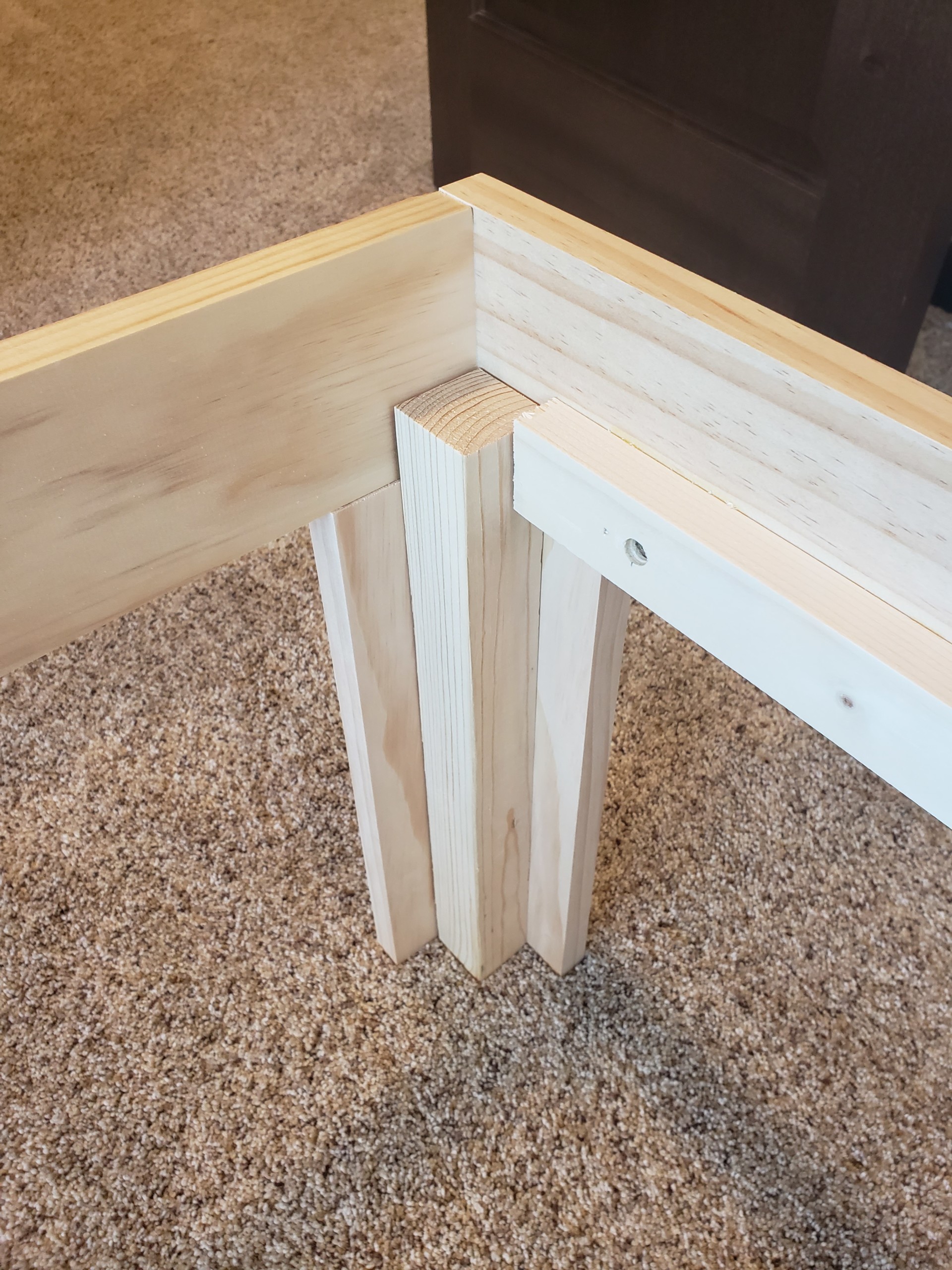
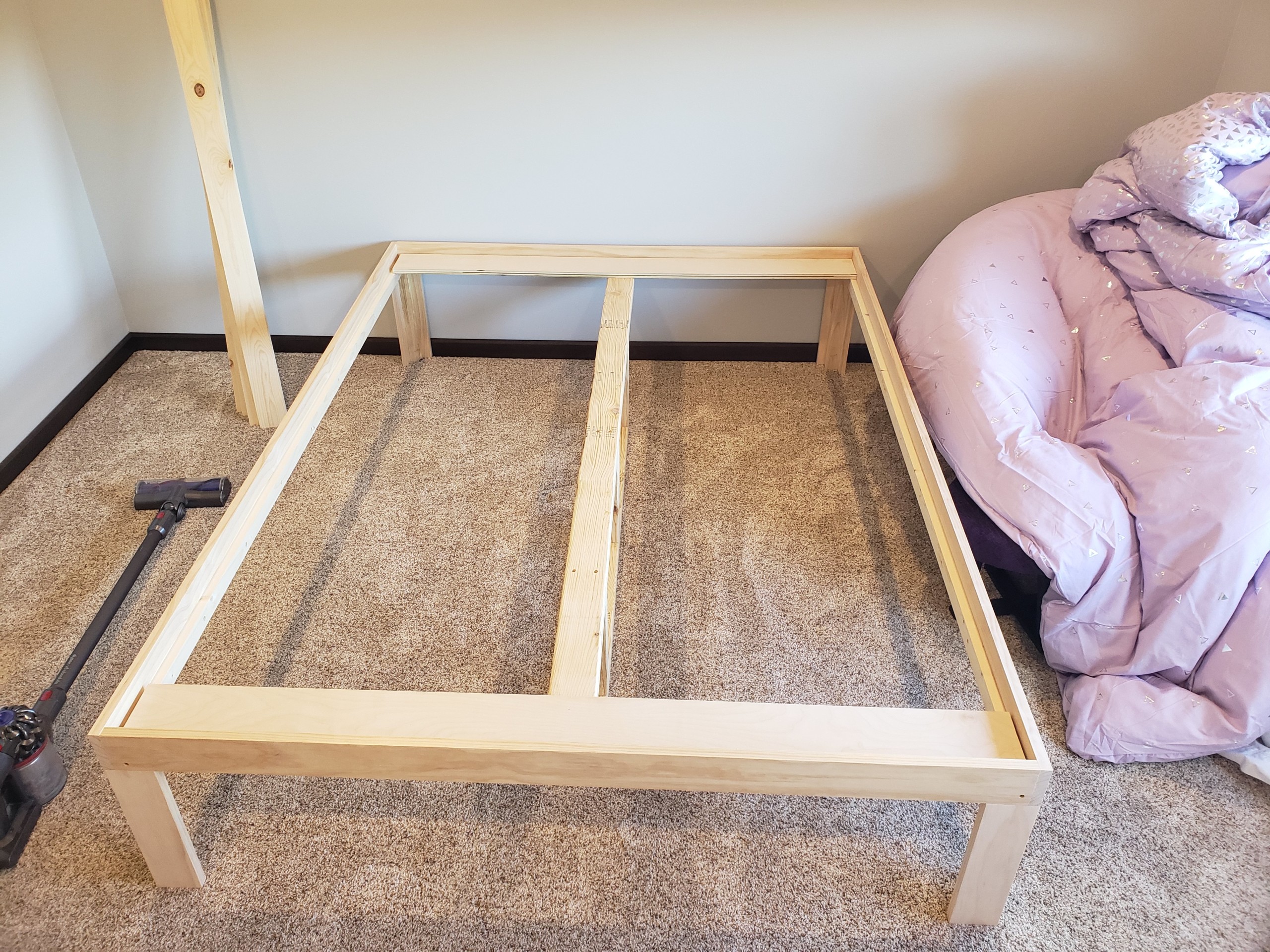
Set the center support in the middle of the bed frame.
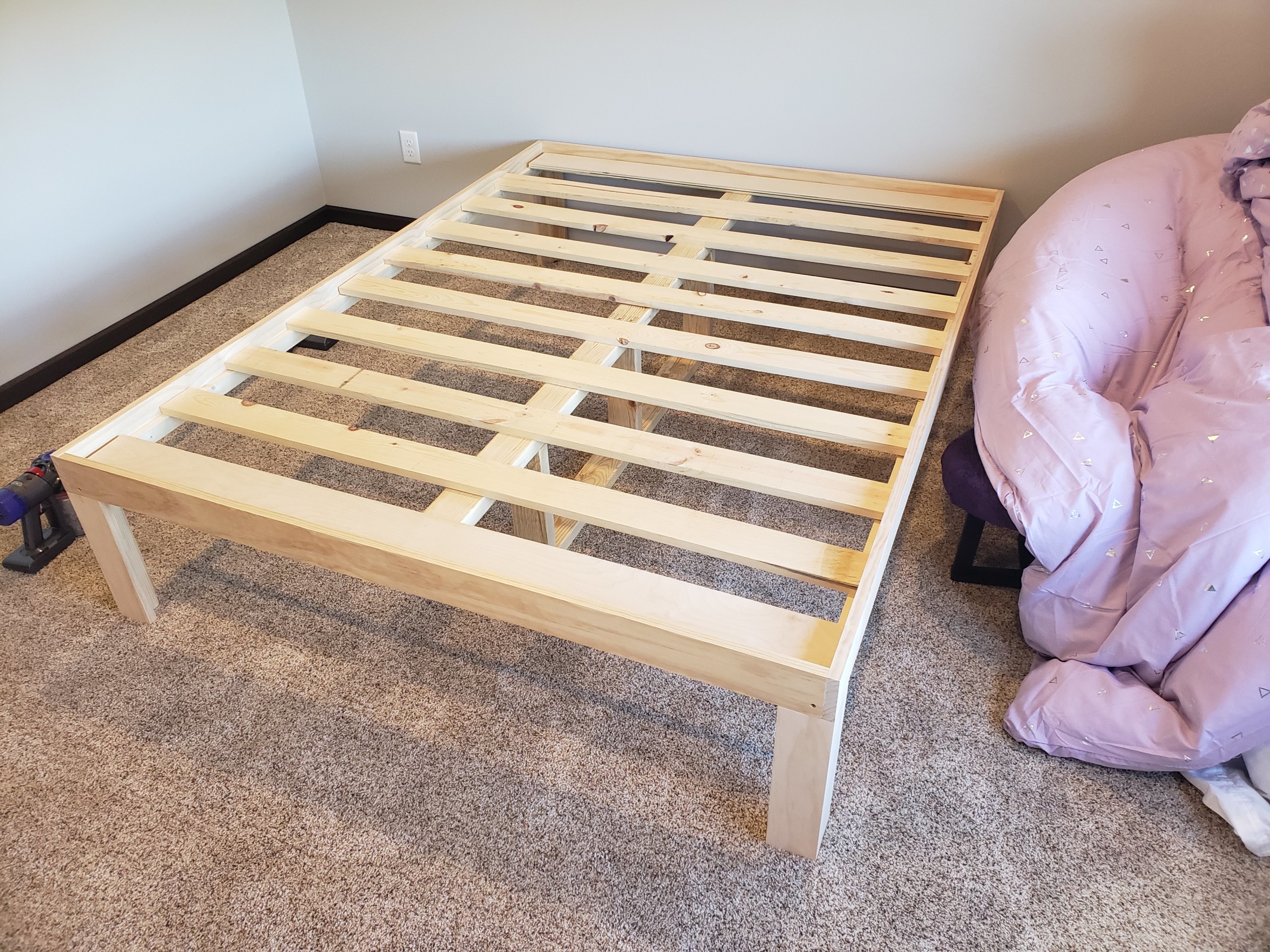
Lay your 1″ x 4″ bed slats on top of the side rail and center support. Evenly space the slats across the bed frame. Attached the slats to the center support using 2 brad nails for each. (Or to be able to disassemble the bed easier in the future, pre-drill holes through the end of each slat and into the side rail support board. Then drive a screw in to hold it in place.)
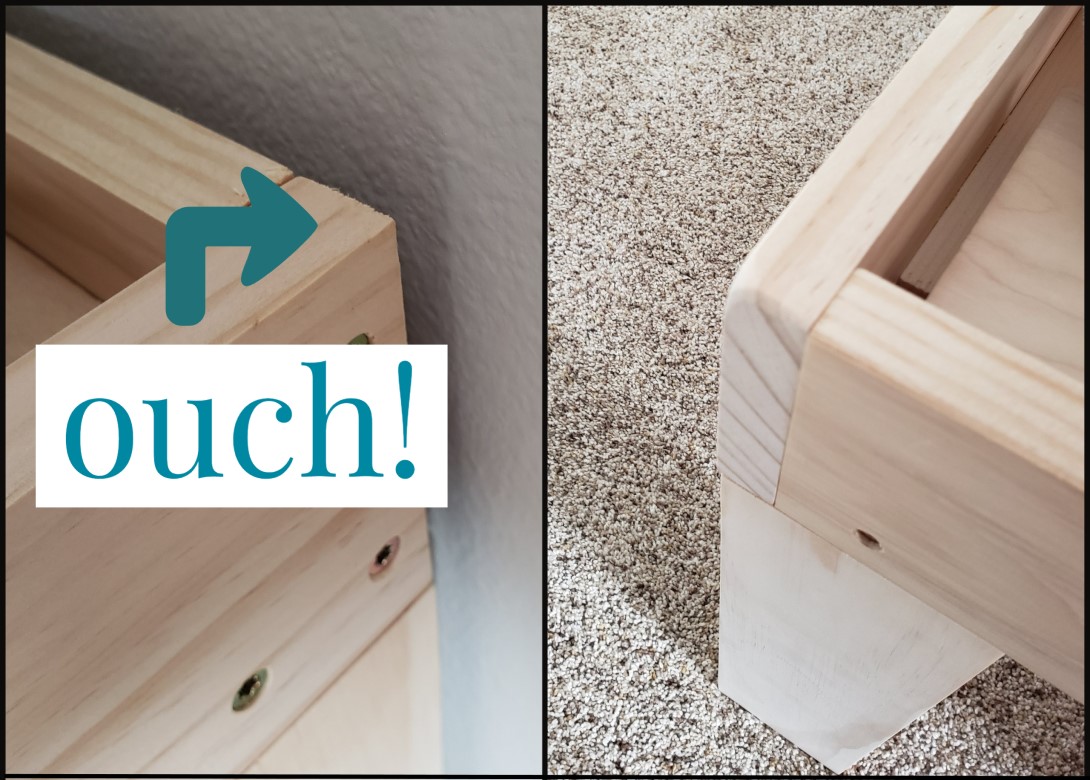
Step 5: Sanding the corners

Hand sand the bottom two corners of the frame to avoid any injuries to shins, legs, and bedding.
Step 6: Make the Bed

Lay the mattress onto the bed frame. Then make the bed and get ready to watch the new owner get a good night’s sleep.
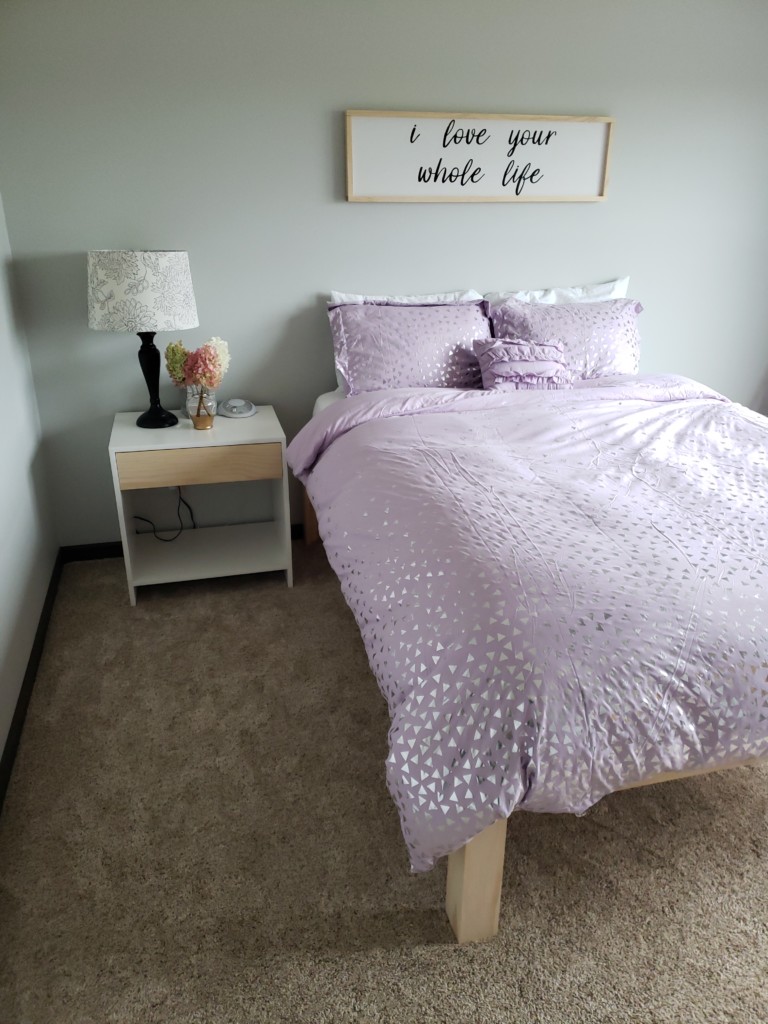
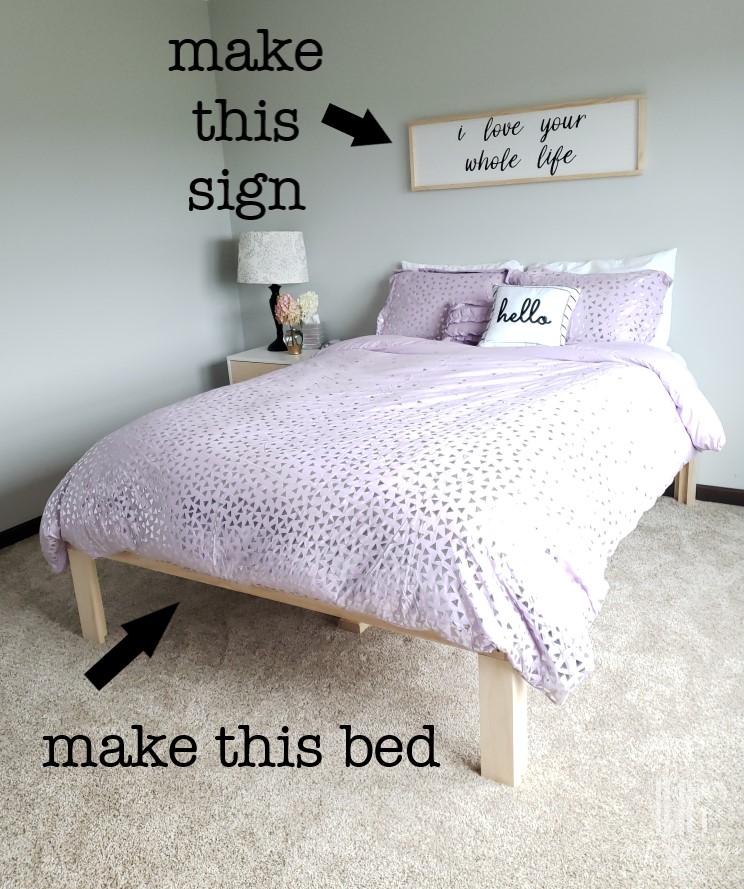
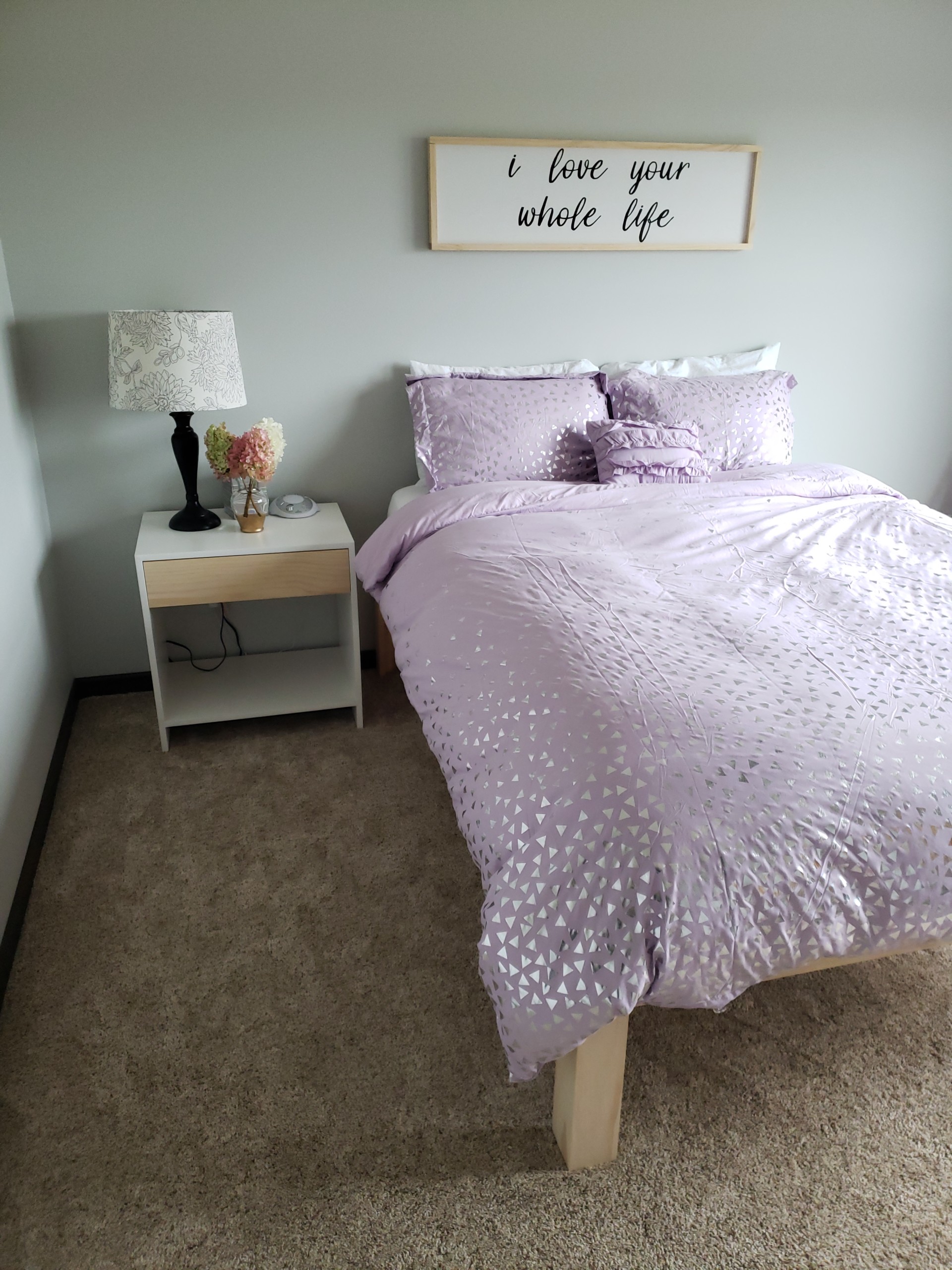
See the “I love your whole life” sign on the wall? You can learn how I make my own signs! Click over to view my tutorial for making a DIY Quote Sign. I even have a trick for adding faux-shiplap detail.

If you’re not ready to make the bed right now, pin this image for later!

DIY Platform Bed

If you liked this build, you’ll also like Brittany’s Farmhouse Style King Bed with Storage drawers:
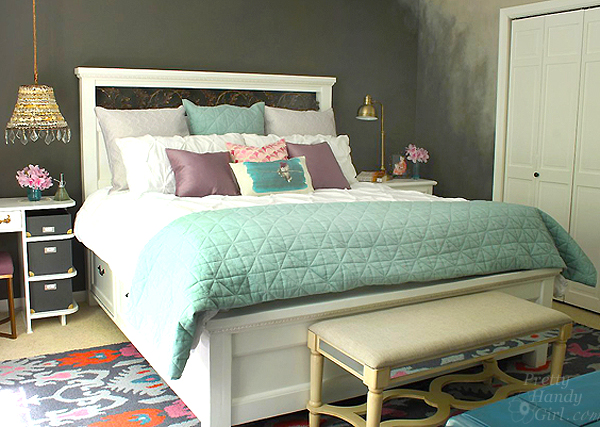
Modified King Size Farmhouse Bed with Storage Drawers | Pretty Handy Girl

Stay tuned as I bring you more tutorials for the furniture that I am creating for my girls’ bedrooms! The adorable side table pictured alongside the platform bed is coming next month.  Thanks for building with me.

Hi! I’m Kristen, from In Her Garage, and I am a self-taught woodworker and DIY fanatic from Minnesota where I live with my husband and our two daughters. Between being a wife, mom and, registered nurse, I try to make as much time for DIY as possible. My love for building came after our family built our current home in 2015. After we moved in, we needed furniture and instead of spending massive amounts of money to order the pieces we wanted I decided that I would build them myself. I started with a buffet table plan from the fabulous Ana-white and quickly set out to remodel my entire home office.

Since then I have started a side business building furniture for the people in my community. I love hearing my clients talk about the pieces they wish they had whether it be a rustic buffet table, a one drawer side table, or a toy box and then making it a reality for them. While starting my small business it made perfect sense that I would document my building journey so I simultaneously launched the In Her Garage blog and I love sharing my plans, tips and tricks.

Making something beautiful with your own two hands through a little preparation and determination is an amazing feeling and I hope to bring inspiration and know-how to those looking to tackle a big or small project.
I am so glad that you found me here and please feel free to connect with me on PinterestInstagram, Facebook, and Youtube to see what I am working on right now.

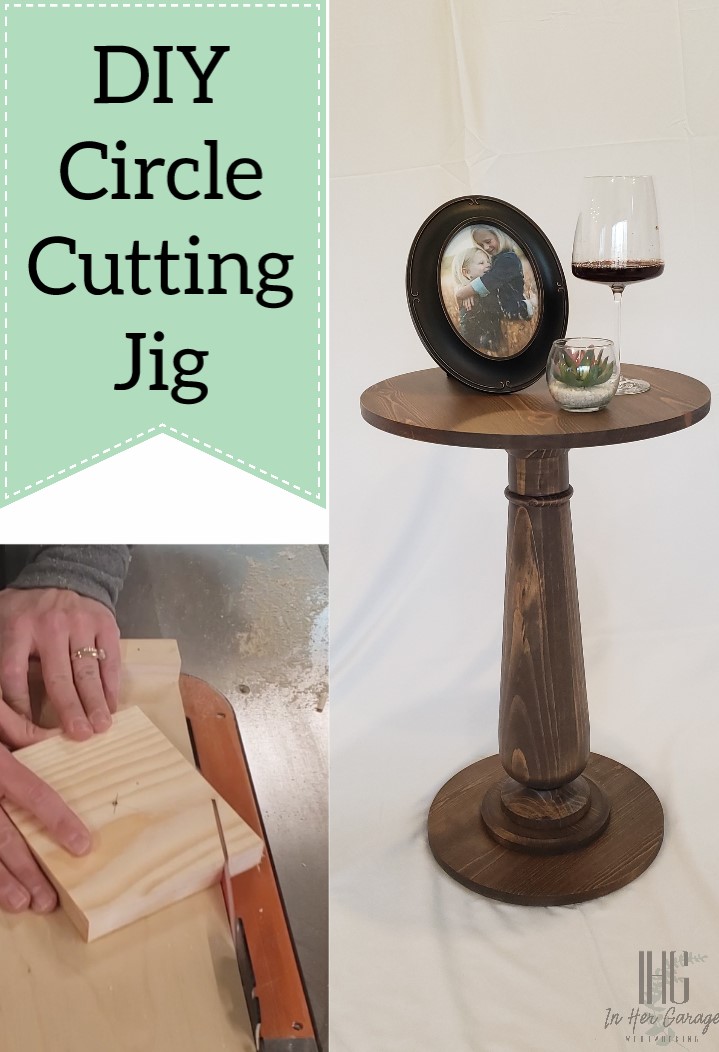
So, you love making DIY projects but want to expand your talents further than squares and rectangles. I’m going to show you how to make DIY Circle Cutting Jig for the Table Saw. Yes!! Your table saw.

DIY Circle Cutting Jig for the Table Saw

Hello!! It’s Kristen, from In Her Garage, back again to bring you a super exciting and simple tutorial!

Making circles with the table saw sounds counterintuitive, right? Table saws are supposed to just rip straight lines, but table saws are one of the most versatile tools in your shop and with just a few pieces of scrap wood, you’ll be cutting circles and making gorgeous side tables and decor pieces in no time at all!! Let’s get started making this DIY Circle Cutting Jig for the Table Saw!

Materials:

(I’ve included affiliate links for your convenience. I earn a small percentage from a purchase using these links. There is no additional cost to you. You can read more about affiliate links here.)

Tools:

Please read through the instructions in their entirety before making this project.

Safety! Before starting, UNPLUG your table saw and completely retract the blade below the level of the table.

Instructions:

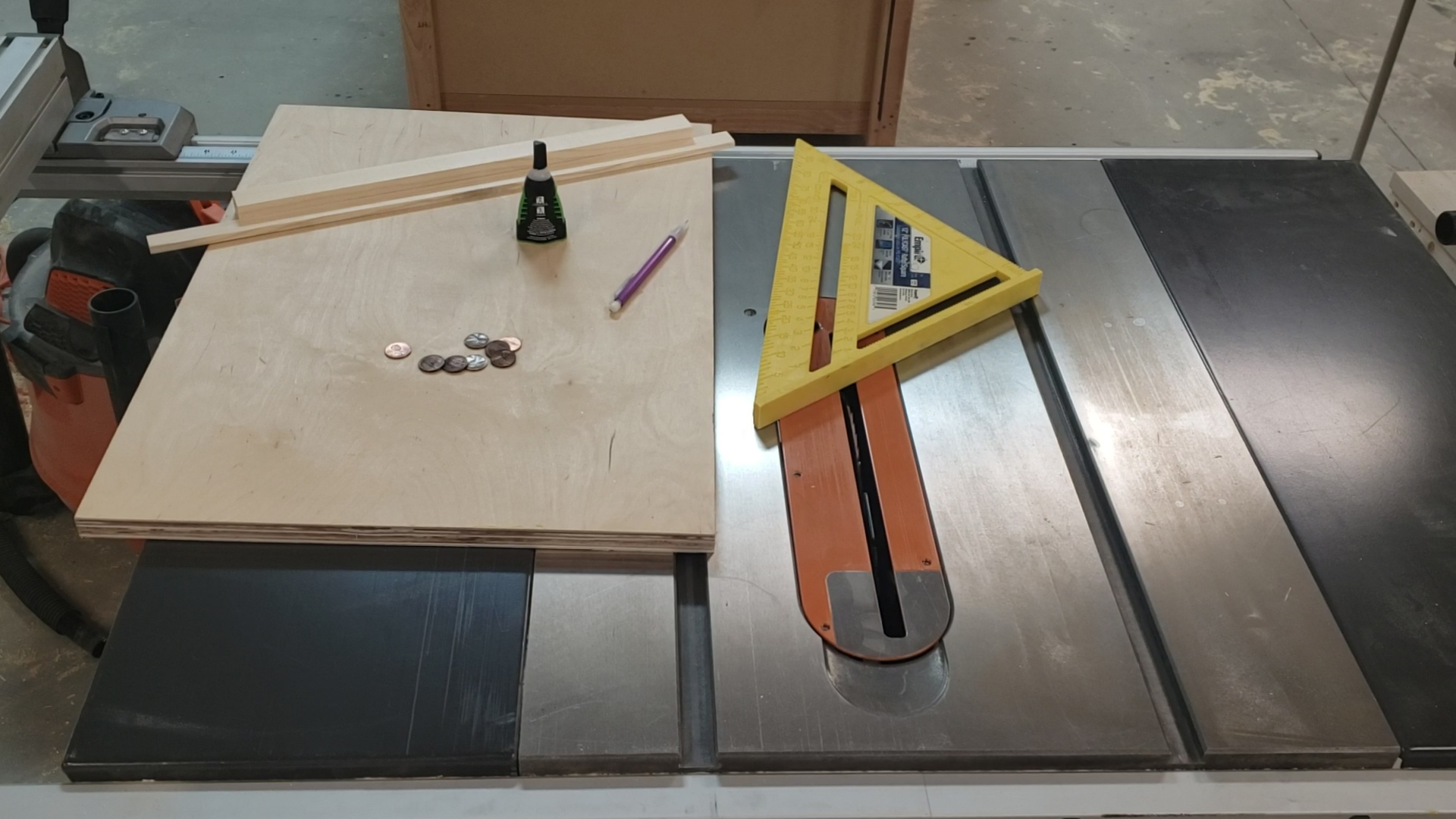
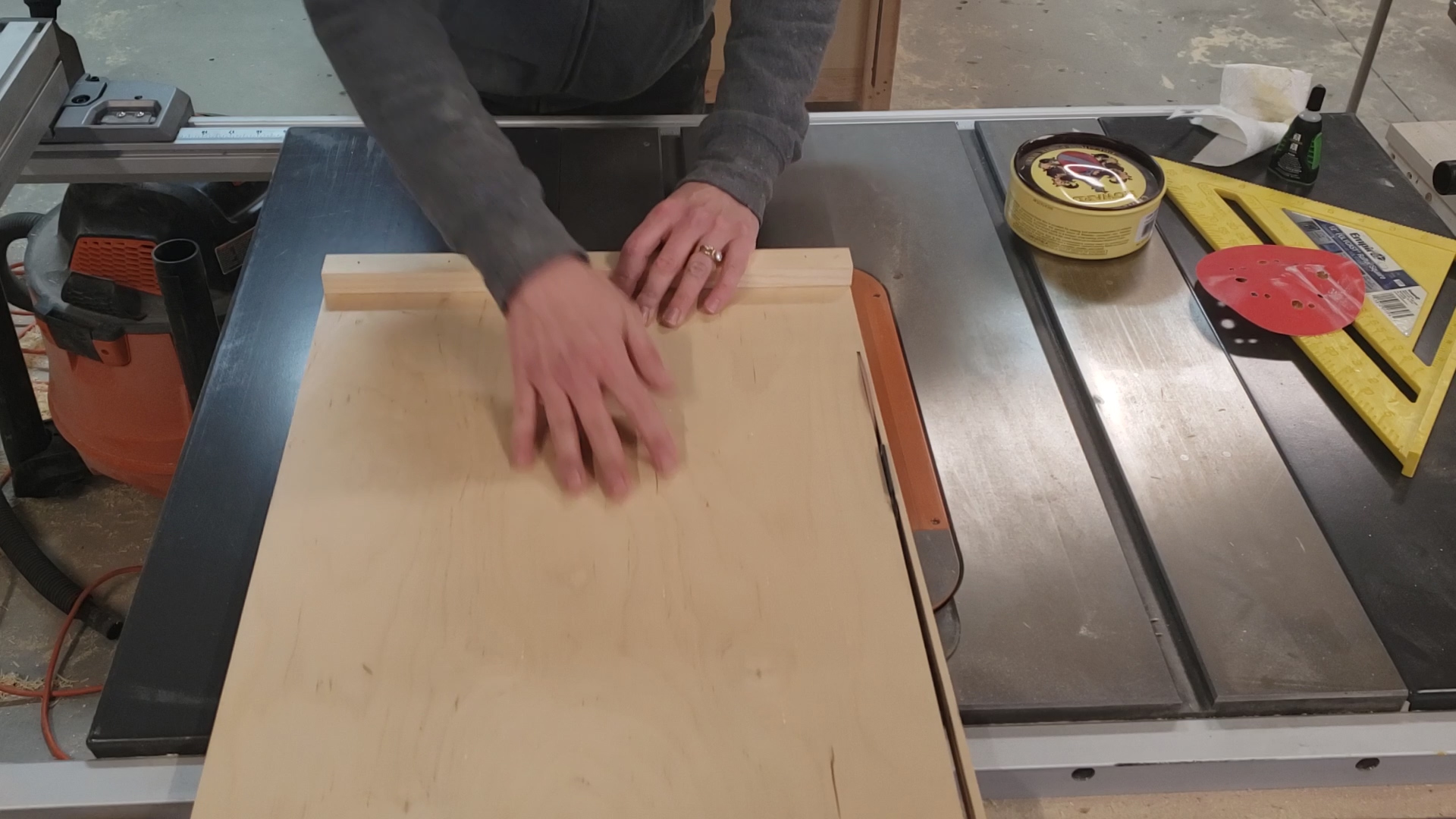
The 3/4”x 1/4” strip of wood will be used as a guide for the jig and will travel within the miter slot to the right of the table saw blade.

Standing at the table saw, place a few stacked pennies within the miter slot and lay the strip of wood over the pennies so it is just slightly above the level of the table.

Place a line CA glue on top of the strip of wood and place the plywood on top of it so that the plywood piece is covering the saw blade about ¼”.

Apply weight on top of the plywood and wait for the glue to adhere to both the miter guide strip and the back of the plywood.

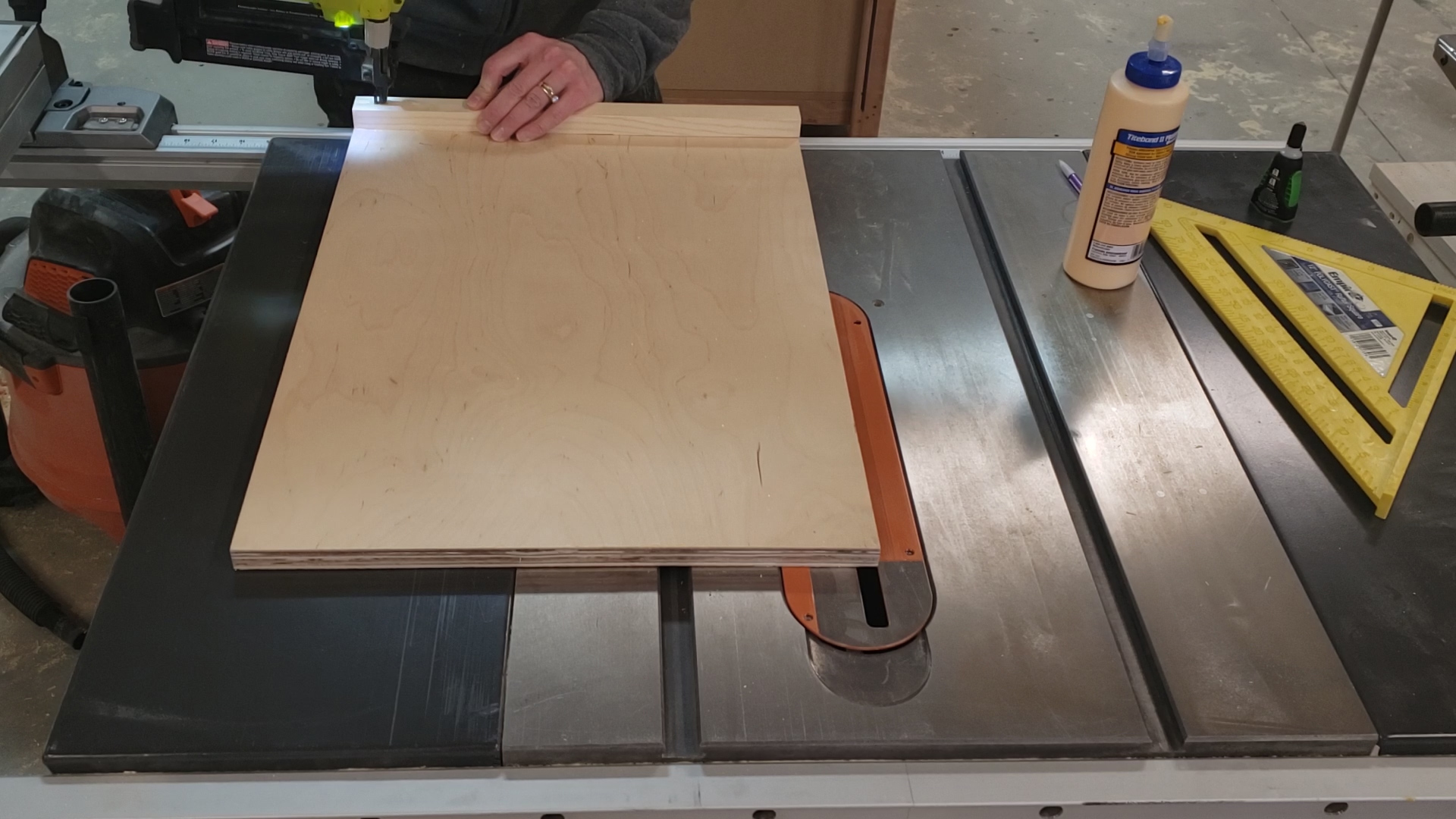
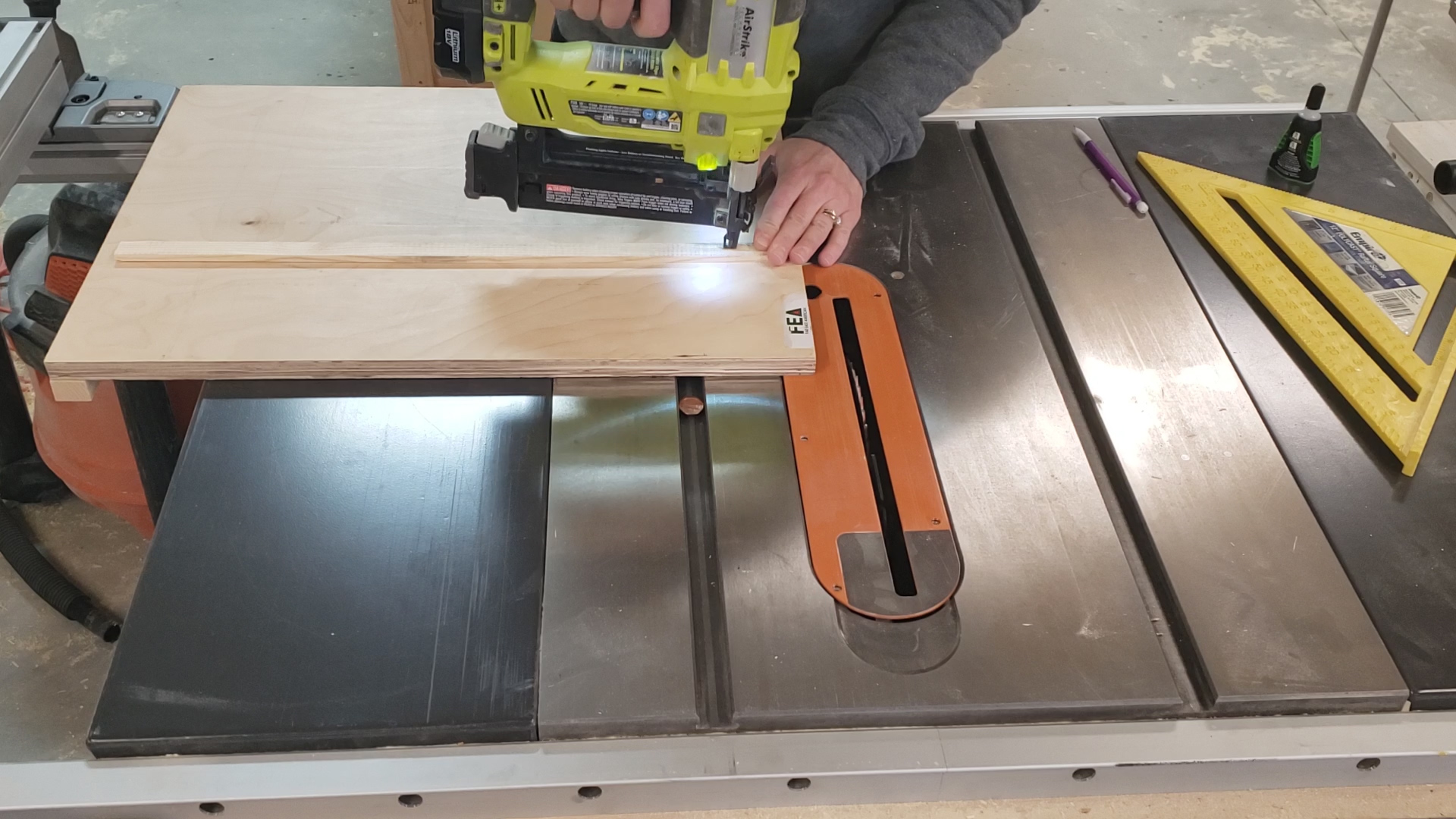
While you are waiting for the glue to dry apply the 12” piece of scrap wood to the front edge of the plywood. Simply apply some wood glue between the two pieces and nail it down with 1 ¼” brad nails or screws. This will act as the handgrip for the jig.

By now the plywood and the miter gauge strip of wood have adhered together. Gently lift the plywood and turn it over.

Using 5/8” inch brad nails or screws secure the strip in place being careful not to split it.

Remove the pennies from the miter slot.

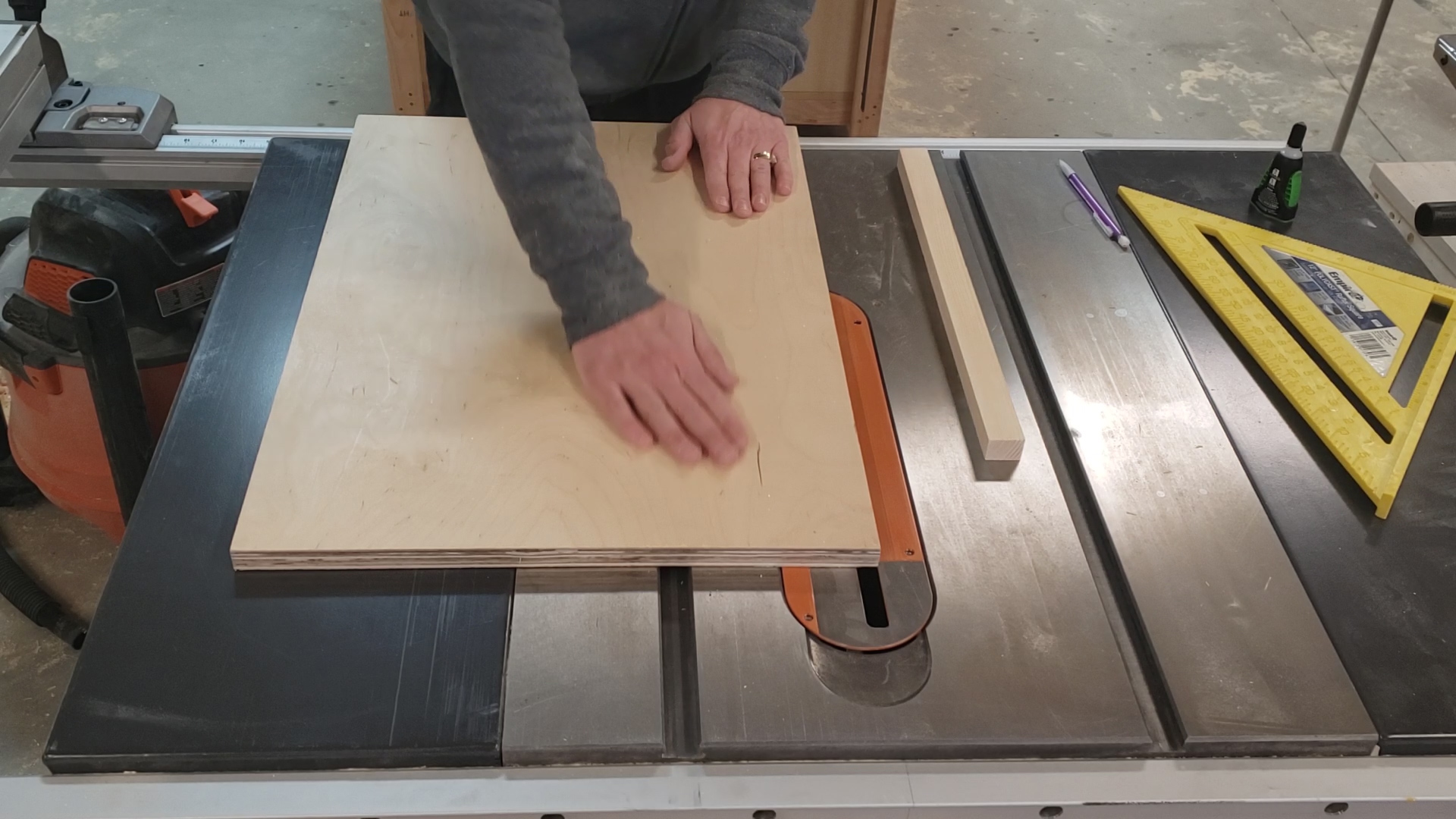
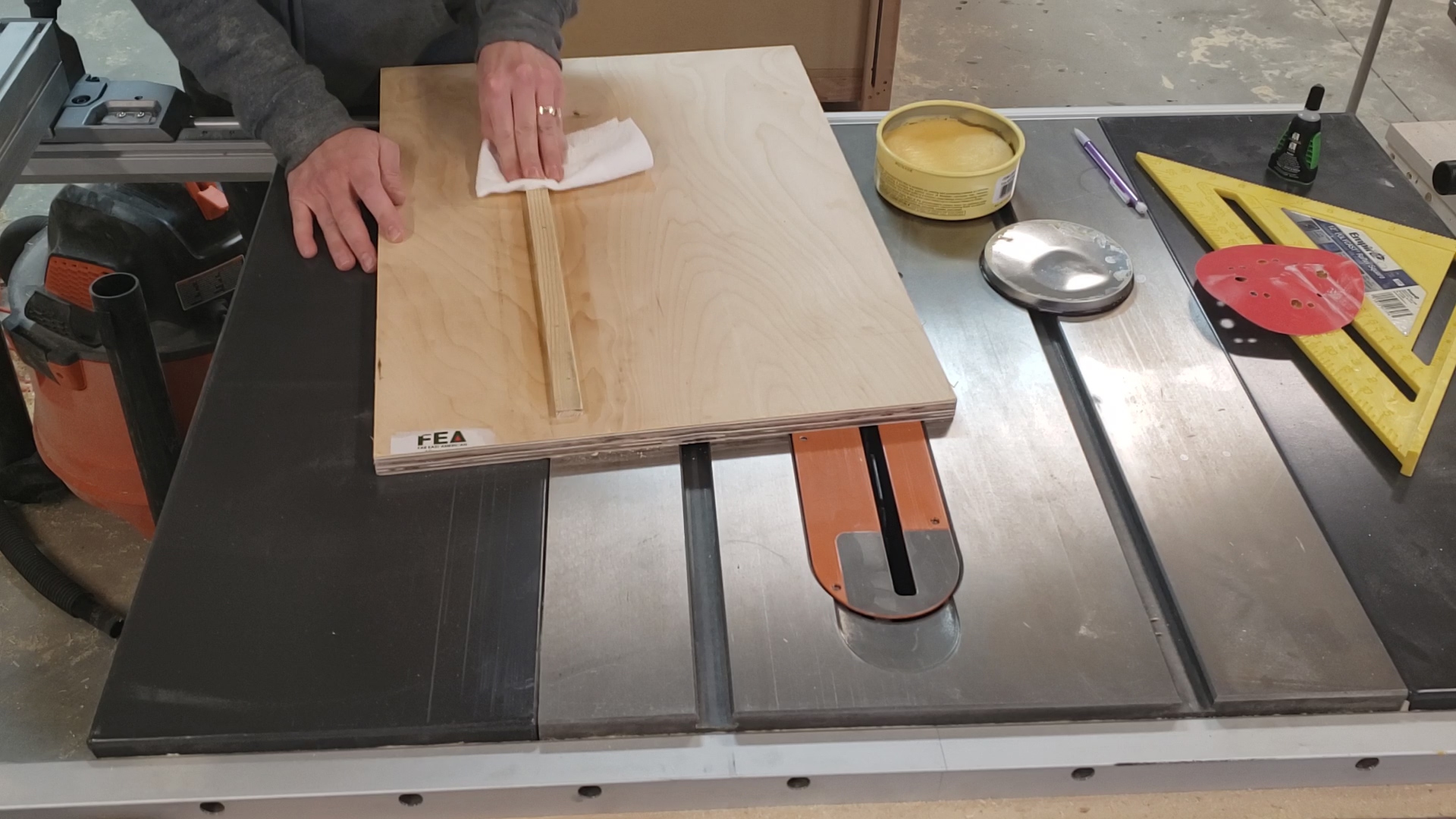
Use some fine-grit sandpaper to smooth out the edges of the miter guide strip to help the jig travel smoothly. Applying some paste wax to the bottom the plywood and miter guide strip will also help with smooth travel. (Not necessary, but will help with smooth movement.)

Flip the jig back over placing the guide strip in the miter slot.

Pull the jig back enough to raise the saw blade just above the level of the hand guide. Plug the saw in.

With the saw on push the jig forward to completely cut off the left side of the jig. This will make the jig perfectly in line with the blade and act as a zero-clearance for clean cuts.

Turn off the saw, lower the blade and unplug.

Circle Cutting Instructions:

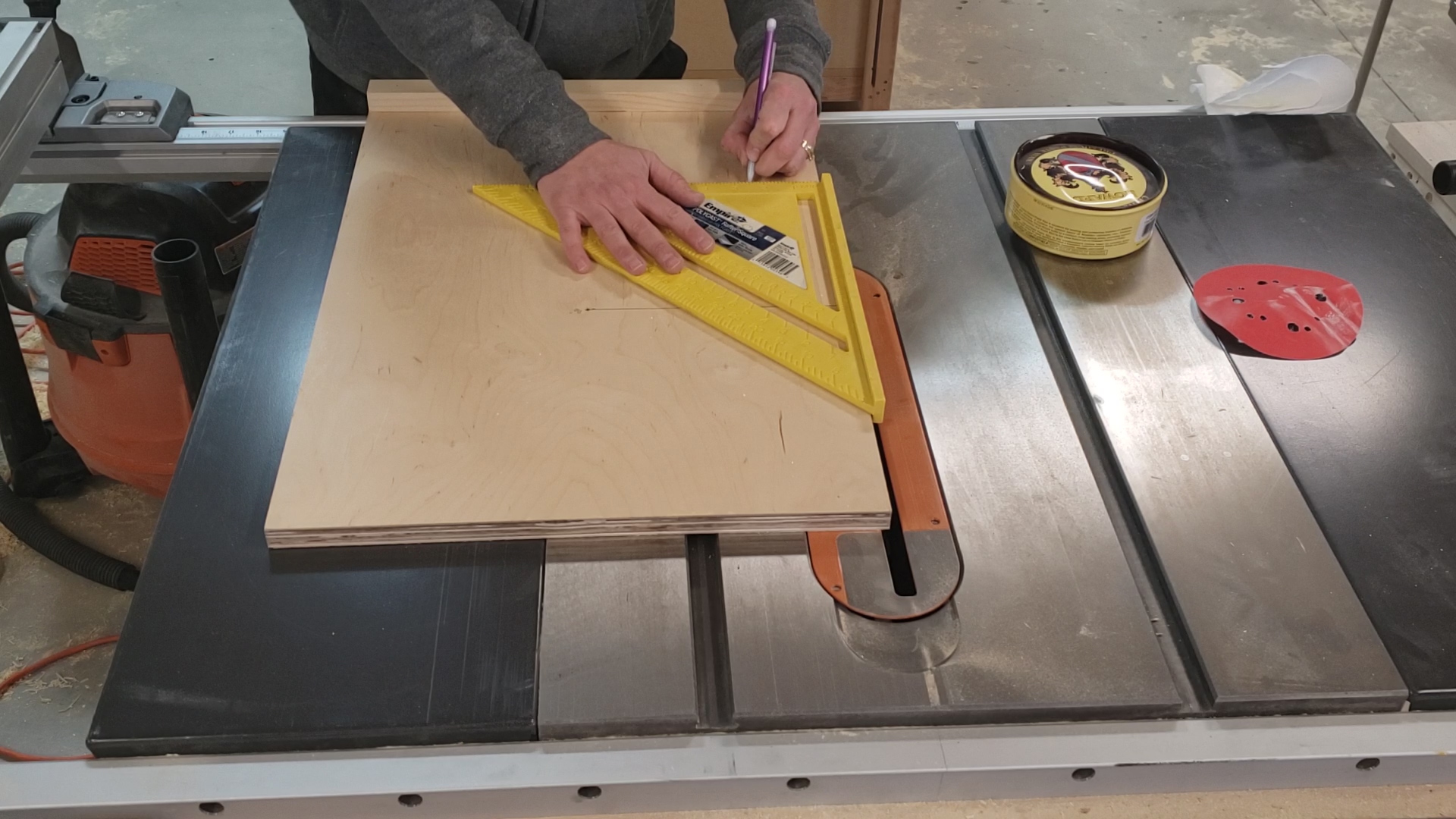
Using your speed square draw a line in the middle of the jig perpendicular to the saw blade.

Now mark the radius measurement for the circle that you want to make on this line. For example, if you want to make a circle that is 10” in diameter measure to 5” with your speed square.

Tap a 1 ¼” nail into the mark.

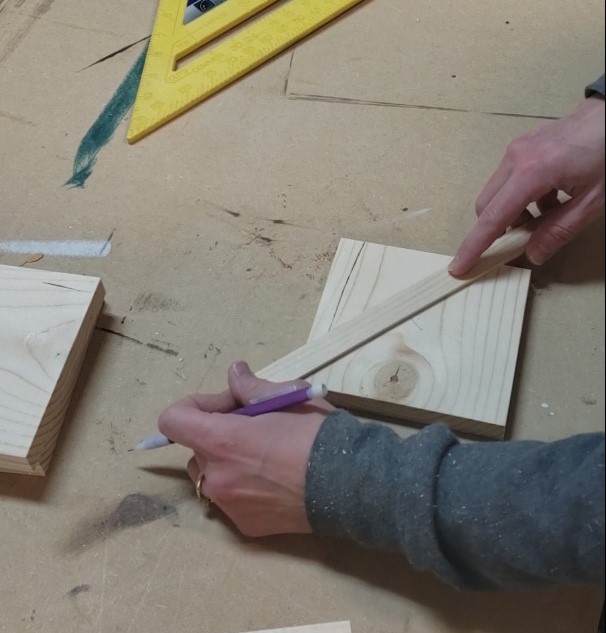
Make a mark in the center of the square piece of wood that you’re wanting to cut into a circle. This is easily done by drawing two lines from each opposite corner. The intersection of these two lines in the center of the square.

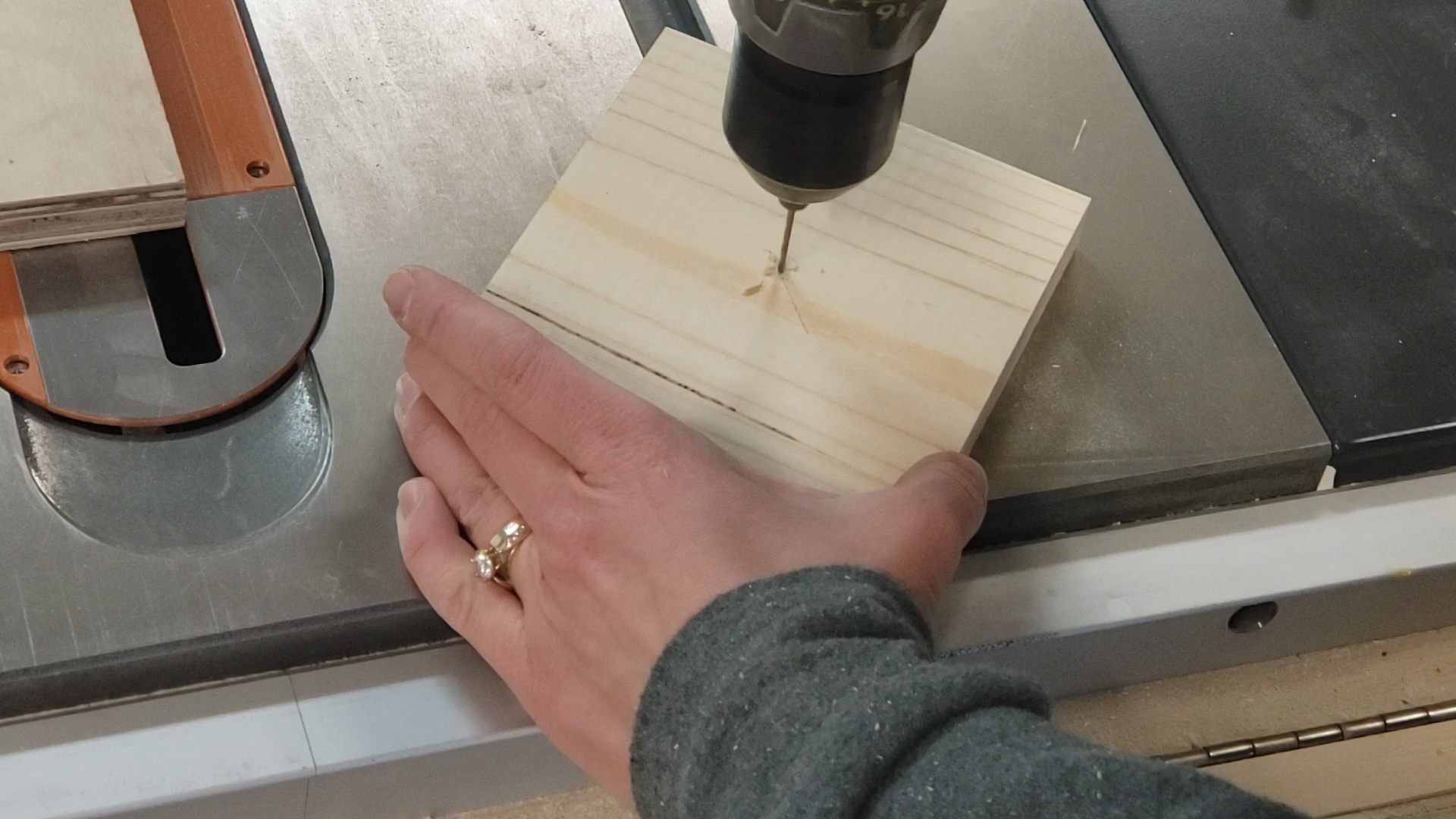
Drill a small hole through this center point.

Place the 1 ¼” nail through the hole and into the hole on the jig and tap securely into place making sure that the square lies completely flat on the jig. Rotate the piece be sure it spins easily and securely.

Pull the jig back and raise the blade to just above the level of the square to be cut.

Plug the saw in. When operating a table saw always try to stand off to the right side and never directly in front of the blade.

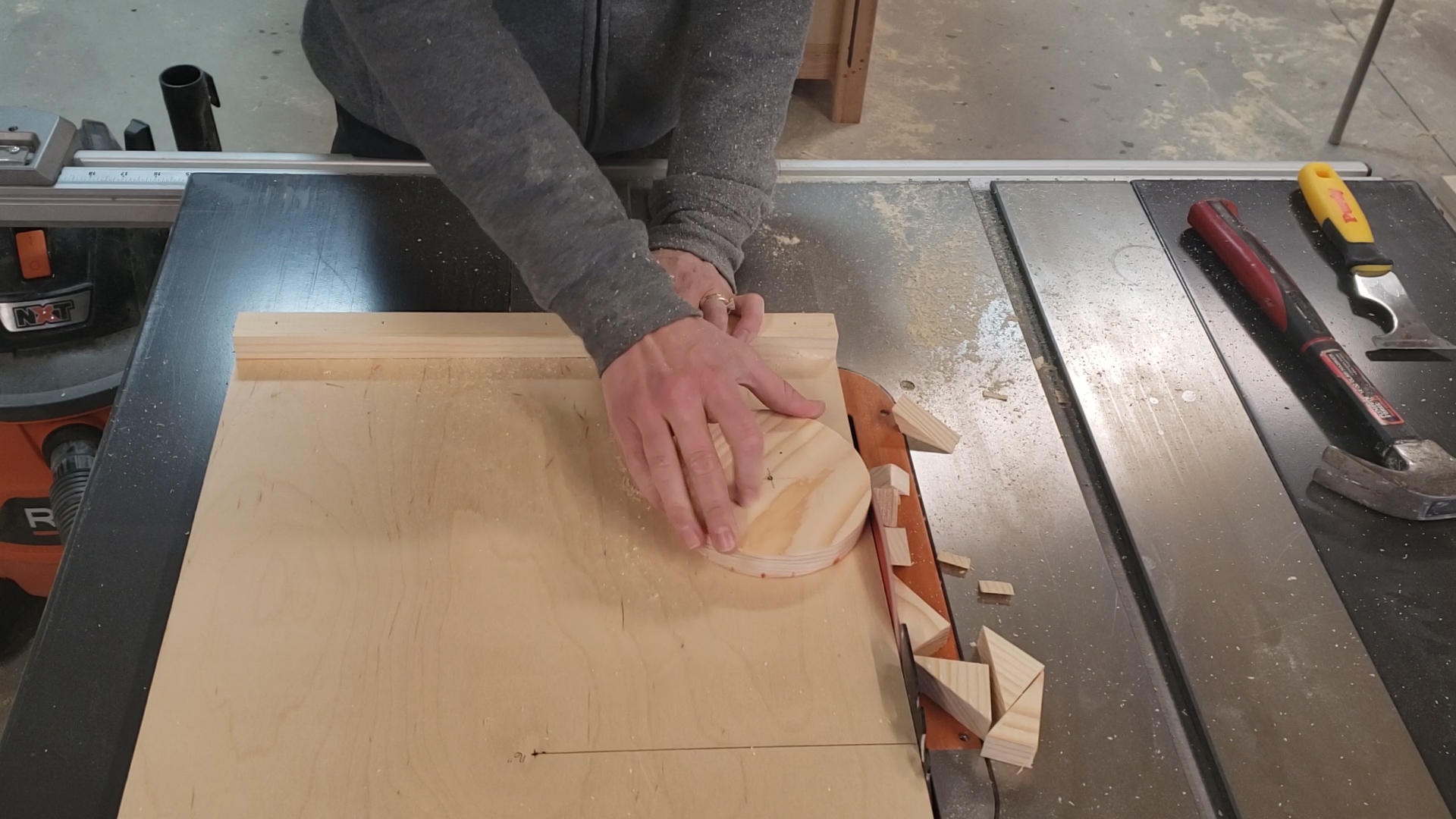
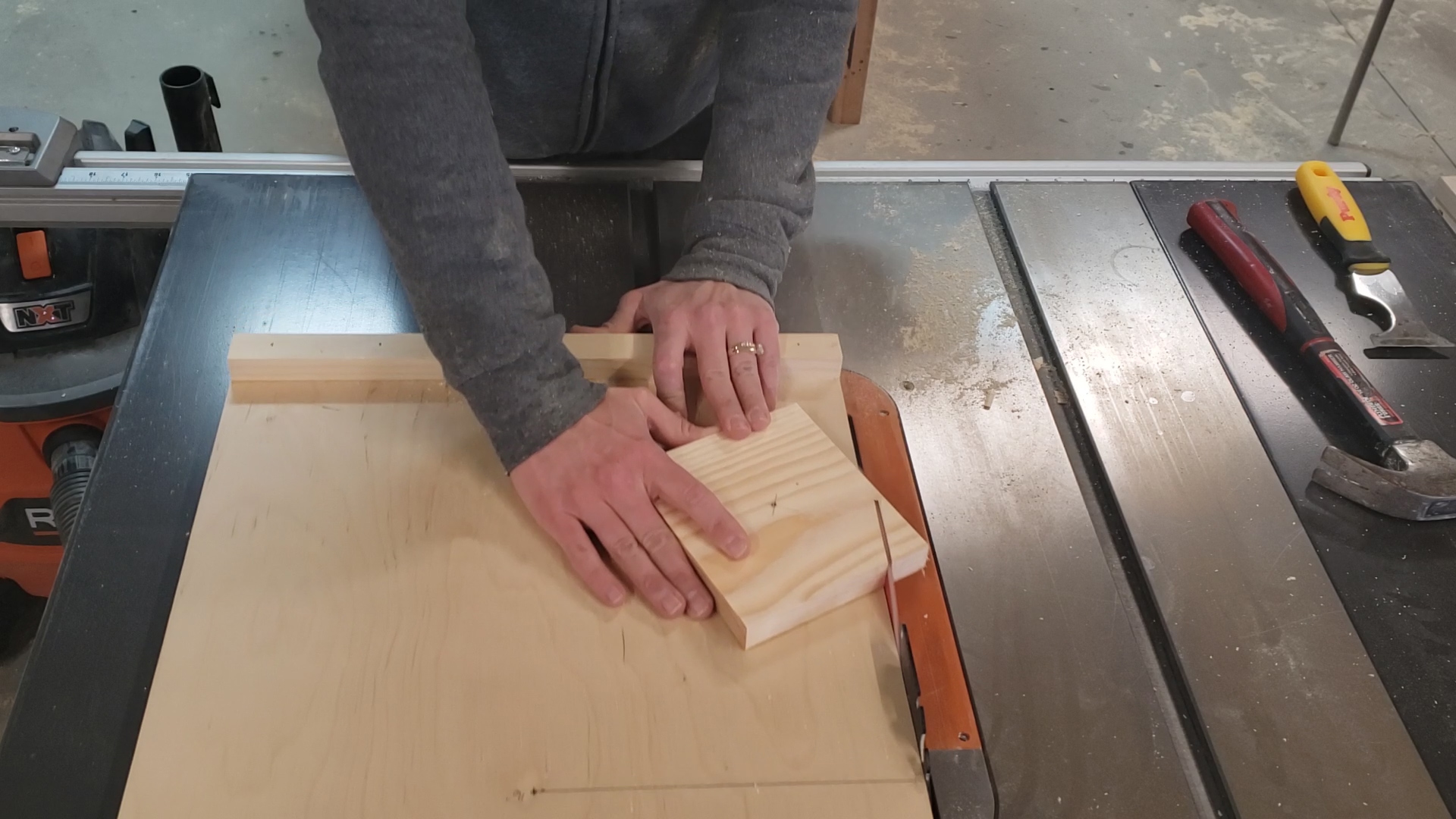
Rotate the piece 45 degrees so a corner of the square overhangs the jig. Turn the saw on and push the jig forward to cut off the overhanging corner. Pull the jig back.

Rotate the piece 90 degrees and repeat until all corners have been cut off.

At this point, you can turn the saw off and wait until the blade comes to a full stop so you can remove the scrap pieces from near the blade. I typically do this for larger circles.

Now continue to rotate the piece, pushing and pulling the jig back and forth until all overhanging corners have been cut off.

Once the piece of wood looks like a very rough circle push the jig forward until the bottom of the piece is in contact with the blade and rotate until the bottom has been cut into a circle.

Push the jig forward slightly and rotate the piece again making a full circle. Repeat until the top of the piece has been cut into a circle.

Pull the jig back and turn the saw off.

Wait until the saw blade has come to a full stop before removing the jig, the circle, or any scrap pieces.

Pretty simple right?! After I made this jig I went on to cut 14 circles for a few tables I was building!!! It was so easy.

Now that you have a perfectly cut circle and a jig that you can use over and over what are you going to make?

Hi! I’m Kristen, from In Her Garage, and I am a self-taught woodworker and DIY fanatic from Minnesota where I live with my husband and our two daughters. Between being a wife, mom and, registered nurse, I try to make as much time for DIY as possible. My love for building came after our family built our current home in 2015. After we moved in, we needed furniture and instead of spending massive amounts of money to order the pieces we wanted I decided that I would build them myself. I started with a buffet table plan from the fabulous Ana-white and quickly set out to remodel my entire home office.

Since then I have started a side business building furniture for the people in my community. I love hearing my clients talk about the pieces they wish they had whether it be a rustic buffet table, a one drawer side table, or a toy box and then making it a reality for them. While starting my small business it made perfect sense that I would document my building journey so I simultaneously launched the In Her Garage blog and I love sharing my plans, tips and tricks.

Making something beautiful with your own two hands through a little preparation and determination is an amazing feeling.  I hope to bring inspiration and know-how to those looking to tackle a big or small project.
I am so glad that you found me here and please feel free to connect with me on PinterestInstagram, and Facebook to see what I am working on right now.
 

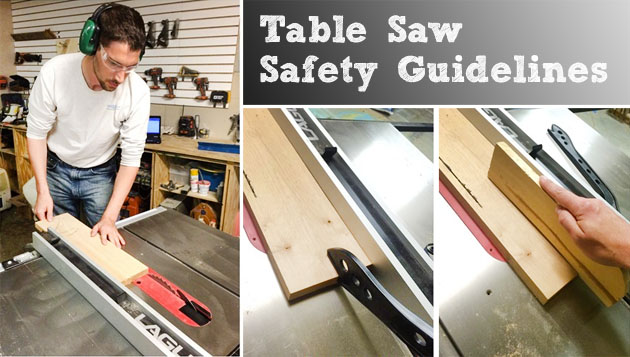
If you liked this post and want more tips about working with table saws then you’ll love this post on Table Saw Safety Guidelines.
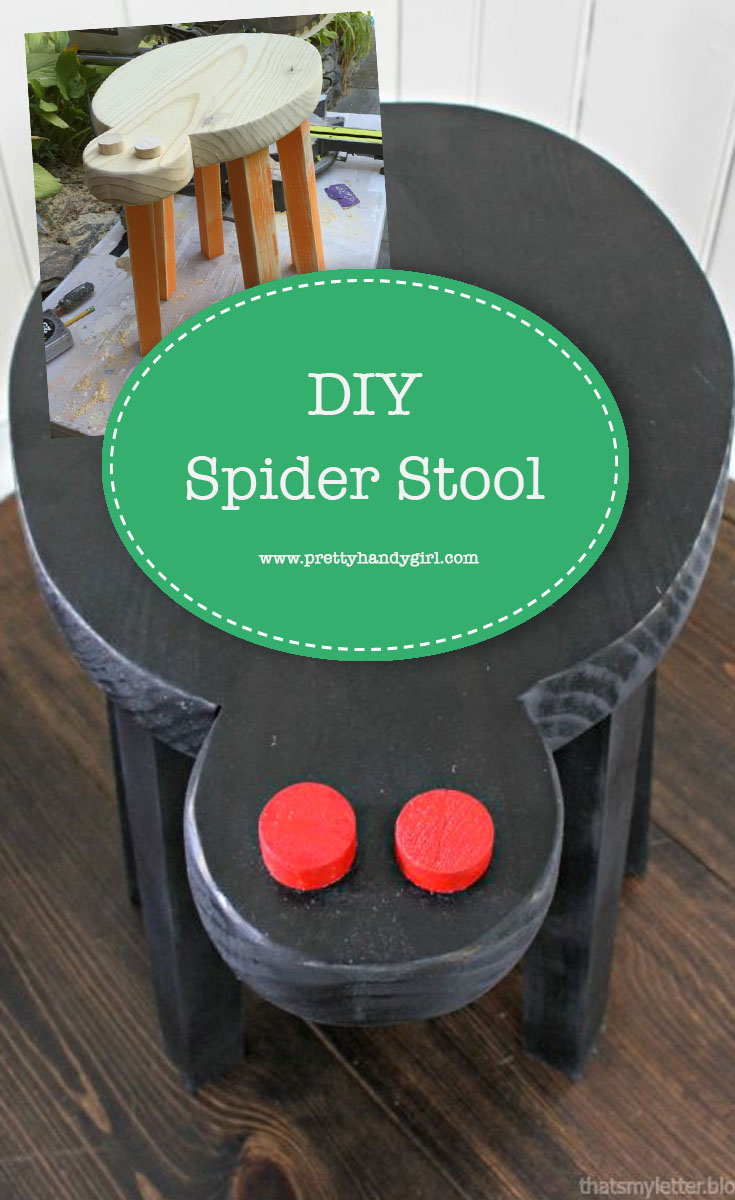
Table Saw Safety Guidelines | Pretty Handy Girl