Removing a door’s hardware (knobs, latch assembly, hinges) is really a piece of cake if you know what you are doing.

There are several reasons you might need to remove a door from its hinges:

  1. The lock is broken and you can’t open the door.
  2. You want to replace your door.
  3. You want to replace the hinges.
  4. Your six year old was warned that if he slams his door one more time he will lose the door (true story).
  5. You want to repaint the door.

When I decided to give my downstairs half bathroom a makeover, I knew I needed to paint the door as well. The easiest way to repaint a door is to remove it from the hinges, remove all the hardware, and lay it flat on sawhorses and paint horizontally.

Before I show you how to paint the door, I will share with you how to remove the door, hinges, and the door knobs (or locksets if it has a key hole). How to remove the locksets is a helpful skill to learn should you wish to replace your door knobs, deadbolts or locksets.

Letting you in on a little secret: Speaking of replacing locksets, did you know that if your house has several different locks you can have them rekeyed to just one key as long as they are all the same brand? When we moved into our home we had three different locks (2 Schlage and 1 Kwikset) and keys to only ONE lock! Arrggghhhh!  Unfortunately, I didn’t have the keys for either Schlage locks.) But, I really wanted to change the locks for the whole house. When I got a quote from a locksmith, I nearly passed out. $250 to get all our locks to match and to cut a few spare keys!

I thanked them and hung up. So, here is what I did. I bought one new Schlage lockset (handles and deadbolt set) for the Kwikset door. Then I took the locksets off the other two doors and brought them to a local locksmith (Busse’s Lock Service in Raleigh.) They were able to rekey both locks using my new Schlage key. The cost was under $50!
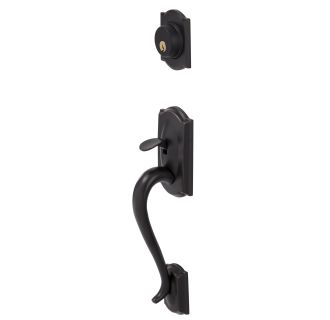
Photo courtesy of Handlesets.com

Later when the old lock on our front door broke, I ordered new ones from Handlesets.com (they sell all types of door hardware) and the customer service rep helped me enter the code from our master key when I placed the order. That way my new locks would match the rest of our house. Best of all they didn’t charge extra to for that service!

Sorry for the diversion, but I really wanted to let you in on that little secret.

Removing the Door Handles and Latch Assembly:

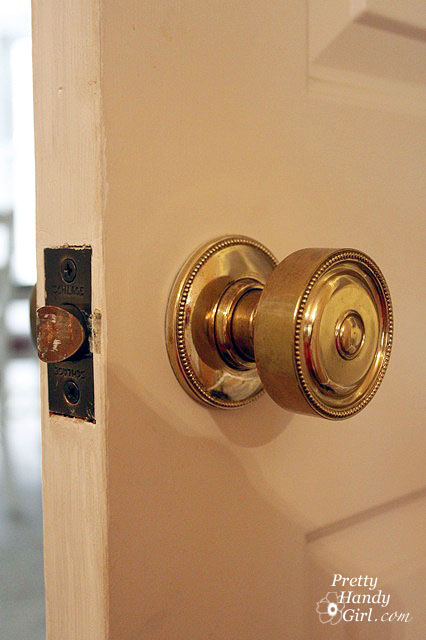
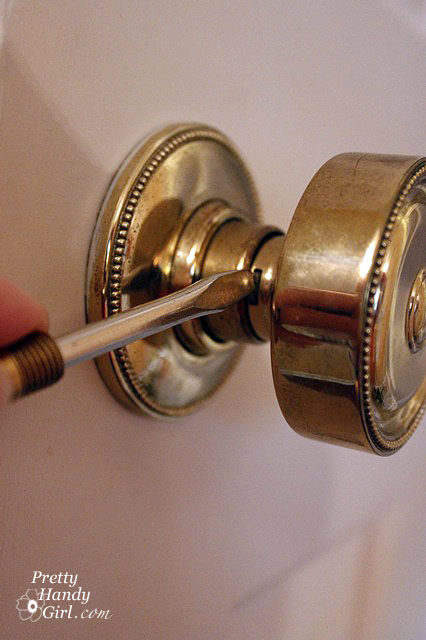
There are several types of door handles, you will need to inspect yours to determine how to remove it. Most door handles have screws on the interior side (for safety reasons, you definitely want them on the interior) that you unscrew to release the handles. Our door handles are a little different, but almost as easy to remove.

Insert a flat head screwdriver into the little slot on the side of the handle.
Pull the handle out and away from the door until it releases.
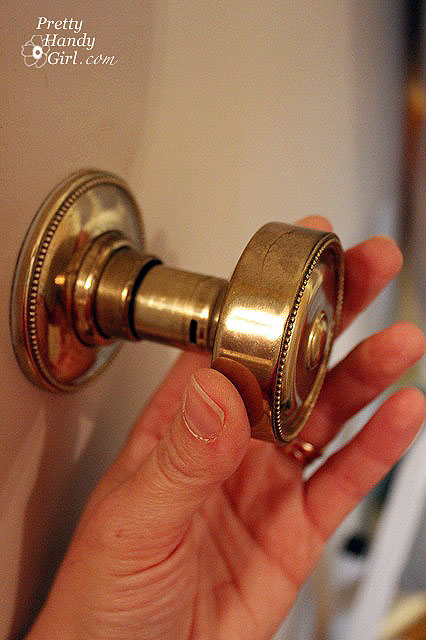
Unscrew the collar (also called a trim piece or escutcheon – yup, there is that word again!) that is up against the door until it comes off. You might need to use pliers to coax it free.
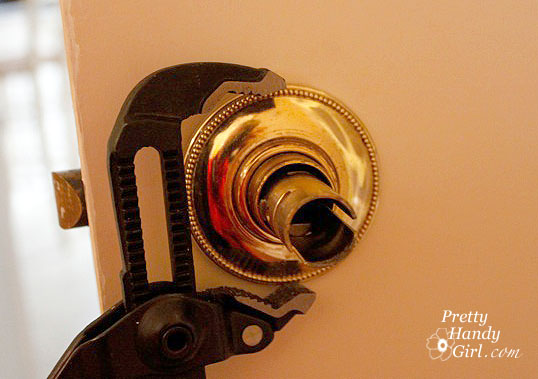
When it releases from the threads, remove the collar (ring, trim piece, escutcheon, WHATEVER.)
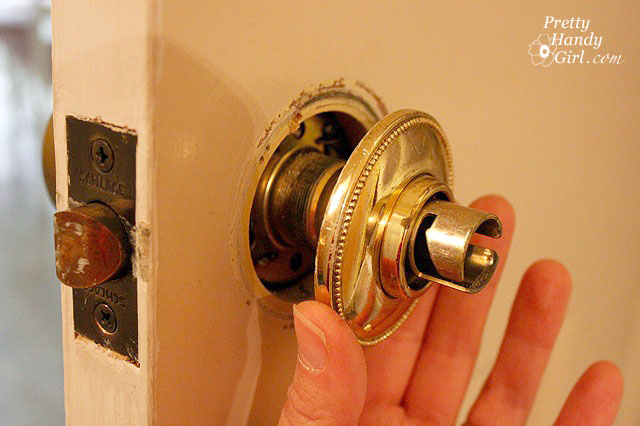
Gently pull the other handle off.
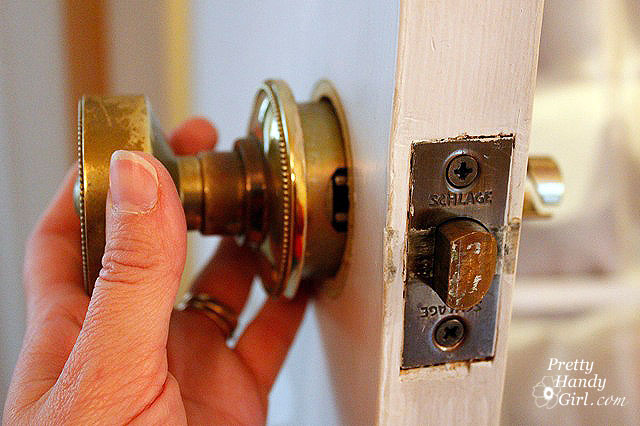
To remove the latch assembly, unscrew the two screws above and below the latch.

Gently pry the latch assembly out.
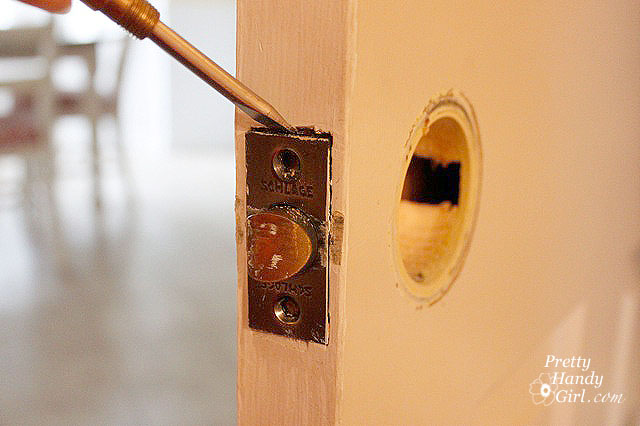
And remove it being sure to keep the screws with the latch.

Removing the hinges:

If you have the type of door hinges that the pin can be removed from, follow these instructions. If not, you will have to unscrew the hinges from your door (but don’t worry, I’ll show you how to do that in a minute.)

Removing the hinge pin is a snap. I use a flat head screwdriver and a hammer. Set the screwdriver just below the head of the pin and tap it lightly with the hammer until the screwdriver can fit below the head. If you can’t get the screwdriver under the head of the pin, insert the screwdriver into the bottom of the hinge and tap the bottom of the pin up slightly. Then angle the screwdriver end up and the handle down. Continue to tap on the screwdriver handle with the hammer until you can release the pin*.
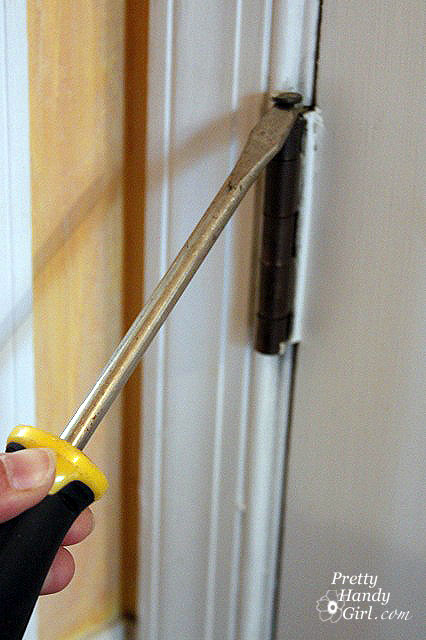
*Oh, and before you remove all the pins, you may want to ask someone help hold the door while you remove the pins from the other hinges. Not that I’ve ever made that mistake (uh, okay, maybe I did.)

Remove the other two hinge pins and gently pull the door off the hinges.
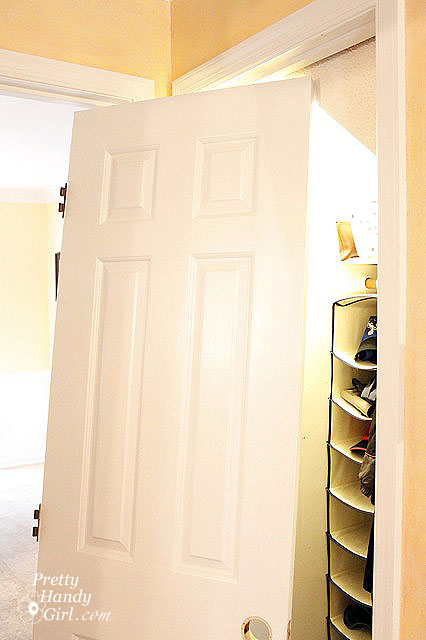
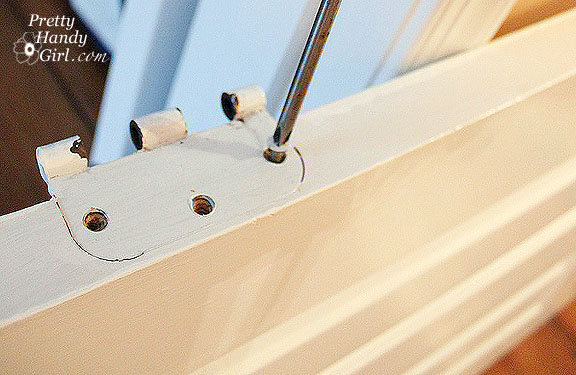
Use a screwdriver or cordless drill with a screwdriver bit to remove the hinges from the door and door frame if you are painting the trim as well.

I ran into a few painted over screws that I couldn’t turn. Here is how to deal with those little buggers.

Lay your door on it’s side with the hinge facing up. Fit a screwdriver into the screw slots as best you can.
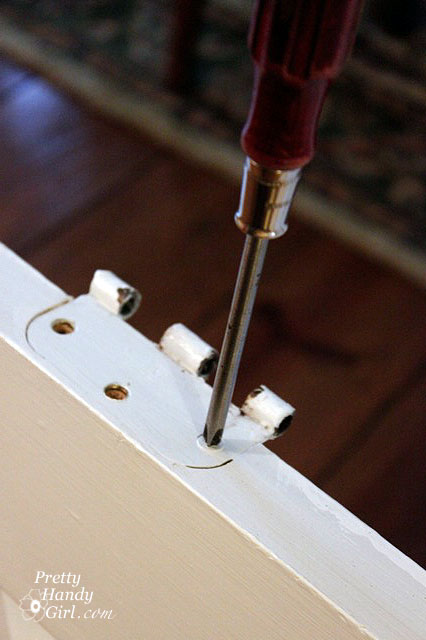
Then use a hammer to bang on the other end of the screwdriver.
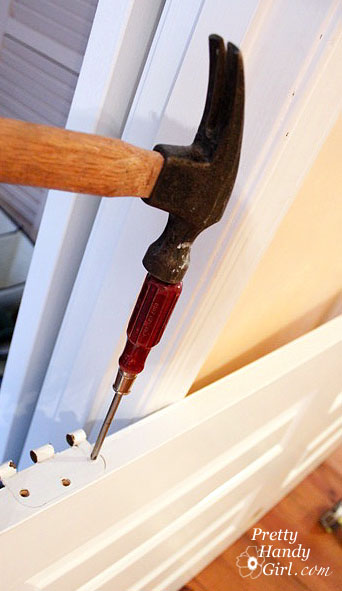
This will either crack the paint or make enough of an indentation that you can turn the screw.

Be sure to keep all your hinges and screws in a separate bowl or bag.

Now you are ready to paint your door or paint your hardware (Like Beckie at Infarrantly Creative did HERE) or both! More tutorials to come.
Our downstair’s bathroom is a little retreat for me from the boys. It is a great place to catch up on my Country Living magazines and if I bring my iPhone with me I can check email. Best of all the boys know to respect my privacy (well, most of the time.)

When we first moved in Pretty Handsome Guy accidentally leaned against the TP holder and pushed it through the wall. I patched it and painted the brush stroke texture on the walls trying to hide the poor condition of the walls.

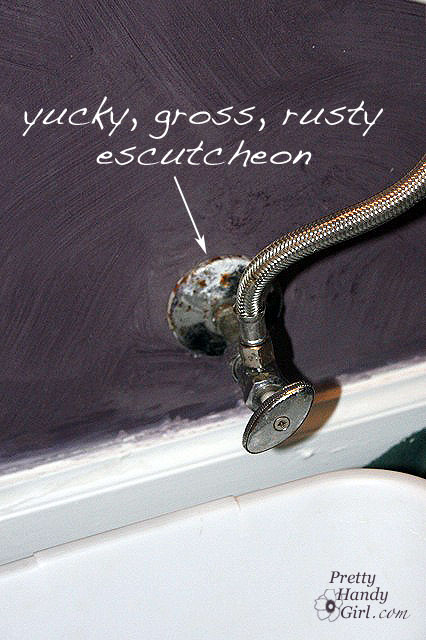
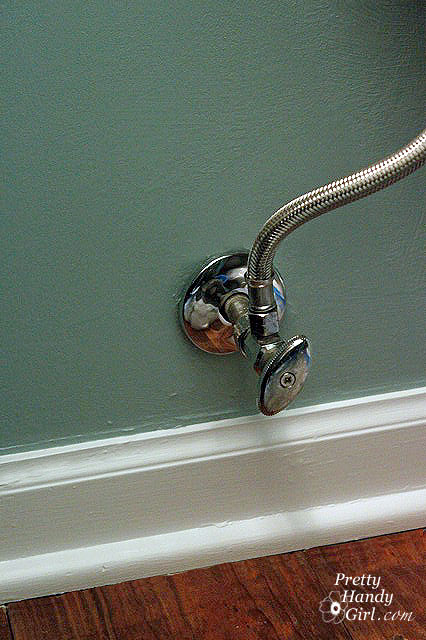
Unfortunately, spending that much time in that bathroom gave me lots of time to focus on all the imperfections. The uneven paint where the trim meets the wall, the dinged, scratched and pocked wall, the beech veneer vanity, and the NASTY RUSTY ESCUTCHEON.

Es-car-go what? An escutcheon is the metal collar that covers the hole in the wall where a plumbing pipe extends out of the wall.

So, in a spur of the moment decision, I decided to give the whole room a facelift. I know, from one little escutcheon to an entire room refresh, that’s how I roll.

First things first, I told that rusty eyesore that he was coming out TODAY!

I’ve replace the escutcheons on several of our shower heads. They are really easy to replace. Simply unscrew the shower head, slip off the old U-G-L-Y escutcheon and slip on the new one, then screw the shower head back on. Easy peasy!!! So, I figured replacing the toilet’s water supply line escutcheon would be just as easy.

First, I turned off the water to the whole house. Then I drained all the faucets (if you don’t drain the upstairs faucets as well as the downstairs, then you will have a lot of water being pulled down by gravity when you open up your supply line.

When the faucets ran dry, I placed a bucket under the water supply line (some water will still drip out), then removed the braided line going to the toilet.

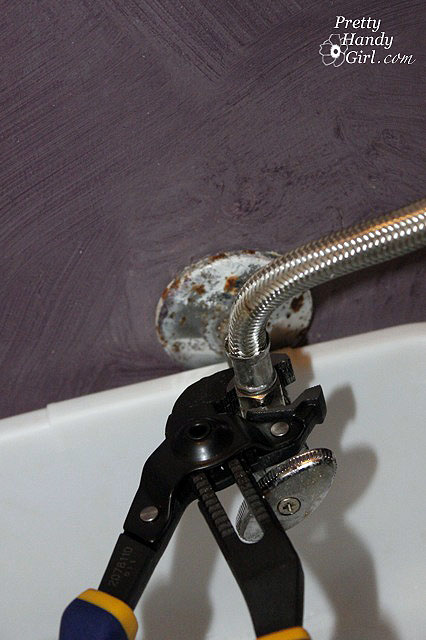
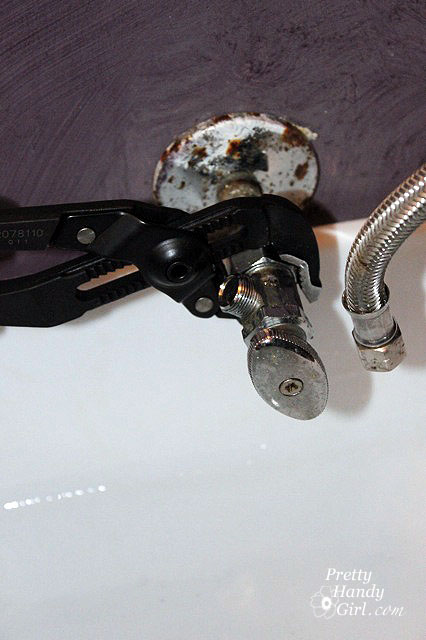
Next l grabbed my super strength Irwin groove lock plyers. With the long handles and adjustable grip, these are my new “go to” pliers. I began to turn the water supply line, lefty loosey. I turned, and turned, and turned, and turned.

Finally, I realized that it wasn’t unscrewing. Ooops! I guess it wasn’t a threaded nut. (I will be checking that nut for the next few months to make sure that it isn’t leaking now that I loosened it.)

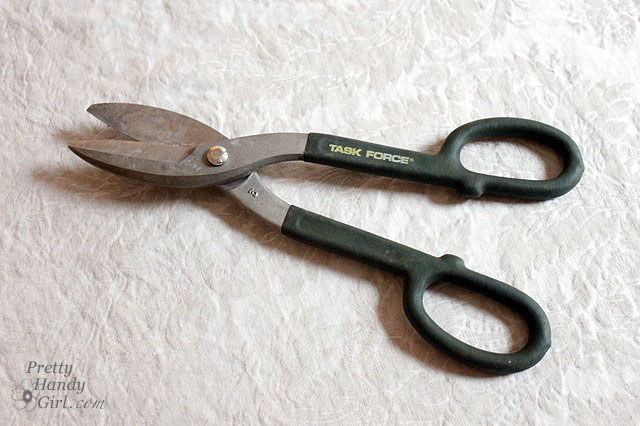
Okay, on to Plan B (because I am good to my word and I promise that escutchen that he was gone, TODAY!) I went back to my tool stash and I grabbed these suckas! That’s right escutcheon, quake in your boots!

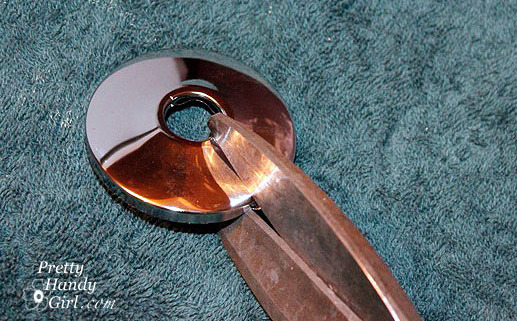
These are my tin snips (okay they really need a more macho name like Tin Destroyer!) Escutcheon, say your goodbyes! And within one easy snip, that rusty, nasty ring was HISTORY!

To put the new one on I made a cut through the new ring and then rotated the two edges in opposite directions.

I slipped it over the supply line and bent it back into shape. By positioning the cut section on the bottom, you don’t even notice it!

AND WOW, look at how that new escutcheon just brightens up that little corner under the toilet. It even distracts your eye from the uneven trim paint and the dark purple walls! Ha, ha, yes, this is a true after pictures. I’ll be sharing with you more this week on “How to Prep a Room for Painting”; “How to Paint a Room Like a Professional”; “How to Paint Doors, the Right Way”; and maybe more.

Okay, gotta go, I have a few more finishing touches to put on my retreat half bathroom. Check back soon to see the progress.

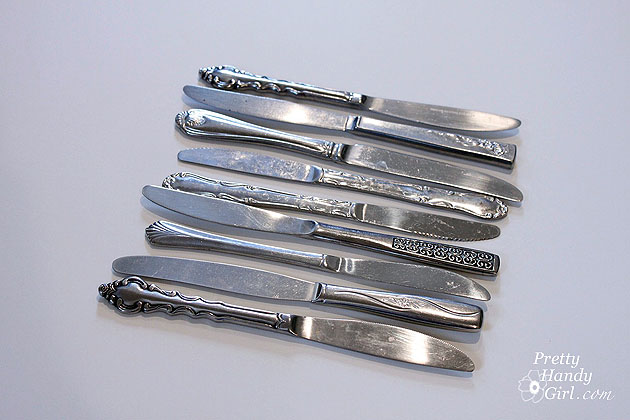
Okay, so I know you all think I’ve gone off my rocker. I bought a bunch of silverware (err, excuse me flatware) from Goodwill recently. I made some Fork Photo Holders (which I absolutely adore!) And had been thinking of some cool projects to do with the knives.

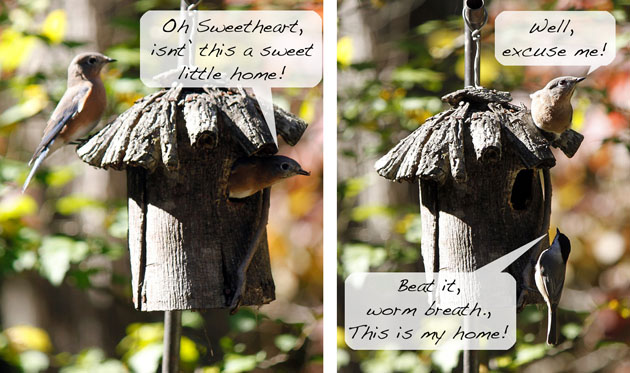
Inspiration hit when my chickadee’s birdhouse roof caved in. I knew I had to act quickly and build a new birdhouse for my repeat nesters! Here is a look at the dynamics surrounding the chickadee’s annual nest location.

I had no idea that the little chickadees could continually defend their bird house from the larger birds, but they do. Every year!

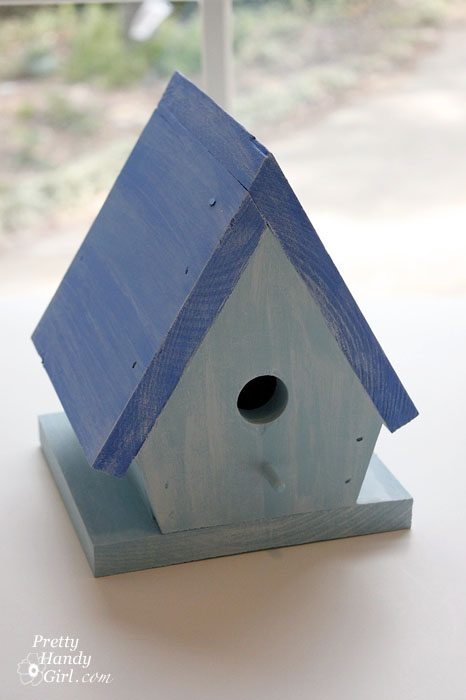
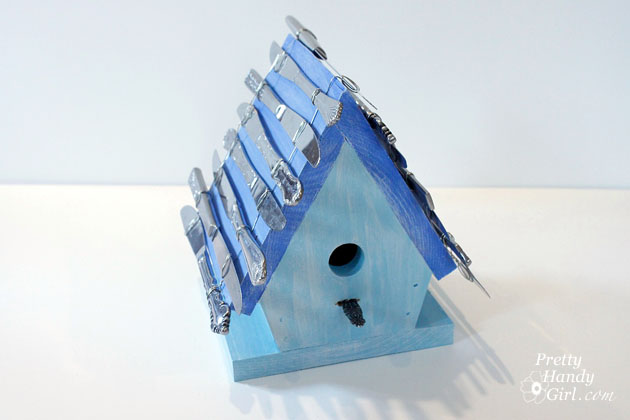
I bought this $3 unpainted birdhouse at AC Moore and painted it a pretty blue;  gave it a white wash; and put a few coats of protective polyurethane on it.

Then, because I can’t leave well enough alone, I decided that the birdhouse needed something extra. Knives!!! Of course, right?!

So, here is what I did:

Materials:

Painted and Polyurethaned Birdhouse
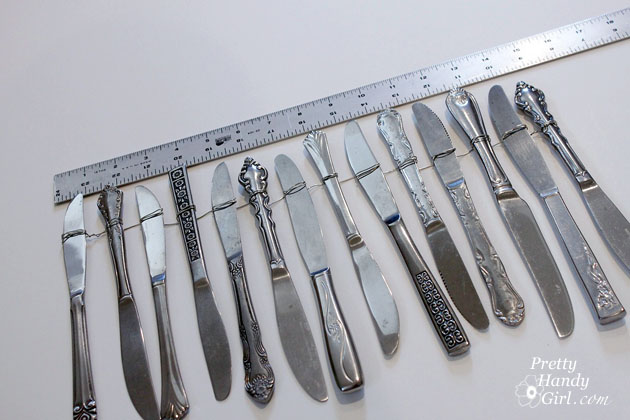
Knives (about 14)
Wire
Wire cutters
Staple Gun
1/4″ Staples
1 Spoon or Fork Handle
Dremel power tool (with metal cutting disc, drill bit, and engraving tool)

Instructions:

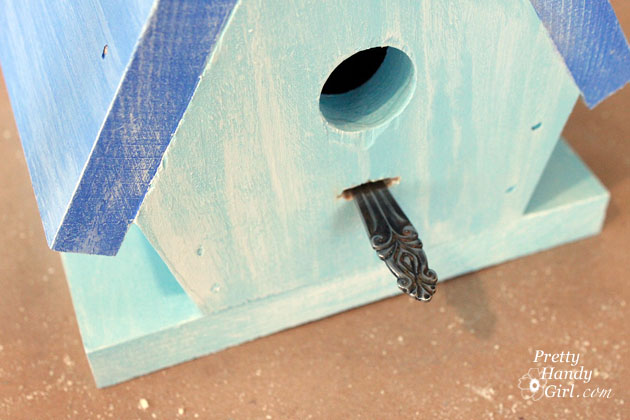
Begin by removing the standard perch (yes, I really can’t leave well enough alone!)

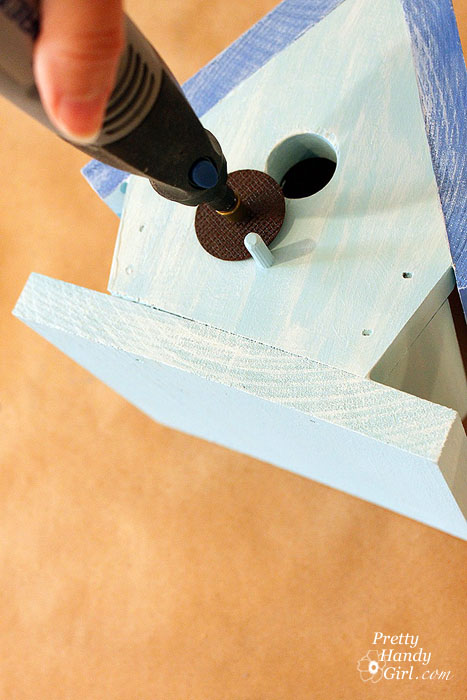
I used my Dremel 8000 that I got for Christmas. Love it!

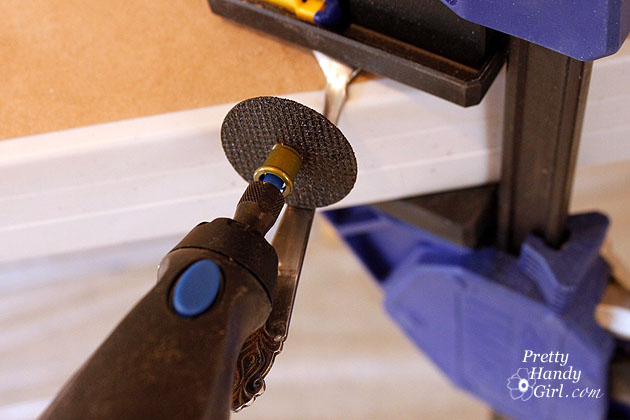
Then clamp the spoon or fork to a work surface and use a metal cutting wheel attachment on the Dremel to cut off the handle (those sparks will fly, so be sure to use safety goggles and keep the work area clear.)


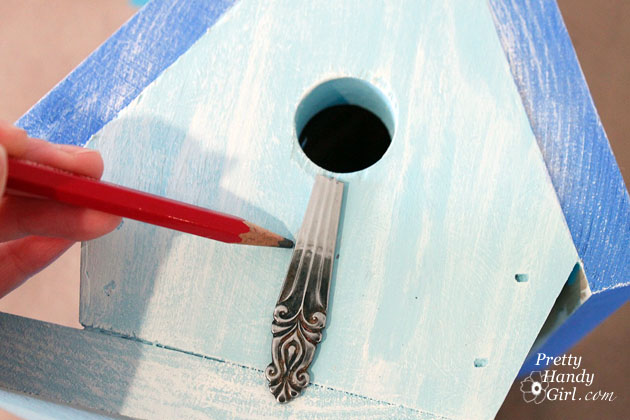
Mark the width of the handle on the birdhouse.

Use a drill bit attachment to drill a series of holes to fit the spoon handle (perch) into.

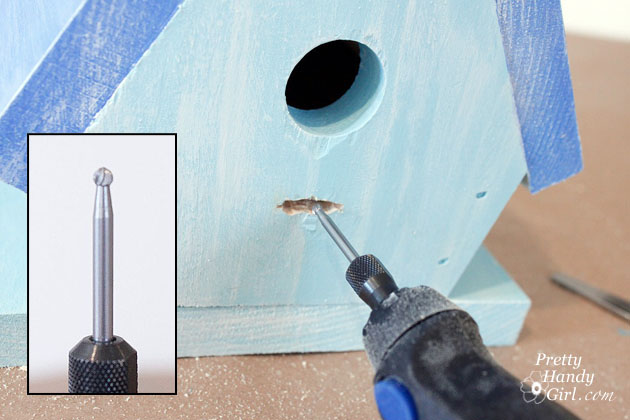
I got tired of drilling holes and eventually cleared out the leftover material with the engraving tip. (If anyone is a Dremel expert and has a recommendation for a better bit to use, I’m all ears!)

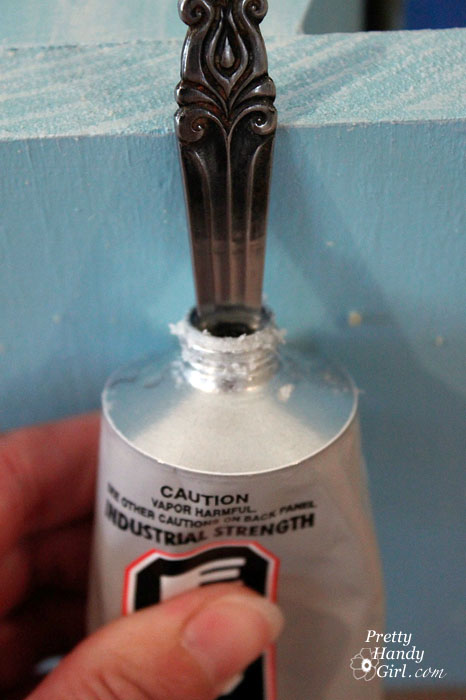
Dip your handle (perch) in the E-6000,

and insert it into the slot you made in the birdhouse.

Now, time to play with the knives! Oooo, that sounds so sadistic! Measure the height of your birdhouse roof and then line up your knives to double that length (to cover both sides of the roof.)

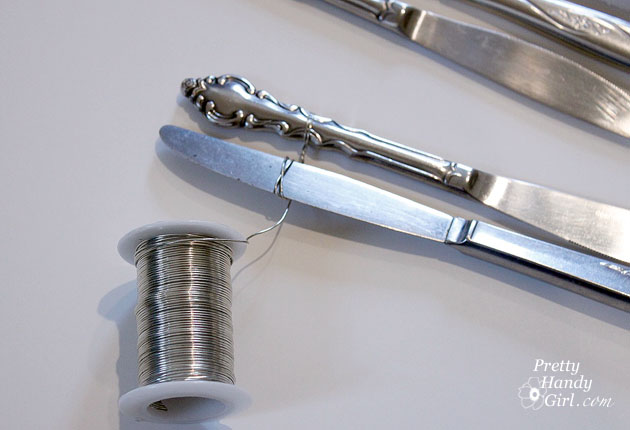
Wrap a wire around the first knife a few times, then wrap it around the second knife a few times to connect them.

Continue connecting the knives together until you reach the double height length of the roof.

Repeat tying the knives together on the opposite side.

Drape the knives over the birdhouse roof and adjust any that have fallen out or are not lined up.

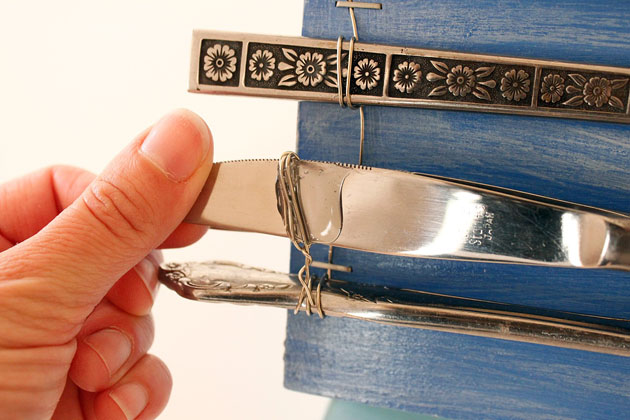
If some of the knives want to fall out, add a drop of E-6000 to the underside to secure the wire to the knife.

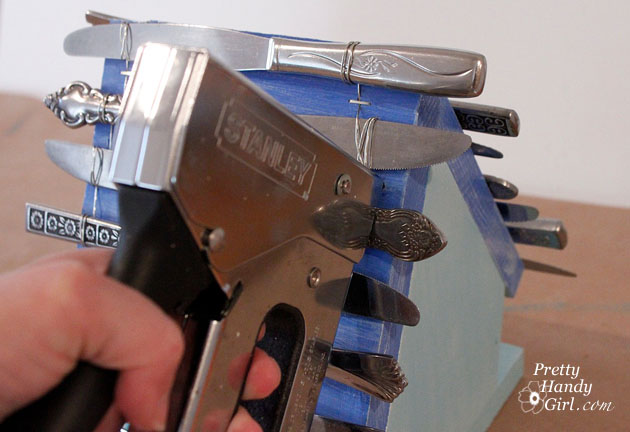
Load your staple gun with 1/4″ staples and staple the wire to the roof. Tap any that didn’t sink into the wood with a hammer.

Finally, add a hook to the top of your birdhouse and hang it up outside! I hope the chickadees appreciate their new home.
Note: At first I wanted to use more knives so that you couldn’t see any space between the knives, but those suckers were so heavy that I had to modify my plans.

PHGFancySign

How to Retrieve Items from the Drain

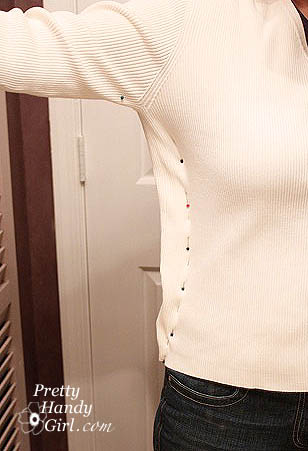
While I was working on my Goodwill sweater, I accidentally dropped one of the pins down the drain.

Now, I could have just left it there, but my “Ms. Fix-It” brain knew that I couldn’t do that. If I left it, I would be dealing with a clogged drain in a month since it would trap all kinds of hair and unmentionable gunk. So, I did the “right” thing and set about retrieving it myself. (And, blogging about it so you know what to do as well.)

Here’s How to Retrieve a Item Dropped Down the Drain

IMPORTANT! If you do happen to drop anything down the drain, turn off the water IMMEDIATELY! You don’t want the water to wash the item beyond the drain, because then it is gone forever (unless you want to explore your city sewer lines.)

Tools:
(contains affiliate links)

 Instructions:

1. Put on your rubber gloves (who knows what’s hiding in your drain!)

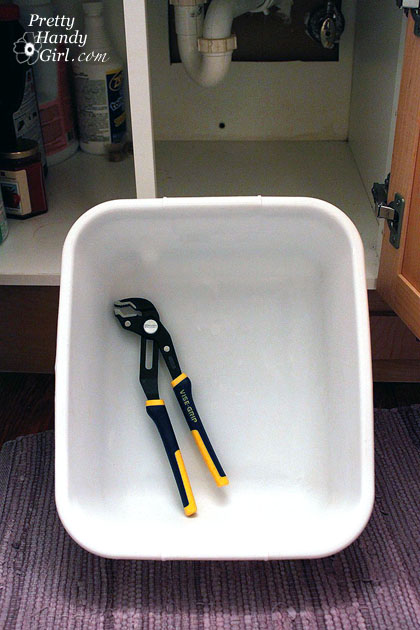
2. Set the basin under your sink’s P-trap.

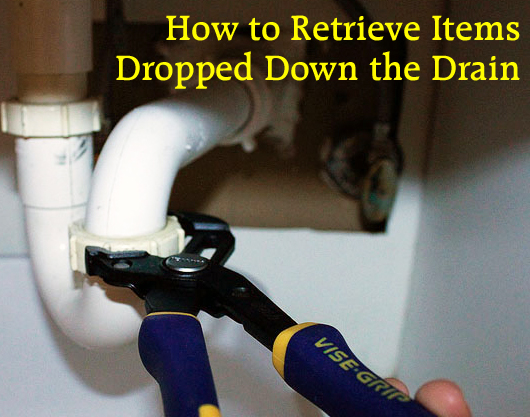
3. Then grab some channel lock type pliers. Irwin recently sent me this quick release Irwin GrooveLock Pliers
that are a snap to open and close the jaws. Just push the button, slide the handle up or down and release. Super quick and easy!
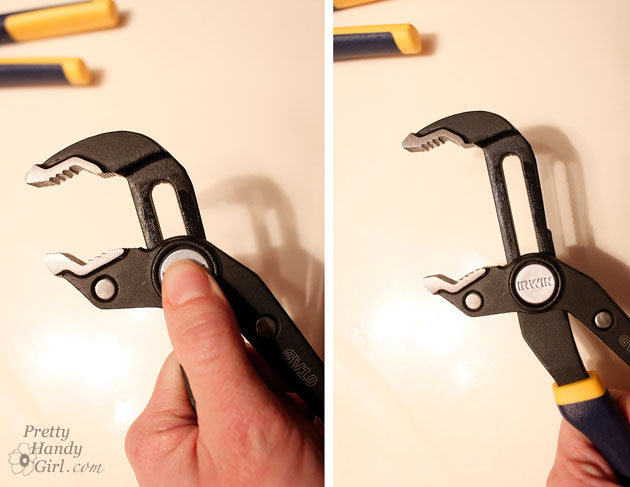
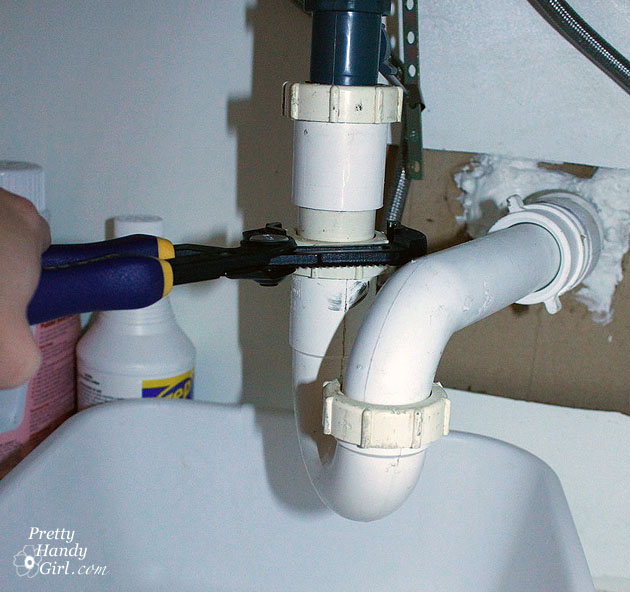
4. Loosen the lower slip nut ring.
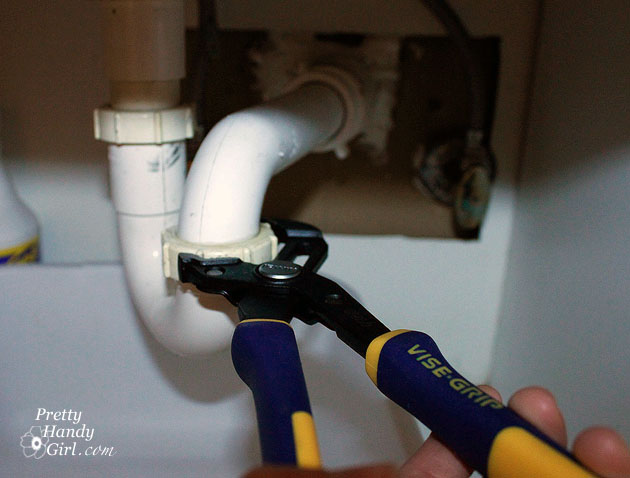
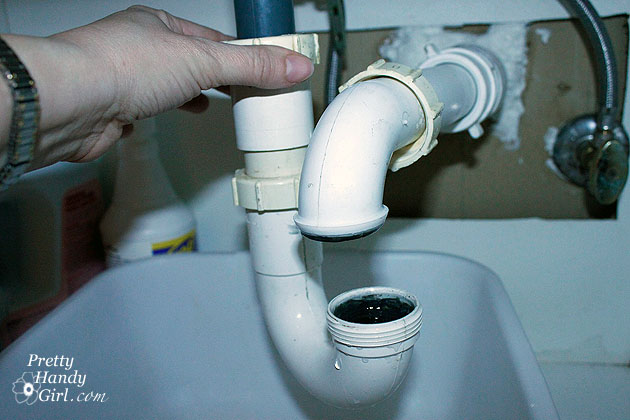
Then slide it up to release one end of the P-trap.

5. Loosen the upper /upper slip nut ring (pay no attention to the slip nut I’m loosening, I actually had to loosen the one above it to free my P-trap.)

6. Then pull down on the P-trap to remove it (you will see in this picture that I had loosened the slip nut higher up to release the drain assembly.) Ewww, gross, don’t look at that string of hair hanging from the drain.


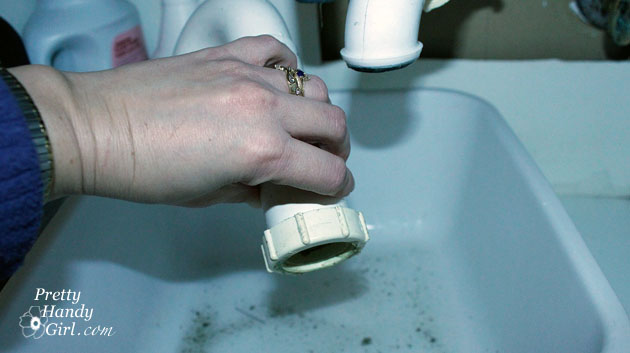
7. (Here comes the next disgusting part.) Turn your P-trap upside down to empty the contents into the basin. Oh and be sure you are wearing your rubber gloves (do as I say, not as I do!)

8. Remove your object. Luckily my pin fell out immediately. If your drain is really gunked up, you may need to run some water or use an old bottle brush to clean out the P-trap and release your object from the yuckiness. In fact, it’s probably a good idea to clean it out anyway while you have it off (if you can stomach it.)

9. Reverse the steps to re-assemble the P-trap. With plumbing I usually hand tighten the nuts and then use the pliers to give it an extra 1/4 turn (but I’m a weakling. If you battle me in arm wrestling YOU WILL WIN!)

10. When your spouse comes home, brag about how you retrieved something from the drain all by yourself!

PHGFancySign

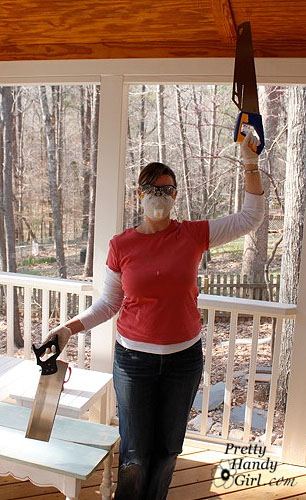
While sanding down my garden bench, I decided to make a design change. I chose to saw off the ball finial posts that are at the end of the armrests. I felt they were too tall and since I’m moving my bench onto our screen porch I didn’t want them obstructing the view if I was sitting with friends and chatting. So, I decided “Off with their heads!”

It was also the perfect opportunity to try out a new handsaw that Irwin sent me to test. They claimed that it is up to 3x faster than a traditional handsaw. Honestly I didn’t believe the claim. I mean – come on – a handsaw is a handsaw.

So, I decided to put their claim to the test with a good old fashioned match up.

The competition:
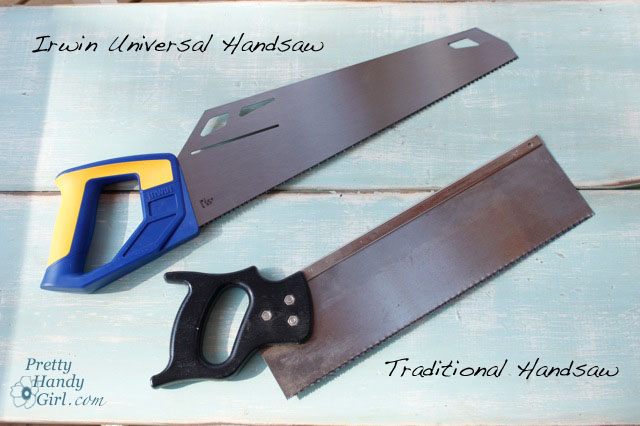
In this corner we have the challenger: the 15″ Irwin Universal Handsaw.

And the reining champion in this corner is my trusty handsaw.

Let me back up and tell you that I have a like/hate relationship with that traditional handsaw. I bought it a long time ago before I could afford a compound miter saw (power tool). So, I bought an el cheapo plastic miter box to use with it when I wanted to cut perfect angles. It took me about a dozen times before I learned how to properly use the hand saw. The key is to let the saw do the sawing (well, duh, right?!) Trust me, it isn’t as easy as it sounds. It is so tempting to press into the wood. But, if you put any force or pressure on the saw, it will skip and bind. Instead you have to gently push and pull the saw back and forth a gazillion times until the saw works its way through the wood. It can be  a brutally slow process.

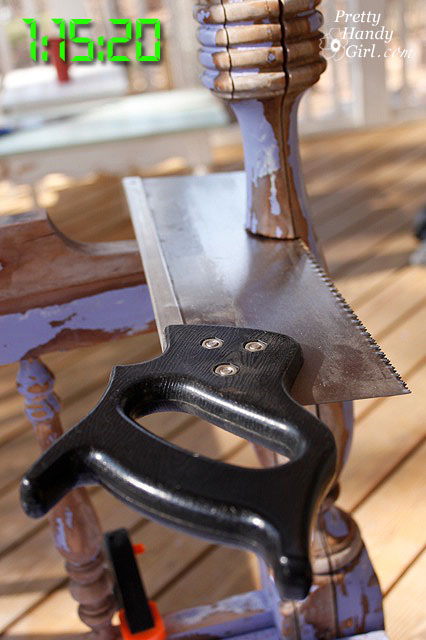
So, back to the match up. I started with my traditional handsaw and started the timer.

About halfway through I had to take a break (and a picture). I gulped down some more coffee and continued sawing. (I stopped the clock at 1:15:20 when I took a break and restarted it when I began sawing again.)

Finally at 2 minutes and 32 seconds the ball finial met it’s demise and toppled to the ground. I wanted to topple down with it, exhausted.

I resisted the urge to go grab one of my power tools for the other side, but instead picked up the Irwin Universal Handsaw.

The angled handle felt a little strange in my hand (not bad, just different from the traditional one I was used to.)

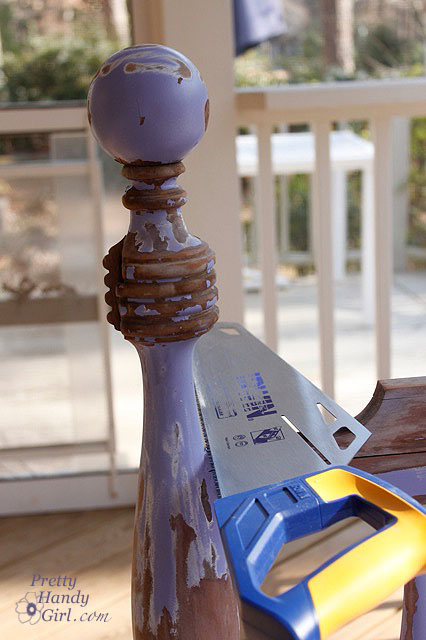
I set the blade against the base of the post and began to saw. It cut through the wood easily and within 32 seconds it had lopped of the head of the other post. I was amazed. I double checked my timer, but it was working. Only 32 seconds and I was barely breathing heavy!

AND THE WINNER IS:

The Irwin 15″ Universal Handsaw by a longshot!

Here are a few details about the saw: It has a triple-ground tooth design, I’m guessing this has something to do with its speed. And the unique angled handle combined with the tooth design is supposed to eliminate binding. I had no binding, so it appears to work.

There are 45º and 90º angle markers built into the blade. I’m not sure that I would use them instead of my carpenter’s square, but I suppose they are convenient to have in a pinch. With a retail price of $18.99, the 15″ Irwin Universal Handsaw is a great and economic addition to your toolbox. (Especially if you can’t afford a power miter saw).

I’ve decided to send my traditional handsaw packing to make room for the Irwin Universal handsaw in my toolbox. Anyone want a gently used traditional handsaw for cheap?

Disclaimer: I was not paid for this review. I was sent the Irwin Handsaw at no charge, but the opinions and testing were my own and were not influenced by Irwin or anyone else. For more information you can view my disclosure statement HERE.